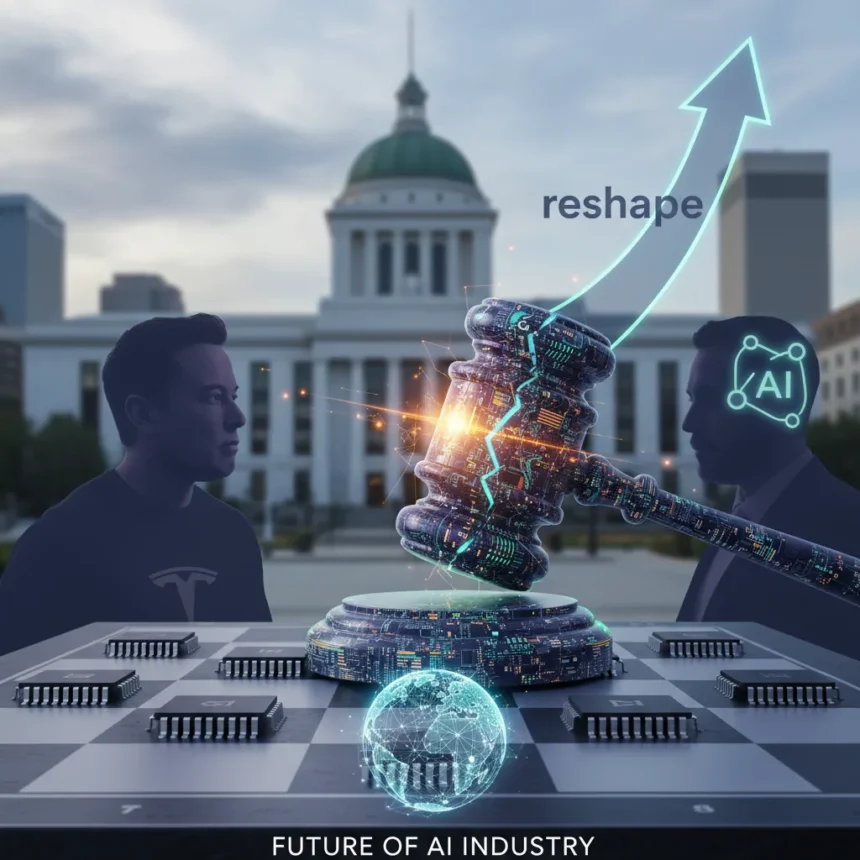
The OpenAI nonprofit lawsuit between Elon Musk and Sam Altman has reached federal court in Oakland, California, with a jury of nine hearing arguments that could fundamentally reshape how artificial intelligence companies operate. Musk co-founded OpenAI in 2015 as a nonprofit committed to developing AI for public benefit, but alleges the organization abandoned that mission when it shifted toward a for-profit structure backed by Microsoft’s investment.
Key Takeaways
- The OpenAI nonprofit lawsuit trial began this week in Oakland federal court with jury selection and opening arguments
- Musk seeks $130-150 billion in damages and demands OpenAI revert to nonprofit status
- Microsoft’s $2 billion investment and subsequent exclusive licensing deal transformed OpenAI into a closed-source, for-profit entity, according to Musk’s legal team
- The trial could complicate OpenAI’s planned 2026 IPO and intensify competition in the AI arms race
- OpenAI counters that Musk pushed for for-profit structure before leaving due to loss of control
What the OpenAI nonprofit lawsuit alleges
Musk’s legal team argues that OpenAI violated its founding agreement by abandoning its nonprofit, open-source mission. The core claim centers on Microsoft’s involvement: the company’s initial $2 billion investment evolved into a 2022 deal that gave Microsoft control through exclusive IP licensing, effectively converting OpenAI into a closed, for-profit operation. Musk’s lawyer stated the principle plainly: “There is nothing wrong with a nonprofit having a for-profit subsidiary, but (it) has to advance the mission”.
The case hinges on whether OpenAI’s transformation served the public good or enriched insiders at the expense of the nonprofit’s original charter. Musk testified on Tuesday, with each side allocated 22 hours for the liability phase, while Microsoft receives 5 hours. The trial unfolds at a critical moment for AI governance—a moment when the industry is watching whether courts will enforce nonprofit commitments or allow Silicon Valley’s pivot-to-profit playbook to proceed unchecked.
OpenAI’s defense and the control dispute
OpenAI and Altman’s defense reframes the narrative entirely. They argue Musk himself advocated for a for-profit structure before departing over disputes about control and organizational direction. The counterargument suggests Musk’s lawsuit stems from regret and jealousy, particularly as OpenAI’s ChatGPT became the dominant consumer AI while Musk launched his own AI venture, xAI, as a competitor.



Julia Powles, a tech law professor at UCLA, observed that both sides claim to champion the public good: “Both are arguing in this case that they have the public good at heart… But what I think the evidentiary record shows is that both like to tell you what you want to hear”. This tension between rhetoric and motive runs through the entire case. OpenAI’s pivot to for-profit structure, the defense argues, was necessary to attract the capital required to compete in an AI arms race dominated by tech giants.
How this lawsuit threatens OpenAI’s IPO and the AI industry
OpenAI plans to go public in late 2026, but the OpenAI nonprofit lawsuit creates existential risk. A verdict forcing reversion to nonprofit status would destroy the company’s valuation, complicate its IPO, and potentially redistribute control away from current leadership. Dan Ives, an analyst at Wedbush Securities, downplayed the damage: “We believe any major damage to OpenAI and Altman will be more scrapes and bruises than real consequences”. Yet the broader implications are harder to dismiss.



If courts enforce nonprofit commitments, it could reshape how AI companies structure themselves, forcing a reckoning across the industry about whether closed, for-profit AI development aligns with public-interest founding principles. The trial also intensifies competition: Musk’s xAI and other rivals like Anthropic stand to benefit if OpenAI is weakened by legal liability or forced restructuring. For consumers, the outcome determines whether AI’s future is governed by nonprofit accountability or proprietary corporate control.
The evidence: AGI and the shifting mission
One telling detail emerged in the trial record: OpenAI’s 2018 founding principles document mentions artificial general intelligence (AGI) 12 times, while recent versions mention it only twice. Musk petitioned in 2024 to establish whether OpenAI’s systems constitute AGI under the original charter. Meanwhile, a 2017 message from Altman to Musk stated: “[I] remain enthusiastic about the non-profit structure!”—a statement that now cuts both ways in court, either evidence of sincere commitment or a promise later abandoned.
FAQ
What damages is Musk seeking in the OpenAI nonprofit lawsuit?
Musk seeks $130-150 billion in damages and demands that OpenAI revert to nonprofit status with Altman and Greg Brockman removed from the board. The exact allocation of damages between the nonprofit arm and other claims remains contested in the trial.
Could the OpenAI nonprofit lawsuit actually force OpenAI to go nonprofit again?
Yes, if the jury finds OpenAI breached its founding agreement, the court could order reversion to nonprofit status. This would be unprecedented in Silicon Valley and would require restructuring of Microsoft’s licensing deal and OpenAI’s corporate governance.


How does this lawsuit affect Musk’s own AI company, xAI?
Musk’s xAI competes directly with OpenAI in the AI arms race. A weakened or distracted OpenAI could benefit xAI’s market position, though the lawsuit also consumes Musk’s attention and resources during a critical period for AI development.
The OpenAI nonprofit lawsuit represents more than a corporate dispute—it is a referendum on whether founding principles bind technology companies or dissolve in the pursuit of scale and profit. The verdict will ripple across the AI industry, determining whether other startups can pivot from nonprofit to for-profit structures without legal consequence, and whether the public good remains a meaningful constraint on how AI is developed and deployed.
Edited by the All Things Geek team.
Source: TechRadar