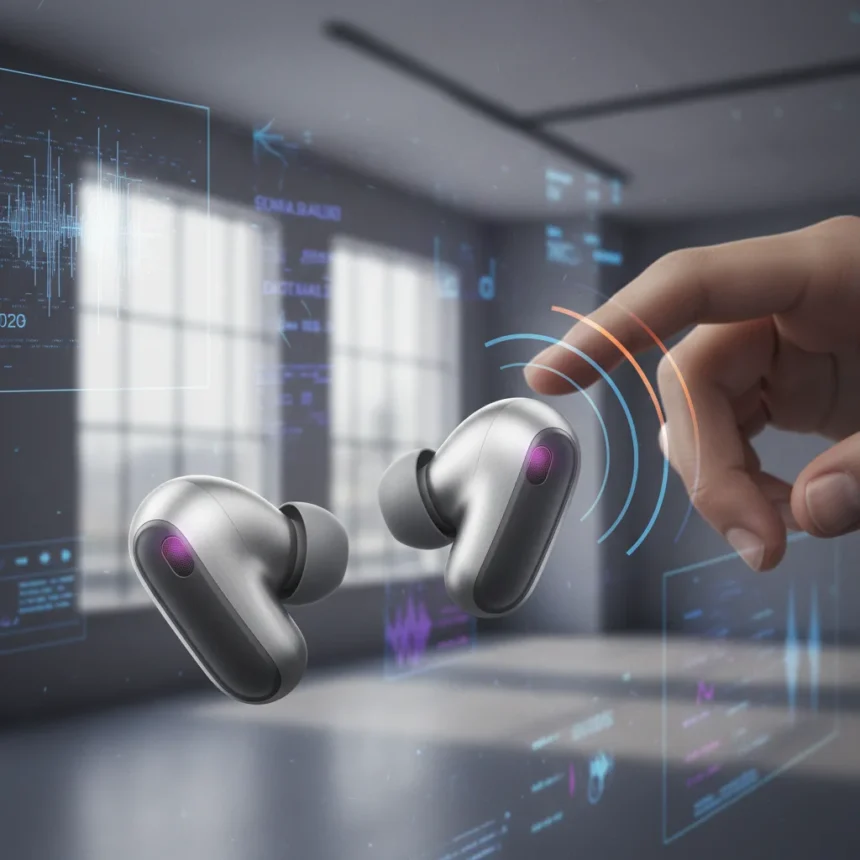
Apple’s next flagship AirPods could be getting a significant hardware overhaul, with rumors pointing toward an Ultra variant that introduces infrared sensors and advanced gesture controls. The speculation suggests Apple is preparing its most ambitious earbud upgrade yet, moving beyond audio quality into spatial awareness and interaction design.
Key Takeaways
- Apple’s next flagship AirPods rumored to include infrared sensors for gesture recognition
- New H3 chip expected to power next-generation model
- Ultra branding suggests premium positioning and feature differentiation
- Gesture controls could enable hands-free navigation without voice commands
- Infrared technology may enable new health or spatial awareness features
What Apple’s next flagship AirPods could bring to market
The rumors around Apple’s next flagship AirPods center on a fundamental shift in how users interact with their earbuds. Rather than relying solely on voice commands or touch controls, infrared sensors would enable gesture recognition in ways current AirPods cannot match. This approach would let users control playback, answer calls, or navigate menus through subtle head movements or hand gestures near the ears, reducing the need to reach for a phone or speak aloud in public.
The Ultra branding itself signals Apple’s intent to position this as a premium offering, distinct from the standard AirPods Pro line. Apple has used the Ultra designation successfully with the Apple Watch Ultra and iPhone models, establishing it as a marker for advanced features and higher price positioning. An AirPods Ultra would likely target power users and those willing to pay more for capabilities beyond basic wireless audio.
The H3 chip and processing power
Central to the next-generation design is expected to be a new H3 chip, which would handle the processing demands of infrared sensing and gesture recognition. Current AirPods Pro use the H1 chip, so a jump to H3 represents a meaningful generational advance in computational capacity. This additional processing power would be essential for real-time gesture interpretation while maintaining battery efficiency—a critical constraint for any earbud design.



The H3 chip would also enable more sophisticated audio processing and potentially new features in spatial audio or adaptive listening modes. Apple’s track record with custom silicon suggests the company would use this opportunity to differentiate its audio processing from competitors, though specifics remain unclear from available rumors.
How Apple’s next flagship AirPods compare to current models
Today’s AirPods Pro rely on touch controls and voice commands through Siri, requiring users to tap the stem or speak aloud to control functions. An infrared-enabled model would eliminate this friction, offering a more seamless interaction model that works even when hands are full or in noisy environments where voice recognition struggles. The gesture-based approach also sidesteps the occasional misfires that plague touch-sensitive earbud controls, where accidental taps can trigger unwanted actions.



Current wireless earbuds from competitors like Sony, Bose, and Samsung focus primarily on audio quality and noise cancellation tuning. None currently offer infrared gesture recognition at scale, which would give Apple’s next flagship AirPods a genuine feature gap if the rumors prove accurate. This represents a shift in Apple’s competitive strategy—moving from audio parity to interaction innovation.
When might Apple’s next flagship AirPods arrive?
No official launch date has been announced, and the rumors remain speculative at this stage. Apple typically updates its AirPods lineup on a 1-2 year cycle, so timing remains uncertain. The company has not confirmed the Ultra branding or any of the infrared sensor specifications, meaning these features remain unverified until Apple makes an official announcement.
Will infrared sensors change how we use earbuds?
Infrared gesture recognition could fundamentally alter earbud interaction if implemented well. Rather than fumbling with touch controls or speaking to an assistant, users could simply move their head or hand to trigger actions. This would be particularly valuable in professional settings, fitness environments, or social situations where voice commands feel intrusive.
How much might Apple’s next flagship AirPods cost?
Pricing remains entirely speculative, but the Ultra designation and advanced sensors suggest a premium tier well above current AirPods Pro pricing. Apple’s history with Ultra products indicates a significant price premium—the Apple Watch Ultra costs considerably more than the standard Watch. An AirPods Ultra would likely follow a similar pricing strategy, though the exact figure depends on manufacturing costs and Apple’s positioning strategy.



The rumors around Apple’s next flagship AirPods point toward a company willing to rethink earbud interaction from first principles. If infrared gesture controls and a new H3 chip materialize, Apple would be betting that users value seamless interaction as much as audio quality. Whether that gamble pays off depends on execution—and official confirmation from Apple itself remains the only fact that matters until then.
Where to Buy
Edited by the All Things Geek team.
Source: T3