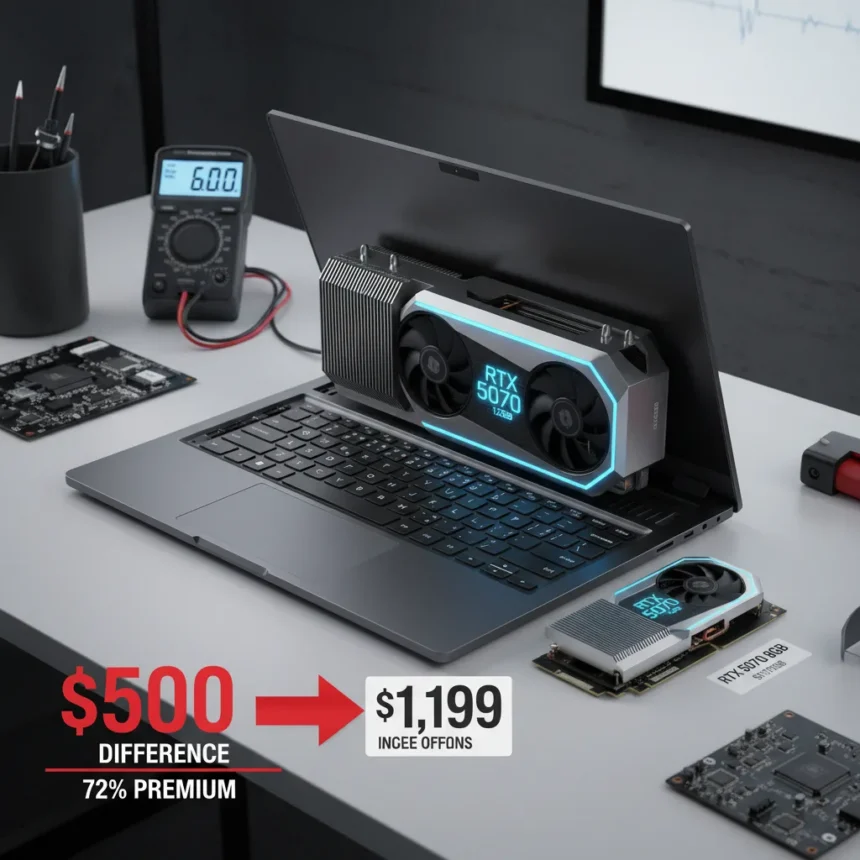
Framework RTX 5070 12GB pricing has just become a cautionary tale about modular laptop economics. The new RTX 5070 12GB graphics module for the Framework Laptop 16 costs $1,199, a 72% premium over the RTX 5070 8GB model priced at $699, available for pre-order. That $500 jump for an extra 4GB of memory raises a fundamental question: when does modularity stop being consumer-friendly and start being consumer-hostile?
Key Takeaways
- Framework RTX 5070 12GB module costs $1,199, 72% more than the 8GB version at $699
- Both modules are identical except for memory capacity and bandwidth specifications
- Framework attributes pricing to memory supply constraints beyond its control
- The premium reflects broader GPU market supply issues affecting component costs
- Pre-orders are now live for the 12GB module
What You Get for the $500 Premium
The RTX 5070 12GB and 8GB modules are functionally identical except for memory capacity and bandwidth. That sounds straightforward until you do the math: you are paying $500 extra for 4GB of additional memory, or $125 per gigabyte. For context, discrete GPU memory pricing in the broader market does not typically command that kind of premium. The bandwidth difference between the two configurations exists, but Framework has not published detailed performance deltas that would justify the markup to buyers considering the upgrade.
This is where modularity hits a wall. Framework’s entire pitch rests on user choice and flexibility—swap components, upgrade what matters to you. But when a memory upgrade costs more per gigabyte than a standalone graphics card, that choice becomes a luxury tax. The Framework Laptop 16 itself is positioned as a premium device, but adding a $500 premium to an already-expensive graphics module strains the value proposition even for enthusiasts who can afford it.
Framework RTX 5070 12GB vs. 8GB: Is the Extra Memory Worth It?
Whether the 12GB variant makes sense depends entirely on your workload. For gaming and everyday productivity, the 8GB module handles current titles and professional applications without strain. The 12GB version targets creators working with massive datasets, high-resolution video editing, or AI model training—workloads where VRAM acts as a hard ceiling on performance. If you hit that ceiling regularly, the upgrade is not optional. If you do not, you are paying $500 for headroom you will never use.


The real frustration is that Framework cannot offer a better explanation. The company states pricing is beyond its control, attributing the disparity to memory supply issues. That may be technically true, but it exposes a structural vulnerability in the modular laptop model: when component costs spike, modular manufacturers cannot absorb the hit without either raising prices or killing the product line. Traditional laptop makers can spread that cost across millions of units. Framework cannot. Buyers end up bearing the full brunt of market volatility.
Memory Supply Constraints Are Reshaping GPU Pricing
The RTX 5070 12GB pricing is not an isolated incident—it reflects broader GPU market dynamics. Memory supply issues have created artificial scarcity in higher-capacity configurations. NVIDIA’s reference designs may have reasonable pricing, but the moment a third-party integrator like Framework adds custom engineering, supply chain complexity, and small-batch manufacturing, costs balloon. A 12GB module is simply not produced in the same volumes as 8GB variants, and Framework bears those manufacturing inefficiencies directly.



This matters beyond Framework. If modular laptop upgrades become consistently expensive due to supply-side constraints, the entire category risks pricing itself out of viability. Early adopters will pay the premium. Mass-market buyers will stick with soldered configurations from Dell, Lenovo, and ASUS, where economies of scale keep costs reasonable. Framework’s bet on modularity only works if upgrades feel like genuine value, not punishment for choosing flexibility.
Should You Buy the RTX 5070 12GB Module?
If you already own a Framework Laptop 16 with the 8GB module and your workload demands more VRAM, the upgrade path exists—but it is expensive. If you are buying a Framework Laptop 16 today, decide whether you need 12GB or can live with 8GB before committing. The $500 premium is real money, and Framework’s assurance that pricing is out of its control does not change the fact that you are paying it.
For most users, the 8GB module is sufficient. The Framework Laptop 16 is already a premium device; the RTX 5070 12GB module is a premium within a premium, reserved for professionals whose productivity gains justify the cost. Everyone else should save the $500 and invest it elsewhere—better cooling, additional storage, or simply keeping it in your pocket.
Is the Framework RTX 5070 12GB really 72% more expensive?
Yes. The 12GB module costs $1,199 while the 8GB version costs $699, a difference of $500 or 72%. That calculation is straightforward, though the underlying reasons—memory supply constraints and small-batch manufacturing—help explain why Framework cannot offer a smaller premium.



Can you use the RTX 5070 12GB module in older Framework laptops?
The research brief does not specify backward compatibility with older Framework models. The module is designed for the Framework Laptop 16, but whether it works with previous generations is unclear. Check Framework’s official compatibility matrix before assuming you can upgrade an older device.
Will the RTX 5070 12GB price drop after launch?
Framework has not announced price reductions or timelines for cost adjustments. If memory supply constraints ease, pricing may eventually normalize, but that is speculation. Plan on the $1,199 figure as the current reality, not a temporary anomaly.
Framework RTX 5070 12GB pricing exposes the hard truth about modular devices: flexibility comes at a cost, and when supply chains tighten, that cost gets passed directly to buyers. The 12GB module is not a bad product—it is simply expensive in a way that undercuts the entire modularity promise. Choose the 8GB version unless you genuinely need the extra memory, and do not expect Framework’s supply-chain explanation to ease the sting of that $500 premium.
Edited by the All Things Geek team.
Source: Tom's Hardware