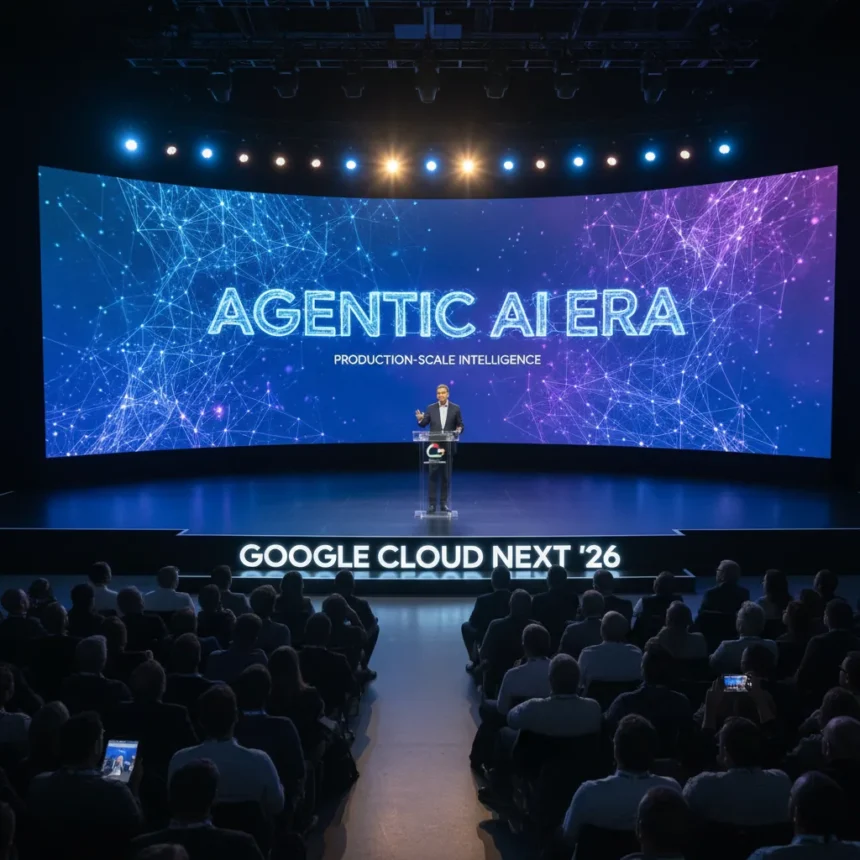
The agentic AI era has officially arrived, according to Google Cloud. At Google Cloud Next ’26, Thomas Kurian opened the keynote with a stark declaration: “The era of the pilot is over. The era of the agent is here.” This shift marks a fundamental change in how enterprises are deploying artificial intelligence—moving from experimental pilots to production-scale agents that autonomously handle complex workflows across multiple systems and environments.
Key Takeaways
- Google Cloud Next ’26 keynote declared the agentic AI era has begun, ending the pilot phase of AI deployment.
- Agent2Agent (A2A) protocol now in production with 150+ organizations enabling cross-platform agent communication.
- Gemini Enterprise Agent Platform includes Agent Studio, Agent Development Kit, Agent Runtime, and governance tools.
- At Google, over 25% of new code is generated or reviewed by AI before human review.
- Agents now span enterprises through protocols like MCP and A2A, evolving toward intent-based communication.
What the Agentic AI Era Actually Means
The agentic AI era represents a fundamental architectural shift. Unlike traditional AI pilots that prove concepts in isolation, agentic systems spawn sub-agents, preserve state over hours or days, trigger external systems, and execute multi-hop tool chains with unpredictable execution times. This is not incremental improvement—it is a different operational model entirely. Kurian articulated the core equation driving this shift: “Intelligence plus automation must deliver value. To make this work, you need context and action. Intelligence comes from your data, automation is driven by agents.”
At Google itself, this transition is already operational. More than 25% of new code is now generated or reviewed by AI before human review, demonstrating that agents are not theoretical constructs but active participants in production workflows. AI agents streamline cybersecurity threat intelligence, enable multi-agent developer and marketing workflows, and handle tasks that would previously require dedicated teams. This internal adoption signals where enterprise AI is headed—not as a nice-to-have, but as essential infrastructure.
The Gemini Enterprise Agent Platform and Its Architecture
Google Cloud’s response is the Gemini Enterprise Agent Platform, an evolution of Vertex AI designed for the agentic era. The platform operates across four distinct phases: build, scale, govern, and optimize. Each phase addresses a specific challenge in deploying agents at scale.

The build phase offers two pathways. Agent Studio provides a low-code visual interface for teams without deep coding expertise, while the Agent Development Kit (ADK) caters to code-first teams with AI-native coding capabilities. This dual approach democratizes agent creation—empowering everyday employees to become AI builders without requiring specialized data science teams. Kurian emphasized this shift: “Companies aren’t just redesigning workflows, they’re turning their everyday employees into AI builders, empowering them to solve their own hardest problems.”
The scale phase introduces Agent Runtime, re-engineered for long-running agents that maintain state across extended periods. Backed by Memory Bank for persistent context, Agent Runtime handles the operational complexity that distinguishes production agents from experimental prototypes. The govern phase layers Agent Identity, Agent Registry, and Agent Gateway—centralized controls that enforce enterprise guardrails, trackable identity, and accountability across all deployed agents. Finally, the optimize phase includes Agent Simulation, Agent Evaluation, and Agent Observability, providing execution traces and real-time reasoning visibility for debugging and improvement.



Agent2Agent Protocol Enables Cross-Enterprise Workflows
One of the most significant announcements is the production-ready Agent2Agent (A2A) protocol, now operational with 150+ organizations. This protocol solves a critical problem: how do agents from different platforms—Salesforce, Google, ServiceNow—communicate and collaborate without exposing internal knowledge or creating security vulnerabilities?
A2A enables federated agent networks. A Salesforce agent can coordinate with a Google agent, which then coordinates with a ServiceNow agent, each maintaining its own context and permissions. This interoperability is essential for enterprises with heterogeneous technology stacks. The protocol is natively supported in Google’s Agent Development Kit, and adoption is spreading through ecosystems like LangGraph and CrewAI, indicating broader industry momentum toward standardized agent communication.
The implications are substantial. Rather than forcing enterprises to consolidate on a single vendor’s platform, A2A creates an open architecture where agents can be specialized, distributed, and orchestrated across organizational boundaries. This is the opposite of vendor lock-in—it is vendor flexibility at scale.
Security Agents and Governance in the Agentic Era
Google Cloud is extending agentic capabilities into security operations. The Google Cloud MCP server for Security Operations is now generally available, with a chat interface in preview. This allows security teams to deploy agents that autonomously detect, investigate, and respond to threats. Wiz, recently acquired by Google Cloud, brings AI-APP and Security Agents capabilities, while new Workflow features address risks and threats with automated response chains.



Security is not an afterthought in the agentic era—it is foundational. Agents that span multiple systems and trigger external actions require robust governance, audit trails, and identity controls. Google‘s platform addresses this through Agent Identity and Agent Gateway, ensuring every agent action is traceable and compliant with enterprise policy.
Is the agentic AI era really here, or is this marketing hype?
Google’s internal metrics suggest the transition is real. When over 25% of code is AI-generated or reviewed, agents have moved from experimental to operational status. However, the broader enterprise adoption remains concentrated among early adopters—the 150+ organizations using A2A are leaders, not the mainstream. The agentic era has begun for innovators; mainstream adoption will follow as tools mature and use cases multiply.
What is the difference between agentic AI and traditional AI pilots?
Traditional pilots are time-bound experiments testing a single capability in isolation. Agentic systems are continuous, stateful, and multi-step. They spawn sub-agents, preserve context over extended periods, and trigger actions across multiple platforms without human intervention between steps. Pilots prove concepts; agents deliver production value.
How does Agent2Agent protocol improve interoperability?
A2A enables agents from different platforms to communicate and coordinate workflows without sharing internal knowledge or requiring centralized control. A Salesforce agent can request information from a Google agent, which queries a ServiceNow agent—each system remains independent but participates in a unified workflow.
The shift from pilots to production-scale agents represents a genuine inflection point in enterprise AI. Google Cloud is betting that the era of experimental AI is over, and the era of automated, multi-system, context-aware intelligence is beginning. Whether enterprises embrace this vision at the pace Google envisions remains to be seen, but the infrastructure and protocols are now in place. The agentic era has been declared. The question now is how quickly organizations will actually move into it.
Edited by the All Things Geek team.
Source: TechRadar