





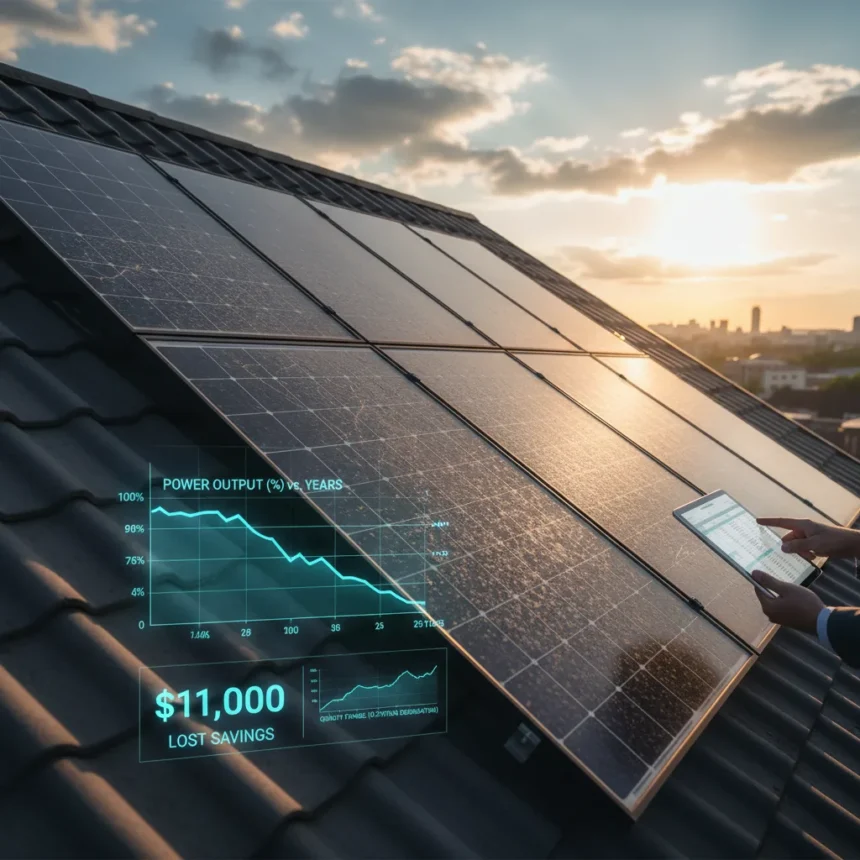
Solar panel degradation rates are the hidden cost that undermines decades of energy savings, yet most homeowners never check them before buying. According to solar experts, this single oversight can cost upwards of $11,000 over a 25-year system lifespan due to faster power loss in lower-quality panels. As solar adoption accelerates and utility bills climb, understanding degradation warranties has never mattered more.
Key Takeaways
- Solar panel degradation rates are specified in linear power warranties and directly impact long-term savings.
- Choosing budget panels over Tier 1 high-quality options can cost $11,000+ over 25 years in lost output.
- Tier 1 panels with annual degradation below 0.5% offset higher upfront costs through superior performance.
- Oversizing systems wastes power at low export rates and adds unnecessary equipment costs.
- Shade on even one cell can cut panel output by 50-80% through the string effect, requiring mitigation strategies.
What Solar panel degradation rates Actually Mean
Solar panel degradation rates refer to the annual percentage of power output a panel loses over time, typically specified in the linear power warranty that covers up to 25 years of operation. This warranty guarantees the minimum degradation manufacturers will accept, but it is often overlooked by homeowners focused on upfront price or peak wattage ratings. The difference between a panel degrading at 0.5% annually versus 0.7% or higher compounds dramatically across decades, turning a seemingly minor specification into tens of thousands of dollars in lost savings.
The problem starts with misleading sales claims. Many installers argue that because modern solar panels use similar cell technology, they all degrade at comparable rates, making the linear warranty irrelevant. This framing ignores real performance differences between Tier 1 high-quality panels and budget alternatives. Tier 1 manufacturers invest in superior materials, manufacturing controls, and testing protocols that genuinely slow degradation, yet homeowners are told these distinctions do not matter.
Why Tier 1 Panels Win Over Time, Not Just on Paper
High-quality Tier 1 solar panels with degradation rates below 0.5% annually appear more expensive upfront, but this cost difference vanishes when calculated across 25 years of operation. A panel that loses 0.4% of power each year delivers significantly more total kilowatt-hours than one degrading at 0.7%, especially as the system ages. For a typical residential installation, this performance gap translates into the $11,000 difference between a wise choice and a budget compromise.


The misconception that Tier 1 panels are prohibitively expensive persists because installers emphasize initial sticker shock rather than lifetime value. When degradation rates are factored into total energy production, the cost-per-kilowatt-hour over 25 years often favors quality panels, offsetting the higher purchase price. This calculation requires comparing linear power warranties side by side, a step most homeowners skip.
Solar panel degradation rates and System Oversizing: Another Silent Drain
Beyond panel quality, oversizing a solar system creates a separate financial leak. Many installers push larger systems without conducting proper energy audits, assuming bigger always means better. However, grid export limits cap how much power a single-phase home can feed back to the grid—typically 5 kilowatts without special approval. Excess power generation above this threshold is wasted at export rates of only 6–8 cents per kilowatt-hour, compared to standard retail rates of 30–35 cents per kilowatt-hour.



This mismatch forces homeowners to buy additional equipment like export limiters to comply with regulations, adding cost without benefit. A properly sized system matched to actual energy consumption avoids this waste and unnecessary hardware expenses. The temptation to oversize stems from the same logic that drives budget panel selection—the assumption that more capacity equals more savings—when in reality, precision sizing and quality components deliver superior returns.
Shading, Monitoring, and Installation Quality Matter More Than Marketed
Shade is an often-underestimated threat to solar performance. A single shaded cell can reduce an entire panel’s output by 50–80% through the string effect, where cells are wired in series and the weakest link limits current flow. This degradation can cause hot spots, bypass diode failure, and permanent damage if shade sources are not identified and eliminated before installation. Proper site assessment and, if necessary, the use of microinverters or optimizers can mitigate shading, but these solutions require upfront planning that many rushed installations skip.
Many homeowners treat solar as a set-it-and-forget-it investment, ignoring the importance of ongoing monitoring. Performance tracking systems reveal output anomalies early, allowing technicians to address issues before they compound into major losses. Professional installation also prevents mismatched component disasters—undersized inverters, incompatible connectors, or DIY configurations that risk fire hazards and system failure. The difference between a professional install and a budget DIY approach extends far beyond initial cost.
How to Avoid the Degradation Mistake
Start by comparing annual degradation rates and linear power warranties across panel options, not just upfront price or peak wattage. Request detailed warranty documentation from your installer and calculate the total kilowatt-hour output over 25 years for each option, accounting for degradation. This calculation reveals which panels deliver the lowest cost-per-kilowatt-hour despite higher upfront expense.



Next, ensure your system is sized to match your actual energy consumption, not inflated projections. Ask your installer for a detailed energy audit and clarify how export limits affect your specific location and grid configuration. If shade is unavoidable, budget for microinverters or optimizers rather than accepting a shaded system as-is. Finally, choose a professional installer with proven track records and monitoring systems, avoiding DIY or discount installers who cut corners on design and safety.
Does solar panel degradation vary by climate or region?
The research brief does not specify regional climate variations in degradation rates. However, panel quality (Tier 1 vs. budget) remains the primary determinant of degradation performance regardless of location. Tier 1 panels are engineered to perform consistently across diverse climates, while budget panels may degrade faster in extreme conditions.
How much does monitoring a solar system actually cost?
The research brief does not provide specific monitoring system costs. However, professional monitoring is essential to catch performance issues early and prevent thousands in lost output over the system’s life. The cost of monitoring is minimal compared to the $11,000+ potential loss from poor panel selection or installation errors.
Can I upgrade my panels if degradation becomes a problem?
The research brief does not address panel upgrades. However, since solar systems last 25 years or more, the initial choice of panel quality is critical—you cannot easily replace panels mid-system life. This underscores why selecting Tier 1 panels with superior degradation warranties from the start is a one-time decision that pays dividends for decades.
The solar panel degradation rates mistake is a perfect storm of overlooked specifications, misleading sales claims, and the illusion that all modern panels perform identically. By comparing linear power warranties, choosing Tier 1 panels, sizing systems to actual consumption, and investing in professional installation with monitoring, homeowners can reclaim the $11,000 or more that budget corners would otherwise cost. In a market flooded with incentives and hype, the boring warranty document often contains the most important truth.
Where to Buy
This article was written with AI assistance and editorially reviewed.
Source: Tom's Guide