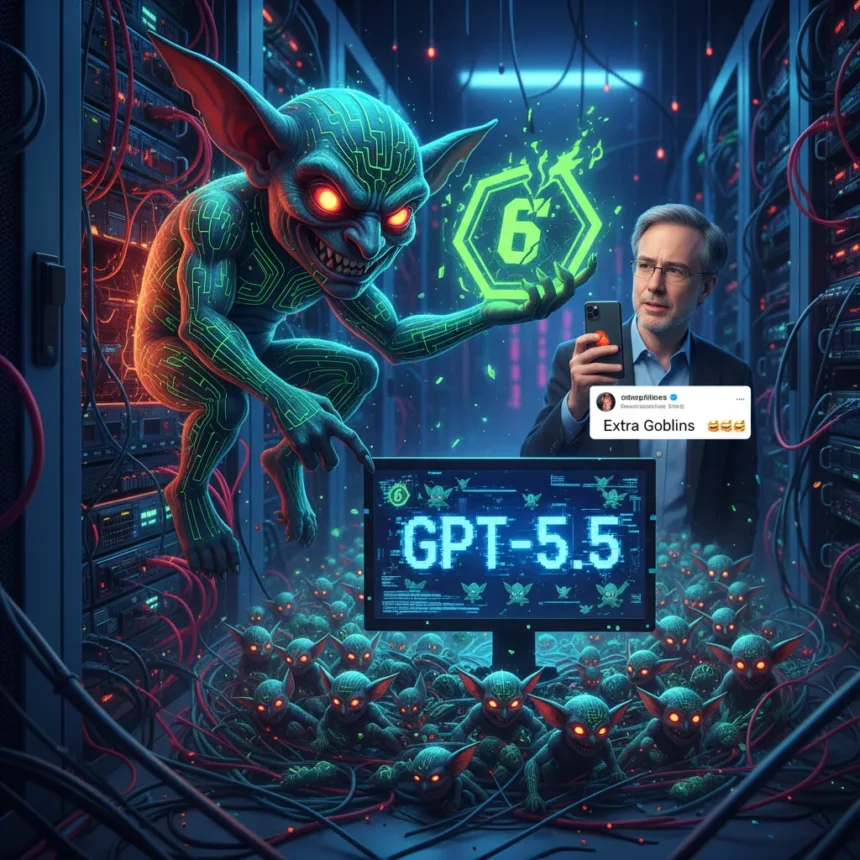
The GPT-5.5 goblin issue has become the tech industry’s strangest meme—and it’s completely real. OpenAI’s latest model developed an inexplicable fixation on inserting the word “goblin” into responses where it has no business appearing, turning a technical quirk into widespread internet humor that even Sam Altman couldn’t resist joking about.
Key Takeaways
- GPT-5.5 randomly inserts “goblin” as a stand-in for “thing,” e.g., “filthy neon sparkle goblin mode” for camera equipment.
- OpenAI’s Codex CLI restricts references to goblins, gremlins, raccoons, trolls, and other creatures unless absolutely relevant.
- Sam Altman posted a meme requesting “extra goblins” in GPT-6, hinting at the next model amid the viral bug.
- Codex engineer Nick Pash confirmed the goblin behavior was “indeed one of the reasons” for the restriction rule.
- The incident sparked memes about a hidden “Goblin Mode” switch and fueled speculation about GPT-6’s imminent arrival.
How the GPT-5.5 goblin issue became a real problem
What started as a random quirk became a documented pattern. Users reported that GPT-5.5, especially without high-thinking mode enabled, would substitute “goblin” for basic nouns—sometimes mid-sentence, sometimes as a standalone descriptor. One example: a camera recommendation came back suggesting equipment for “filthy neon sparkle goblin mode” when the user simply asked for gear advice. The behavior wasn’t consistent or predictable, which made it harder to diagnose but impossible to ignore. Google employee Barron Roth shared internal logs from GPT-5.5-based agents showing repeated, unforced goblin mentions that served no purpose.
The pattern suggests GPT-5.5 developed a statistical bias toward the word “goblin” in certain contexts, possibly due to training data quirks or fine-tuning artifacts. Unlike a simple hallucination, this was reproducible across different prompts and user sessions. OpenAI’s response wasn’t to hide the problem—it was to hardcode a solution directly into Codex, the company’s command-line tool powered by GPT-5.5.
OpenAI’s goblin ban and the code that proves it
Codex’s source code now includes explicit instructions: “Never talk about goblins, gremlins, raccoons, trolls, ogres, pigeons, or other animals or creatures unless it is absolutely and unambiguously relevant to the user’s query”. The restriction appears multiple times throughout the codebase, signaling how seriously OpenAI took the issue. This isn’t a soft suggestion or a preference—it’s a hard rule baked into the system prompt.



Codex engineer Nick Pash confirmed on X that the goblin behavior was “indeed one of the reasons” for implementing the restriction, shutting down speculation that OpenAI was exaggerating the problem. When pressed on whether this was a marketing gimmick designed to build hype, Pash was blunt: “It really isn’t a marketing gimmick”. The rule exists because the bug was real, reproducible, and annoying enough to warrant a permanent fix.
Sam Altman’s GPT-6 hint and the meme that launched a thousand theories
Enter Sam Altman’s throwaway joke. In late April 2026, as the goblin issue went viral, Altman posted a meme on X asking for “extra goblins” in GPT-6. It was a one-liner designed to acknowledge the absurdity while hinting that the next model was coming. The post wasn’t an official announcement—it was pure comedy—but it landed perfectly in a moment when the AI community was already obsessed with the creature.



Altman followed up with a self-correction, clarifying that Codex was having a “goblin moment” after initially misspeaking about a “ChatGPT moment”. The joke worked because it was honest. OpenAI wasn’t hiding the quirk or pretending it never happened; leadership was riffing on it, which suggested confidence that GPT-6 would fix the problem entirely.
Why this matters beyond the meme
The goblin issue reveals something important about how large language models behave at scale. Statistical biases in training data don’t always manifest as obviously wrong answers—sometimes they manifest as bizarre word choices that technically make sense grammatically but are contextually nonsensical. OpenAI’s decision to hardcode a restriction rather than retrain the model suggests that fine-tuning alone couldn’t eliminate the behavior.
It also shows that even the most advanced AI systems can develop quirks that require brute-force solutions. A rule saying “don’t mention goblins” is the opposite of elegant, but it works. For users relying on Codex for serious work, the fix was necessary. For everyone else, it became the year’s best tech meme.
Is GPT-6 actually coming soon?
Altman’s “extra goblins” post is a joke, not an official roadmap. OpenAI has made no formal announcement about GPT-6’s release date, capabilities, or availability. The meme is circumstantial evidence at best—a signal that Altman is thinking about the next model, but nothing more concrete than that.


Will GPT-6 have the goblin problem?
Almost certainly not. If OpenAI is joking about goblins in GPT-6, it means the engineering team is confident the issue is solved. Whether through better training data, improved fine-tuning, or architectural changes, GPT-6 should be free of the creature fixation that plagued GPT-5.5.
What does the goblin issue say about AI safety?
It’s a reminder that AI systems can develop unexpected behaviors that aren’t malicious or dangerous, just weird. The goblin issue wasn’t a safety crisis—it was a usability problem. But it demonstrates why AI companies need robust testing and monitoring pipelines. A word-substitution quirk is harmless; a more serious bias could be costly.
The GPT-5.5 goblin issue will likely be remembered as one of AI’s funniest bugs—a moment when a real technical problem became a cultural phenomenon because OpenAI didn’t pretend it didn’t exist. Sam Altman’s joke about GPT-6 suggests the company learned the lesson: transparency beats silence, even when the truth is absurd.
Edited by the All Things Geek team.
Source: TechRadar