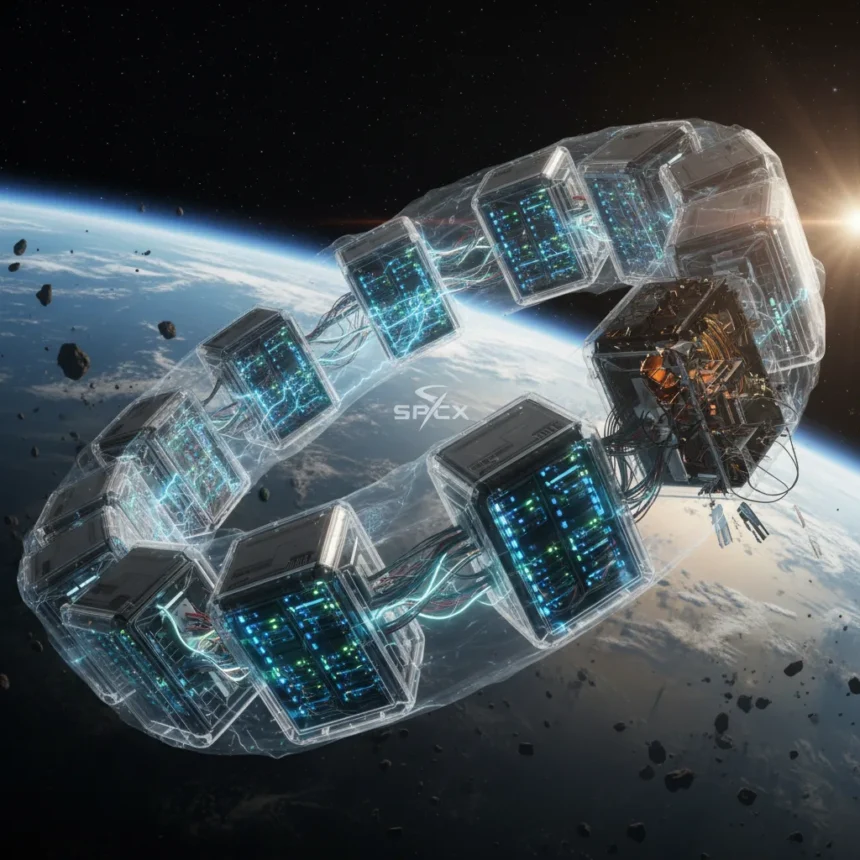
SpaceX’s orbital AI data centers represent one of the most ambitious infrastructure plays in the space economy, yet the company’s own confidential pre-IPO filing warns they involve significant technical complexity and unproven technologies that may not achieve commercial viability. The contradiction between Elon Musk’s public confidence and SpaceX’s private risk disclosures reveals the enormous gap between hype and engineering reality in space-based computing.
Key Takeaways
- SpaceX’s S-1 filing discloses orbital AI data centers may not achieve commercial viability due to unproven technologies
- The harsh space environment poses unique risks including radiation, thermal stress, and unpredictable failures
- GPU hardware depreciation every 2-3 years requires costly orbital replacement missions
- SpaceX has applied for FCC approval to deploy one million data center satellites
- Musk claimed space-based AI is achievable in two to three years, contradicting the filing’s risk warnings
What SpaceX’s Filing Actually Says About Orbital AI Data Centers
In its pre-IPO disclosure, SpaceX stated that initiatives to develop orbital AI data centers and in-orbit industrialization are in early stages and involve significant technical complexity and unproven technologies, with no guarantee of commercial viability. This cautious language appears designed to protect the company from investor litigation, yet it directly contradicts the optimism Musk expressed at Davos in January, where he called space-based AI a no-brainer achievable within two to three years. The filing’s explicit warning about the harsh and unpredictable environment of space—which could cause orbital infrastructure to malfunction or fail—suggests SpaceX’s engineers have identified fundamental challenges that public statements gloss over.
The company’s application to the FCC for one million data center satellites underscores the scale of ambition, but also the regulatory fast-track nature of the approval process, which skips environmental impact assessment despite potential debris, pollution, and astronomy interference concerns. SpaceX targets a $1.75 trillion IPO valuation, making the success or failure of orbital AI compute a material financial question for potential investors.
The Hardware Problem: Radiation, Depreciation, and Replacement
Orbital AI data centers face a hardware replacement crisis that terrestrial data centers never encounter. GPUs depreciate every 2-3 years as newer chips arrive, but swapping hardware in orbit requires either specialized launch missions, in-orbit docking procedures, or robotic repair operations—each exponentially more expensive than replacing a server in a climate-controlled warehouse. Radiation exposure in orbit causes bit flips and circuit damage, forcing SpaceX to rely on radiation-hardened chips that lag several generations behind commercial processors, reducing computational efficiency. To mitigate radiation damage, the company would need to implement triple modular redundancy, which triples the hardware footprint and cost.


This creates a vicious cycle: slower chips generate less revenue per unit, yet orbital replacement logistics consume vast resources. A terrestrial data center operator can retire a GPU after three years and install a newer model for the cost of shipping and labor. An orbital operator faces launch costs, docking complexity, and the risk of mission failure—making the economics fundamentally different from ground-based infrastructure.
Energy Demands and the Starship Dependency
The International Energy Agency projects data center electricity consumption will exceed 1,000 terawatt-hours by the end of 2026, reflecting AI’s voracious power appetite. Delivering that power to orbital data centers requires solar panels, batteries, and thermal management systems that must function reliably in the vacuum and extreme temperature swings of space. Each proposed data center could stretch up to 330 feet long, positioned at altitudes between 310 and 1,243 miles in pole-to-pole orbits with constant sunlight exposure. The engineering required to cool and power such massive structures in orbit remains unproven at scale.



SpaceX’s entire orbital AI strategy depends on Starship achieving reliable, frequent launch cadence and reusability. The company’s own filing states that any failure or delay in Starship development would delay or limit its ability to execute its growth strategy. Starship has not yet achieved regular orbital launches, let alone the sustained cadence required to maintain and refresh a constellation of orbital data centers. This dependency creates a single point of failure for the entire business case.
Astronomy and Space Debris Concerns
Starlink satellites were dimmed to near International Astronomical Union brightness limits after protests from astronomers, yet the proposed orbital data centers would be far larger and brighter, creating unprecedented interference with ground-based astronomy. Jonathan McDowell, an astronomer cited in discussions of the proposal, noted that the scale of SpaceX’s orbital compute ambitions would undermine years of progress made in mitigating Starlink’s impact on observation. With three old satellites and used rocket bodies currently deorbiting daily, adding one million new data center satellites would dramatically increase space debris risk and collision probability.
Who Else Is Pursuing Orbital Computing?
SpaceX is not alone in exploring space-based compute. Starcloud, Google through Project Suncatcher, and Blue Origin are pursuing their own orbital compute programs, suggesting the concept has industry-wide appeal. However, none of these competitors have disclosed the technical risks or hardware challenges as explicitly as SpaceX’s filing does. The competitive landscape remains fragmented, with no clear winner or proven business model yet established.
Is SpaceX actually building orbital AI data centers right now?
No. SpaceX’s filing states the initiatives are in early stages, and the company has not announced specific launch dates or customer contracts. Musk’s two-to-three-year timeline appears aspirational rather than based on concrete development milestones. The FCC application for one million satellites is a regulatory placeholder, not evidence of imminent deployment.



Why would orbital AI data centers ever make economic sense?
The theoretical advantage is latency reduction for certain AI workloads and potential use cases in remote locations or aboard spacecraft. However, the hardware replacement logistics, radiation shielding costs, and power delivery complexity make orbital compute far more expensive than ground-based alternatives for most applications. Only niche use cases—such as processing data from space-based sensors or serving clients in orbit—might justify the cost premium.
What does SpaceX’s filing say about the risks?
SpaceX explicitly warns that orbital AI data centers operate in the harsh and unpredictable environment of space, exposing them to a wide and unique range of space-related risks that could cause malfunction or failure. The company also acknowledges significant technical complexity and unproven technologies, with no guarantee of commercial viability. These disclosures suggest SpaceX’s engineers have identified fundamental challenges that make the business case uncertain.
SpaceX’s pre-IPO filing reveals a company aware of the technical and financial risks its orbital AI ambitions face, yet proceeding with regulatory applications and public optimism. The gap between Musk’s confident Davos claims and the filing’s cautious risk language tells the real story: orbital AI data centers remain an unproven concept with enormous engineering hurdles, making their path to commercial viability far less certain than the hype suggests. Investors and regulators should take the filing’s warnings seriously, not the headline optimism.
Edited by the All Things Geek team.
Source: TechRadar