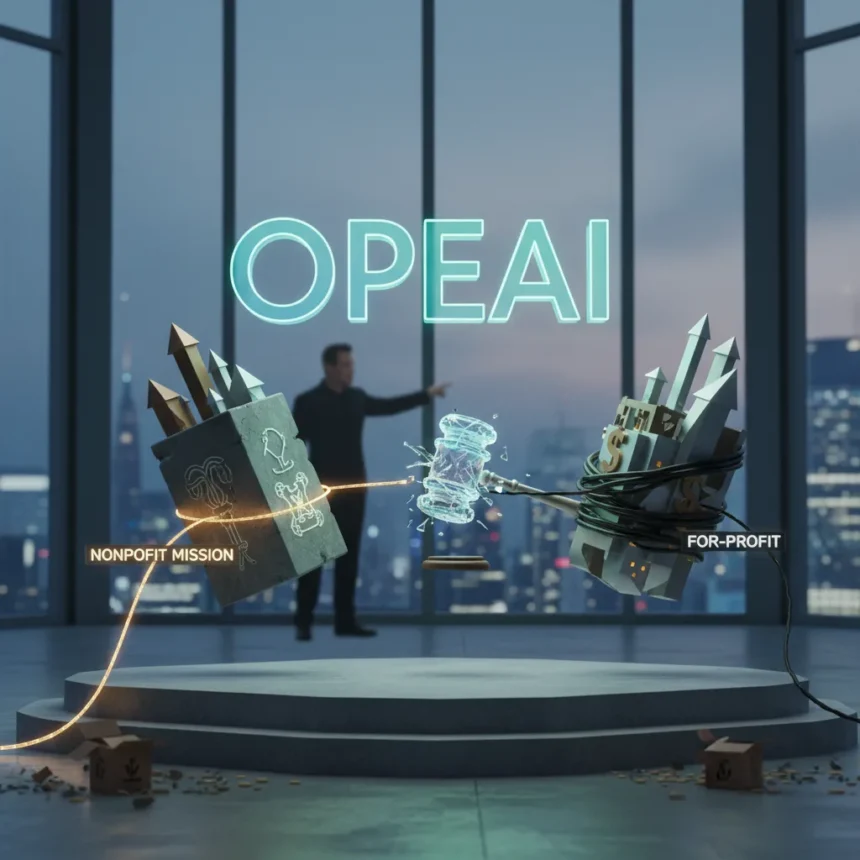
OpenAI nonprofit reversal is now the central issue in a high-stakes federal lawsuit that opened April 28, 2026, in Oakland, California, with Elon Musk seeking to undo the company’s transformation from nonprofit to for-profit entity. Musk co-founded OpenAI in 2015, provided approximately $38 million in initial funding, and recruited top talent to build the organization as a nonprofit dedicated to developing AI safely for humanity’s benefit. His legal team argues that OpenAI leaders have abandoned this mission entirely, converting the company into what they call a “profit-seeking juggernaut” designed to enrich executives rather than advance the public good.
Key Takeaways
- Musk’s lawsuit seeks $150 billion in damages with proceeds directed to OpenAI’s charitable arm.
- OpenAI’s for-profit restructuring in October 2025 was approved by California and Delaware attorneys general.
- Musk demands removal of CEO Sam Altman and President Greg Brockman, plus full unwinding of the for-profit structure.
- OpenAI is currently valued at $850 billion, making the company one of the most valuable AI firms globally.
- OpenAI’s legal defense argues Musk supported the 2019 for-profit shift and sued only after failing to become CEO and launching rival xAI.
What the lawsuit demands from OpenAI
Musk’s legal strategy goes far beyond financial compensation. His attorney, Steven Molo, is arguing that OpenAI nonprofit reversal should include complete structural dismantling of the for-profit model, with $134 billion in wrongful gains directed to an “OpenAI charity” benefiting humanity rather than flowing to Musk personally. The lawsuit also demands removal of Sam Altman as CEO and Greg Brockman as president, along with forfeiture of their financial benefits tied to the for-profit entity. This approach positions Musk’s claims as selfless—focused on restoring the original charitable mission rather than personal enrichment. However, a federal judge has ruled that jurors will decide liability without initially knowing about these remedies, preventing Musk from using the charitable angle to influence the verdict.
The stakes for OpenAI nonprofit reversal extend beyond the company itself. If Musk prevails, the precedent could reshape how AI companies structure themselves and how courts view nonprofit-to-for-profit conversions in the tech sector. OpenAI’s October 2025 restructuring had already been approved by California and Delaware attorneys general, suggesting regulatory bodies saw the shift as legally sound at the time. A court-ordered reversal would signal that even government-approved conversions can be challenged if the original mission is deemed abandoned.
OpenAI’s defense and the founding mission dispute
OpenAI’s legal team contests the core narrative. They argue that Musk supported the 2019 shift toward a for-profit structure and only filed suit after failing to secure the CEO role and launching his own rival AI firm, xAI. In their view, Musk’s sudden concern for nonprofit principles masks competitive jealousy over OpenAI’s $850 billion valuation. Sam Altman has also dismissed Musk’s proposed solutions as impractical, calling his space data center plans “ridiculous” for current AI computing needs. This counterargument frames the lawsuit as a power play rather than a principled stand for charitable AI development.



The dispute hinges on how to interpret OpenAI’s founding documents and the 2019 decision to adopt a capped-profit model. Musk’s team contends that leaders became “interested in collecting riches for themselves” rather than advancing humanity’s interests. OpenAI’s defense suggests that a for-profit structure was always part of the long-term plan and that Musk’s objections are selective and motivated by external business failures. This fundamental disagreement about organizational intent will likely dominate testimony throughout the trial.
Implications for AI governance and nonprofit structure
The lawsuit raises urgent questions about how nonprofits in emerging tech fields should be governed and what happens when founding missions conflict with commercial success. OpenAI nonprofit reversal, if ordered by the court, would set a precedent that nonprofit-to-for-profit conversions in AI can be legally unwound years after the fact, even with regulatory approval. This could influence how other AI startups structure themselves and how existing nonprofits protect their missions against future pressure to commercialize. The $850 billion valuation makes OpenAI a test case for whether massive financial success should trigger legal scrutiny of organizational purpose. Smaller nonprofits in AI, biotech, and other fields will be watching closely to see whether courts are willing to reverse structural decisions made in the name of scaling impact. The trial outcome could either reinforce nonprofit protections or signal that regulatory approval of conversions is effectively final, leaving founders with limited recourse if leadership diverges from stated principles.



Why this case matters right now
The timing of this lawsuit reflects growing tension in the AI industry between public benefit claims and private profit motives. OpenAI positioned itself as a safety-focused nonprofit when it launched, building trust with researchers, governments, and the public. The shift to for-profit status, even with a capped-profit structure, signaled a change in priorities that Musk and his legal team argue betrays that original covenant. The court’s decision will influence whether similar companies can convert without facing legal challenges from founders or stakeholders who believe the mission has been compromised. At stake is not just OpenAI’s structure, but the credibility of nonprofit claims in an industry increasingly dominated by venture capital and commercial pressure.
Could OpenAI nonprofit reversal actually happen?
Unwinding a for-profit structure after $850 billion in valuation and years of commercial operations would be extraordinarily complex, even if Musk wins on liability. The logistics alone—determining which assets revert to nonprofit status, how to handle investor claims, and how to restructure governance—present massive legal hurdles. However, the judge has allowed the jury to consider equitable remedies beyond monetary damages, meaning structural unwinding remains on the table as a potential remedy. If the court finds that OpenAI leaders breached fiduciary duties to the original nonprofit mission, judges have discretion to order remedies that go beyond financial compensation, including forced restructuring or leadership changes.
How does Musk’s xAI fit into this lawsuit?
Musk launched xAI after his efforts to influence OpenAI’s direction failed, including a failed bid to become CEO. OpenAI’s legal team argues this context proves the lawsuit is motivated by competitive jealousy rather than principle. However, Musk’s lawyers contend that the existence of xAI is irrelevant to whether OpenAI violated its founding mission—a separation of issues that will likely be debated throughout the trial. The judge’s decision to bar jury knowledge of Musk’s proposed remedies may also prevent jurors from seeing xAI as evidence of Musk’s financial interest in OpenAI’s downfall.
What happens if Musk loses the lawsuit?
If the jury finds no breach of fiduciary duty or abandonment of mission, OpenAI’s for-profit structure stands unchallenged, and the company’s leadership faces no legal consequences. This outcome would effectively validate the October 2025 restructuring and signal that nonprofit-to-for-profit conversions, once approved by regulators, are legally durable. Musk would lose the opportunity to reshape OpenAI’s governance and mission, though xAI would continue as his alternative AI venture. The broader message would be that founding principles, while important for marketing and trust-building, do not create enforceable legal obligations that survive structural reorganization.


FAQ
What is the OpenAI nonprofit reversal lawsuit about?
Musk’s lawsuit seeks to unwind OpenAI’s October 2025 conversion to a for-profit entity, arguing that leadership abandoned the nonprofit’s founding mission to develop AI safely for humanity. He is seeking $150 billion in damages, with proceeds directed to charitable purposes, plus removal of CEO Sam Altman and President Greg Brockman.
How much money is Musk asking for in the lawsuit?
Musk seeks $150 billion in total damages from OpenAI and Microsoft. He proposes that $134 billion in wrongful gains be directed to an “OpenAI charity” benefiting humanity, rather than to himself personally.
Why does Musk claim OpenAI stole a charity?
Musk’s legal team argues that OpenAI was founded as a nonprofit dedicated to charitable AI development, and that converting to a for-profit structure while abandoning the original mission constitutes a theft of the charitable entity’s purpose and assets. This framing emphasizes that the lawsuit is about restoring the nonprofit’s mission, not enriching Musk.
The OpenAI nonprofit reversal case represents a pivotal moment for how courts will treat nonprofit-to-for-profit conversions in tech. Whether Musk prevails or loses, the trial will establish important precedent about the enforceability of founding missions and the limits of regulatory approval in protecting nonprofit principles. For the broader AI industry, the outcome signals whether commercial success can override charitable intent, or whether founders retain legal standing to challenge structural decisions that abandon stated public benefit purposes.
Edited by the All Things Geek team.
Source: TechRadar