






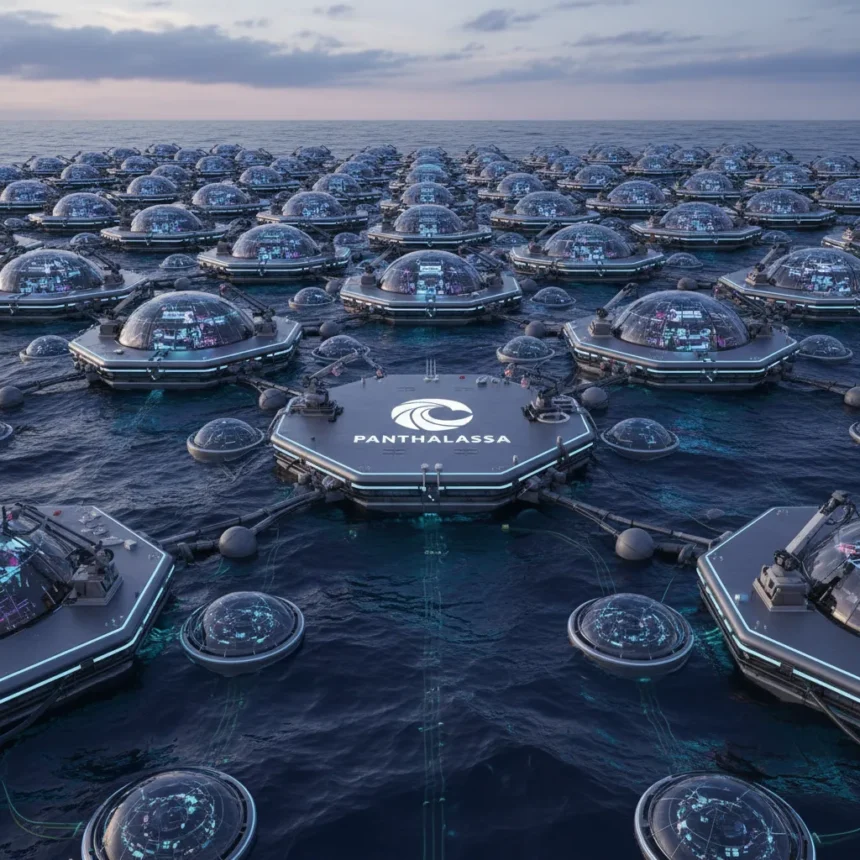
Wave-powered ocean platforms represent a fundamentally different approach to solving the energy crisis facing AI data centers. Rather than building on land or relying on grid infrastructure, Panthalassa is developing self-propelled floating nodes that generate electricity directly from ocean waves and process AI tasks on-site, transmitting results via satellite.
Key Takeaways
- Panthalassa’s wave-powered nodes operate autonomously far offshore without anchors, cables, or land infrastructure.
- Each node generates power as waves force water up a tube into a turbine, spinning a generator that powers onboard GPUs and TPUs.
- Ocean-3, the latest design, is under construction and expected to deploy offshore around August 2025.
- AI data centers could account for 20-50% of total data center energy consumption by 2030, according to the IEA.
- Wave energy could theoretically cover approximately 10% of global electricity consumption.
How Wave-Powered Ocean Platforms Work
The engineering is elegant in its simplicity. Each Panthalassa node resembles a giant lollipop, roughly 20 meters across at the top and extending approximately 80 meters down into the water. As waves move the node up and down, water is forced up a tube into a ball at the top, then funneled through channels into a turbine that spins a generator. The electricity powers onboard servers equipped with GPUs or TPUs, plus batteries for storage. Processed results transmit via satellite—no power cables required. The nodes move autonomously like a Roomba, traveling about 30 miles per day to find optimal wave spots, with no anchors tethering them to shore or seabed.
Garth Sheldon-Coulson, Panthalassa’s co-founder and CEO, frames the device as a floating hydroelectric dam. The comparison captures how the nodes harness natural forces—in this case, waves instead of falling water—to generate continuous power. Unlike traditional data centers that depend on grid connections and fuel deliveries, these platforms operate independently in the open ocean, where wave energy is abundant and uncontested.
Why AI Data Centers Need Ocean-Scale Power Solutions
The timing is urgent. The International Energy Agency estimates that AI could account for 20-50% of total data center energy consumption by 2030. Current data centers already consume staggering amounts of electricity for cooling and computing. Adding AI workloads—which demand constant, intensive GPU processing—pushes energy requirements into the gigawatt range. Land-based facilities face grid strain, environmental reviews, and rising operational costs. Wave-powered ocean platforms sidestep these constraints entirely.



Sheldon-Coulson emphasizes the clean, scalable advantage: no fuel, no land use, no interference with terrestrial activities, and rapid deployment. Wave energy is the cheapest available on the planet, he argues, making it economically attractive for data center operators seeking faster, cleaner alternatives to conventional infrastructure. The ocean’s wave energy potential could cover roughly 10% of global electricity consumption, offering a vast untapped resource.
Wave-Powered Ocean Platforms vs. Existing Floating Data Center Models
Panthalassa’s approach differs sharply from other floating data center concepts. Seaturns, a French startup, has developed anchored floating devices using water pendulums and turbines for wave energy, with a quarter-scale prototype tested in late 2023 that withstood 15-meter waves. However, Seaturns’ design requires anchoring to coastal areas and targets smaller microgrids rather than massive AI workloads. Aikido Technologies operates floating offshore wind platforms that co-locate AI compute with wind turbines, scalable to over 1 gigawatt across wind farms, but these depend on wind rather than waves and remain tethered to coastal infrastructure.



Panthalassa’s untethered, self-propelled approach eliminates the need for cables, anchors, or proximity to shore. This architectural freedom allows deployment far offshore where wave energy is most consistent and powerful. The nodes form a distributed data center swarm, networked together to process AI tasks at scale. No cables to the seabed, no grid connections, no environmental impact on land—just autonomous floating platforms riding waves in the open ocean.
Current Status and Deployment Timeline
Panthalassa has operated largely in stealth for approximately 10 years, with recent publicity surrounding Ocean-2, a test model demonstrated in Vancouver, Washington, which now rests on its side at the company’s facility. Ocean-3, the latest design, is well into construction and expected to deploy offshore around August 2025. The company has secured full private funding from AI firms eager to access cleaner, faster power alternatives.
Plans call for deploying thousands of nodes operating as a networked data center swarm, far offshore where waves are strongest. This is not a near-term pilot—it is a scaled infrastructure play backed by AI companies facing genuine power constraints. The urgency of AI’s energy demands has made Panthalassa’s vision suddenly relevant after years of quiet development.
The Scalability Question
Critics might ask whether thousands of autonomous floating nodes can operate reliably in harsh ocean conditions. The brief does not address storm hardening, servicing complexity, or marine engineering costs at scale. Sheldon-Coulson’s claims about unlimited ocean energy and cheapest-on-planet pricing are compelling but lack quantified cost comparisons or global yield data. Deployment timelines can slip, and Ocean-3 has not yet proven its durability in real storms. The leap from a test model to a thousand-node swarm is vast, and unproven technologies at scale often encounter unforeseen obstacles.



Still, the fundamental premise is sound: AI data centers need enormous amounts of clean power, and the ocean has it in abundance. Whether Panthalassa executes flawlessly or stumbles, the concept itself—wave-powered floating compute platforms—addresses a real constraint in AI’s infrastructure.
Could wave energy really power AI data centers at scale?
Wave energy could theoretically cover roughly 10% of global electricity consumption, and AI data centers could represent 20-50% of total data center energy use by 2030. The ocean’s wave energy is vastly underutilized compared to solar and wind, making it a logical frontier. However, deploying thousands of autonomous nodes at sea introduces engineering and logistics challenges not yet fully tested in practice.
What makes Panthalassa’s nodes different from other floating data centers?
Panthalassa’s nodes are untethered, self-propelled, and powered by waves rather than wind or grid connections. Unlike anchored floating platforms or wind-based systems, they require no cables to shore, no seabed infrastructure, and no proximity to coastal grids. This architectural freedom allows deployment far offshore where wave energy is most abundant and consistent.
When will Ocean-3 actually deploy?
Ocean-3 is expected to deploy offshore around August 2025, according to current timelines, though deployment dates for novel technologies often shift. The company has secured private funding and construction is well underway, but independent verification of performance and durability in real-world ocean conditions remains pending.
Wave-powered ocean platforms represent a bold bet on a simple idea: the ocean has unlimited energy, and AI data centers need it urgently. Panthalassa’s untethered floating nodes could reshape how compute infrastructure scales globally, or they could prove that the ocean is a harder adversary than anyone anticipated. Either way, the stakes are high, and the timeline is accelerating.
This article was written with AI assistance and editorially reviewed.
Source: TechRadar