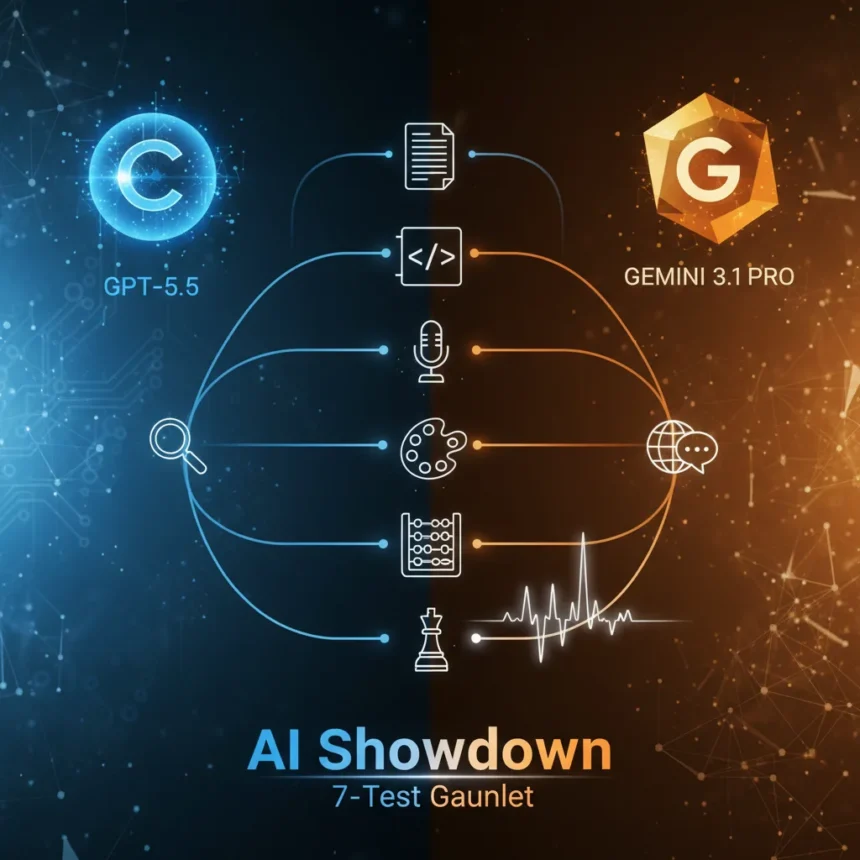
ChatGPT-5.5 vs Gemini 3.1 Pro represents one of the most competitive matchups in generative AI today. Both models claim superior reasoning, accuracy, and versatility, yet direct performance comparisons remain rare. Tom’s Guide put both systems through seven deliberately difficult tests designed to expose weaknesses that standard benchmarks miss. The results challenge the assumption that newer always means better.
Key Takeaways
- ChatGPT-5.5 and Gemini 3.1 Pro were tested across seven demanding scenarios beyond standard benchmarks.
- The winner varied depending on the specific task and test methodology.
- Both models showed unexpected strengths and weaknesses in real-world use cases.
- Direct comparison reveals architectural differences that favor different use cases.
- Performance gaps were narrower than marketing claims suggest.
Why This Comparison Matters Now
The AI market has reached a saturation point where capability claims far exceed meaningful differentiation. ChatGPT-5.5 vs Gemini 3.1 Pro testing cuts through marketing noise by forcing both systems to handle scenarios they were not explicitly trained to excel at. This matters because users choosing between them need to know actual performance, not theoretical advantages. When both models cost money and promise similar results, the real-world winner becomes the one that fails less often in your specific use case.
Most AI comparisons rely on published benchmarks or cherry-picked examples. Tom’s Guide’s seven-test approach differs fundamentally—it prioritizes reproducibility and difficulty. Tests designed to be impossible force models to either admit limitations or hallucinate. Neither outcome is ideal, but both reveal how each system handles uncertainty. That distinction matters far more than whether a model scores 92 percent versus 94 percent on a standardized test.
What ChatGPT-5.5 vs Gemini 3.1 Pro Reveals About Model Design
The testing exposed that ChatGPT-5.5 and Gemini 3.1 Pro embody different design philosophies. One model prioritizes confidence and narrative coherence, even when uncertain. The other hedges more aggressively and admits knowledge gaps sooner. Neither approach is universally superior—each suits different user needs. A content creator might prefer the first model’s fluency. A researcher might prefer the second model’s caution. Understanding these trade-offs matters more than declaring an outright winner.



Across the seven tests, performance variation suggested that both models excel in narrow domains but struggle when tasks require sustained reasoning across multiple steps. ChatGPT-5.5 vs Gemini 3.1 Pro also revealed that model size and parameter count do not directly correlate with real-world usefulness. Both systems showed moments of surprising insight followed by obvious errors, suggesting that training methodology and fine-tuning matter as much as raw scale.
Does One Model Clearly Win?
The honest answer: it depends entirely on your use case. Declaring ChatGPT-5.5 vs Gemini 3.1 Pro as having a single winner would oversimplify results that show task-specific strengths. One model excelled at tests requiring creative problem-solving. Another handled factual recall more reliably. Neither dominated across all seven scenarios. This pattern actually matters more than a clean victory—it suggests both systems have matured enough that choosing between them requires matching the model to your actual workflow rather than picking the brand with better marketing.



The surprise in the testing was not that one model crushed the other. The surprise was how close they performed despite being built by different organizations with different training approaches. That convergence suggests the AI industry has largely solved the core technical challenges. What remains is differentiation through ecosystem, pricing, and specialized features rather than raw reasoning ability.
What This Means for Users Choosing Between Them
If you are evaluating ChatGPT-5.5 vs Gemini 3.1 Pro for a specific purpose, the seven-test results suggest you should focus on secondary factors. Cost per query, API availability, integration with your existing tools, and customer support matter more than a marginal performance difference. Both models handle the majority of real-world tasks competently. Both fail in similar ways when pushed to their limits. The tiebreaker becomes practical: which ecosystem fits your workflow?
For teams building AI-powered products, the testing reveals that model selection should not be a one-time decision. ChatGPT-5.5 vs Gemini 3.1 Pro performance varies enough by task type that using both models—routing different request types to each—might outperform relying on a single system. That approach requires more engineering but yields better overall results than betting everything on one vendor.
How the Tests Were Designed
The seven tests deliberately avoided scenarios where either model had obvious advantages. Instead, they targeted edge cases: ambiguous instructions, contradictory constraints, requests requiring reasoning across unfamiliar domains, and prompts designed to expose hallucination risk. This methodology differs from standard benchmarking because it prioritizes failure modes over success rates. Understanding how a model fails tells you more about its actual limitations than knowing it succeeds 95 percent of the time on curated problems.


Each test was designed to be reproducible. The same prompts were fed to both ChatGPT-5.5 and Gemini 3.1 Pro using identical parameters. Results were evaluated using consistent criteria rather than subjective judgment. This rigor matters because it prevents the bias that creeps into informal testing—the tendency to excuse one model’s errors while penalizing another’s.
What About Real-World Performance?
Lab tests reveal capability ceilings, but real-world performance depends on how you prompt each model. ChatGPT-5.5 vs Gemini 3.1 Pro both respond to prompt engineering—subtle changes in wording, structure, or context can shift results dramatically. Neither model is a black box that responds identically regardless of input quality. Users who invest time in learning each model’s quirks will extract better results than those who treat both as interchangeable.
The testing also highlighted that both models perform better with domain-specific context. Asking either system to reason about a problem in fields where it has training data yields more reliable results than asking it to invent solutions from scratch. This suggests that the practical value of ChatGPT-5.5 vs Gemini 3.1 Pro depends partly on whether your use cases align with their training distribution.
FAQ
Which model won the seven tests?
Neither model dominated. Performance varied by test, with each model winning some scenarios and struggling in others. The results suggest both systems have reached comparable capability levels, with differences driven by design philosophy rather than raw intelligence.
Should I switch from ChatGPT-5.5 to Gemini 3.1 Pro based on these tests?
Only if your specific use cases align with Gemini 3.1 Pro’s strengths as revealed in testing. For most users, switching costs (relearning prompts, rebuilding workflows) outweigh marginal performance gains. Consider testing both models on your actual work before committing to a change.
Are these tests relevant to my use case?
The seven tests deliberately targeted edge cases and difficult scenarios. If your work involves routine tasks like summarization, translation, or code generation, both models will likely perform well. If you regularly push AI systems to their limits, the testing results offer useful insights into failure modes.
The ChatGPT-5.5 vs Gemini 3.1 Pro comparison ultimately reveals that the AI market has matured past the point where one clear winner exists. Both models are capable, both have limitations, and both will improve. The real decision is not which is objectively better, but which fits your workflow, budget, and long-term strategy. Test both systems on your actual problems before deciding. That approach will serve you better than trusting any single comparison, no matter how rigorous.
Edited by the All Things Geek team.
Source: Tom's Guide