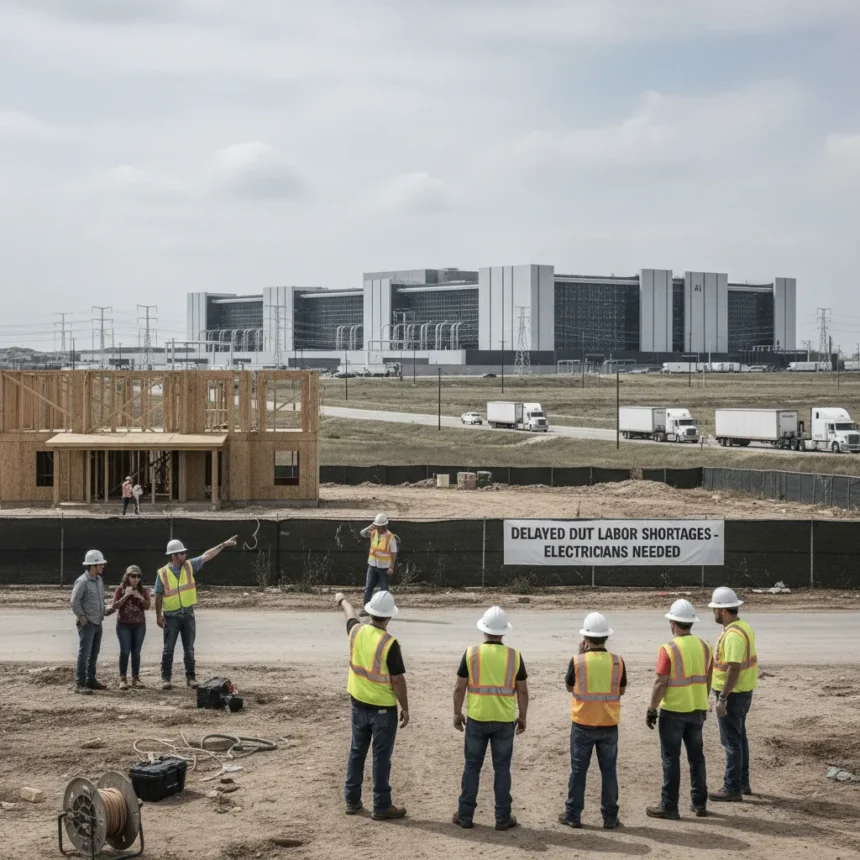
AI data center housing delays have become Texas’s most urgent construction crisis, with residential projects now taking two months longer to complete as electricians abandon home builds for lucrative data center jobs. The Stargate project—a $500 billion infrastructure initiative backed by OpenAI and Oracle in Abilene, Texas—exemplifies the scale of disruption: the facility alone flooded a city of 130,000 with over 6,000 out-of-state construction workers, creating an acute labor shortage that has rippled through the entire housing sector.
Key Takeaways
- Texas housing projects face two-month delays as electricians earn 75% higher salaries working on AI data centers.
- Abilene’s rent surged nearly $1,000 in under a year due to data center worker influx overwhelming short housing supply.
- Stargate data center targets 1 gigawatt of electricity by mid-2026 across 99 million square feet on 1,000 acres.
- More than half of U.S. data centers planned for 2025–2026 face delays; nearly half of 2026 projects canceled or delayed.
- Supply chain bottlenecks for electrical components like transformers and switchgear sourced overseas create a 7 GW capacity gap.
Why AI data center housing delays are crippling Texas construction
The electrician shortage driving AI data center housing delays stems from brutal wage competition. Data center projects offer salaries 75% higher than residential construction, plus superior benefits packages. Contractors building homes cannot compete. The result: electricians vanish mid-project, leaving residential sites understaffed and timelines blown. In Abilene specifically, the housing shortage was already acute—the city was short 5,000+ units before Stargate arrived. Now it faces a perfect storm: massive worker influx colliding with inadequate housing stock, which drove rents up nearly $1,000 in under a year.
This is not a localized problem. Communities across Texas have begun resisting data center expansion. San Marcos held a public hearing that lasted until 2 AM with over 130 testimonies against a proposed facility. College Station faced a petition with 5,000+ signatures opposing a data center project. Wisconsin, Michigan, and New Mexico have experienced similar housing crises and community backlash. The pattern is clear: AI infrastructure growth is outpacing local capacity to absorb it.
The nationwide data center supply chain collapse
Texas housing delays are a symptom of a larger infrastructure crisis. More than half of U.S. data centers scheduled for 2025–2026 face delays due to shortages of critical electrical equipment—transformers, switchgear, and batteries—most of which are sourced overseas. Nearly half of all AI data centers planned for 2026 have been canceled or delayed entirely, creating a 7 GW capacity gap from power grid bottlenecks. This is not a contractor problem. It is a geopolitical supply chain problem.



One industry expert explained the core issue: operating a data center requires 99.99% reliability, which local grids cannot guarantee. Data centers need layered power infrastructure—fuel cells, renewable energy, energy storage—but all these components come from outside the United States. U.S. regulators cannot influence overseas manufacturing timelines or geopolitical disruptions. The result: a cascading delay that affects not just data centers but every construction project competing for the same scarce components.
Stargate’s scale and local impact
The Stargate project in Abilene illustrates both the promise and the cost. The facility aims to reach nearly 1 gigawatt of electricity by mid-2026, spanning 99 million square feet across approximately 1,000 acres. It is expected to generate millions in annual property tax revenue, despite the tax breaks offered to attract the project. Local leaders tout the economic upside. But the construction phase is brutal: projections reached 8,000 workers at peak, overwhelming a city with no infrastructure prepared for that influx.



The long-term employment picture is sobering. Once construction ends, Stargate will create only 357 permanent jobs. The temporary workers will leave. The housing crisis they created will remain. Communities are left managing stranded housing capacity, strained medical resources, traffic congestion, road damage from heavy trucks, and rising electricity and water costs—all for a brief construction boom and a handful of permanent roles.
What happens when housing delays meet broader construction gridlock
AI data center housing delays are not occurring in isolation. They are compounding with nationwide supply chain failures, electrical equipment shortages, and labor competition that spans entire regions. A homebuyer in Texas who signed a contract expecting a six-month build now faces an eight-month timeline. A contractor bidding on residential work must account for electrician unavailability and inflated labor costs. Meanwhile, data center projects continue advancing because they can outbid everyone else.
The housing affordability crisis, already severe in Texas, worsens. Delayed completions push move-in dates back, forcing families into extended temporary housing arrangements. Rising rents in data center boomtowns price out lower-income workers. And because data centers generate far fewer permanent jobs than the construction chaos they create, the long-term economic benefit to communities is marginal at best.
Can supply chains and local housing recover?
Recovery requires action on multiple fronts. Electrical equipment manufacturers must increase overseas production or reshore capacity to the U.S.—neither happens quickly. Local governments must plan housing expansion in anticipation of data center projects, not after they arrive. And the data center industry itself must coordinate construction timelines to avoid overwhelming single communities. None of this is happening at scale yet.



For homebuyers and contractors in Texas right now, AI data center housing delays are a present crisis with no immediate solution. The electricians will not return to residential work until data center wages drop or data center projects finish. The housing shortage will not resolve until new units are built. And new units cannot be built quickly without electricians. It is a cycle that favors large infrastructure projects over individual homeowners, and that imbalance is reshaping Texas construction one delayed closing at a time.
How long will AI data center housing delays last?
Delays are expected to persist through 2026 as data center projects ramp up and electrical supply chain issues remain unresolved. Once major construction phases complete—particularly Stargate by mid-2026—electrician availability may improve. However, new data center projects are already planned, so competition for skilled labor will likely remain elevated for years.
Which Texas cities are most affected by AI data center housing delays?
Abilene is the most severely impacted due to Stargate’s scale and the influx of 6,000+ workers. San Marcos and College Station have also faced significant pressure, though community resistance has slowed or blocked projects in those cities. Other Texas metros with data center development plans are beginning to experience similar pressures.
Are data centers worth the housing crisis they create?
The math is unfavorable for host communities. Stargate will generate millions in annual tax revenue but create only 357 permanent jobs after construction ends. Communities absorb years of housing shortages, infrastructure strain, and traffic congestion for temporary employment and tax benefits that often come with incentive packages. The long-term economic case for small towns is weak, which explains why San Marcos, College Station, and other cities are pushing back.
AI data center housing delays expose a fundamental mismatch between infrastructure ambitions and community capacity. Texas is attracting massive investment in AI and cloud infrastructure, but that investment is creating acute disruption for ordinary residents trying to buy homes or complete construction projects. Until data center development is coordinated with housing planning and supply chain resilience, the two-month delays will continue—and likely worsen.
Edited by the All Things Geek team.
Source: Tom's Hardware