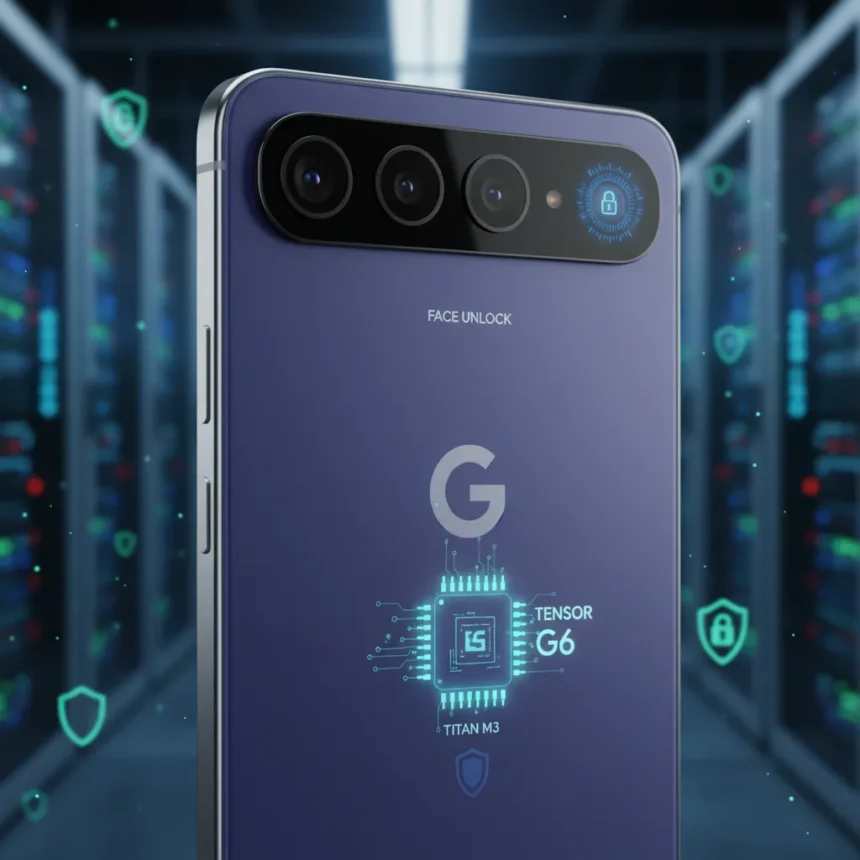
The Pixel 11 Tensor G6 is shaping up to be a significant leap forward for Google’s flagship line, according to leaked details attributed to Mystic Leaks on Telegram. The chip, codenamed Malibu, will power the Pixel 11 series including the Pixel 11 Pro Fold, and brings with it the most substantial security improvements Google has made to its phones since introducing the Tensor chip in the Pixel 6.
Key Takeaways
- Tensor G6 integrates a new Titan M3 security chip (codenamed Google Epic) to compete directly with Apple’s Secure Enclave
- Possible shift to 2nm architecture and MediaTek M90 modem from Samsung’s current solution
- New nanoTPU promises significant camera upgrades beyond current Pixel 10 capabilities
- Under-display IR camera system could enable Face Unlock functionality
- Pixel 11 launch expected in late summer 2026, with possible details at Google I/O in May
Tensor G6 security: The biggest leap since Pixel 6
Google is betting heavily on the Titan M3 to establish Pixel 11 as the security leader in Android. The new security processor, running firmware codenamed longjing, represents the first major upgrade to Google’s dedicated security architecture since the Titan M2 was integrated into the Tensor chip. This move directly targets Apple’s Secure Enclave, which has long been considered the gold standard for smartphone security. Unlike previous generations, the Titan M3 appears to be a more robust standalone component, suggesting Google is taking a page from Apple’s playbook by isolating critical security operations from the main processor.
The significance of this upgrade cannot be overstated. Security breaches in smartphones often exploit vulnerabilities at the hardware level, and a dedicated, hardened security chip makes those attacks exponentially harder. By separating the Titan M3 from the Tensor G6’s main processing cores, Google creates an additional layer of isolation that makes it substantially harder for attackers to compromise sensitive data like biometric information or encryption keys.
Hardware upgrades beyond the security chip
The Tensor G6 is not just a security refresh. Leaked specifications suggest Google is overhauling the chip’s architecture across multiple fronts. A potential shift to 2nm manufacturing process would give the Pixel 11 a significant performance and efficiency advantage over the current Pixel 10 generation. The move from Samsung’s modem to MediaTek’s M90 is equally noteworthy, signaling that Google may be diversifying its supply chain while potentially gaining better 5G and connectivity performance.


The new nanoTPU (neural processing unit) dedicated to camera tasks indicates Google is serious about computational photography. While the Pixel 10 already leads in software-driven image processing, a dedicated hardware accelerator for camera operations could enable real-time processing of more complex algorithms, from advanced noise reduction to improved low-light performance. This is where Google’s software expertise meets hardware muscle—a combination that could push Pixel 11 ahead of competitors relying solely on traditional ISP designs.
Face Unlock and the under-display IR camera
One of the more intriguing leaks involves an under-display infrared camera system supported by the Tensor G6’s image signal processor. If implemented in the final Pixel 11, this would bring Face Unlock functionality to Google’s flagship—a feature conspicuously absent from Pixel phones despite being standard on iPhones for years. An IR-based system offers advantages over visible-light cameras: it works in darkness, resists spoofing attempts with printed photos, and provides depth information for liveness detection.



However, supporting a feature at the chip level does not guarantee it will appear in the finished phone. Google may include the hardware capability but disable it for various reasons—cost, software maturity, or strategic positioning. The fact that the ISP supports it is promising, but expectations should remain tempered until Google makes an official announcement.
Timeline and competitive positioning
Google is expected to unveil Pixel 11 details at its I/O developer conference in May 2026, with the devices launching in late summer 2026. This timing puts the announcement roughly six months before Apple’s typical September iPhone event, giving Google a rare opportunity to set the agenda rather than respond to Apple’s moves. If Google can deliver on the Tensor G6’s leaked promise of superior security and camera hardware, the Pixel 11 could establish a meaningful lead in areas where Apple has historically dominated.
The competitive dynamic is shifting. Rather than playing catch-up on processor performance, Google is investing in specialized security and imaging hardware—areas where Apple has built its reputation. This suggests Google understands that raw chip speed matters less than solving specific problems that consumers actually care about: keeping their data safe and capturing better photos.
What these leaks tell us about Google’s strategy
The Tensor G6 leaks reveal a company thinking systematically about hardware specialization. Instead of cramming more general-purpose cores onto a chip, Google is adding purpose-built processors for security, imaging, and neural tasks. This approach mirrors what Apple has done with the Neural Engine and Secure Enclave, but Google is executing it on its own terms with different architectural choices.



The question is whether Google can execute flawlessly. Leaks are not guarantees. Features can be cut, timelines can slip, and real-world performance can disappoint. But if even half of what Mystic Leaks claims comes to fruition, the Pixel 11 could be the most significant Pixel phone since the original Pixel 6 introduced Tensor to the world.
When will Pixel 11 launch?
Google is expected to reveal Pixel 11 details at Google I/O in May 2026, with the phones launching in the second half of 2026. This gives the company time to finalize the Tensor G6 and ensure software integration is polished before release.
How does Tensor G6 compare to current chips?
The Tensor G6’s potential 2nm process and dedicated Titan M3 security chip represent a generational leap over the current Pixel 10’s Tensor chip. The shift to MediaTek’s modem and new nanoTPU for camera processing suggest more specialized hardware across the board, rather than relying on general-purpose processing for everything.
Will Pixel 11 have Face Unlock?
The Tensor G6’s image signal processor supports under-display IR camera systems, which could enable Face Unlock, but this does not guarantee Google will include the feature in the final Pixel 11. Hardware support is necessary but not sufficient—Google must choose to implement and enable it.
The Pixel 11 Tensor G6 leaks paint a picture of a Google that is thinking seriously about competing with Apple on security and hardware specialization, not just software features. Whether these leaks prove accurate will become clear when Google makes its official announcement in 2026. For now, they signal that the next generation of Pixel phones could be the most ambitious yet.
Edited by the All Things Geek team.
Source: T3