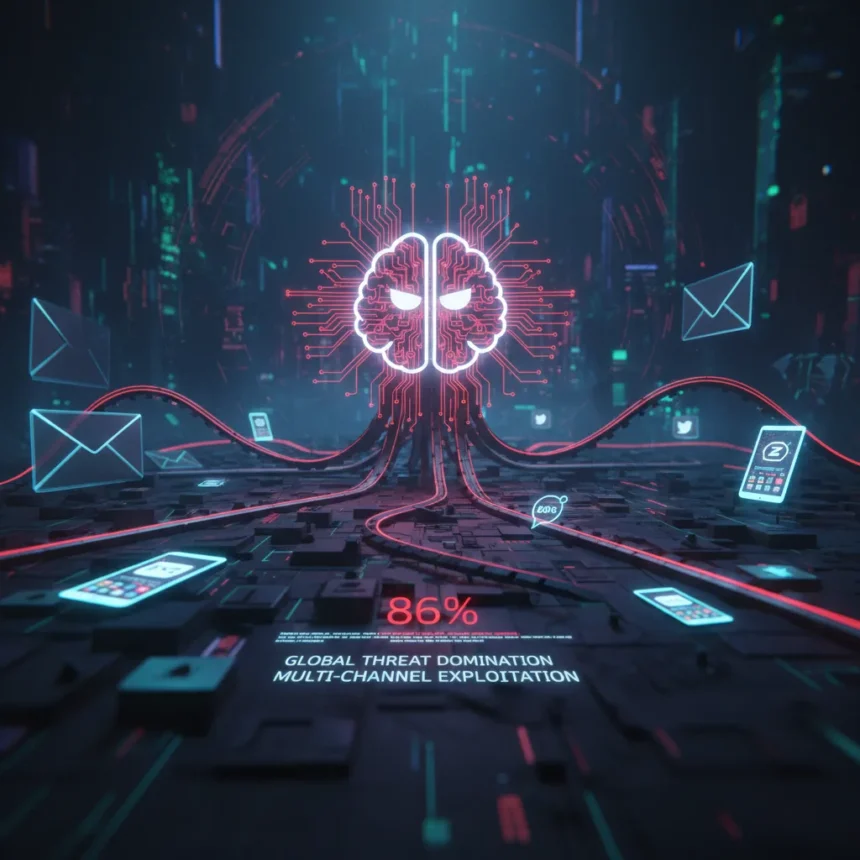
AI-driven phishing attacks now represent the dominant threat in enterprise security, with 86% of all phishing campaigns now powered by artificial intelligence, according to KnowBe4’s Phishing Threat Trends Report: Volume Seven. This seismic shift reflects how attackers are weaponizing generative AI to scale targeted campaigns, bypass traditional defenses, and exploit multiple communication channels simultaneously—far beyond the email inbox.
Key Takeaways
- 86% of phishing attacks are now AI-generated, up from minimal AI usage just two years ago
- Multi-channel attacks have replaced single-vector campaigns, exploiting email, calendar invites, Teams, and messaging apps
- Reverse-proxy attacks stealing Microsoft 365 credentials surged 139% in the past six months
- AI enables attackers to create hyper-personalized messages in minutes, mimicking internal tone and recent business context
- 39% of all SaaS breaches trace back to phishing-stolen credentials, making this the top initial-access vector
The Multi-Channel Threat: Email Is Just the Beginning
The traditional security model—fortifying the email gateway—is obsolete. Jack Chapman, Senior Vice President of Threat Intelligence at KnowBe4, stated plainly: “The inbox is no longer the only front line for coordinated social engineering attacks”. Attackers are now orchestrating coordinated campaigns across multiple collaboration platforms. Calendar invitation phishing surged 49% over six months, while Microsoft Teams-targeted attacks climbed 41%, and internal team impersonation affected 30% of attacks in Q1 2026. This shift reflects organizational reality: employees spend as much time in Teams, Slack, and calendar systems as they do in email, creating new blind spots for security teams trained solely on email-based threats.
The expansion extends beyond text. Voice and video deepfakes now enable vishing (voice phishing) attacks, where attackers impersonate executives or trusted contacts through fabricated audio or video. A single convincing deepfake call requesting a wire transfer or credential reset can bypass multiple layers of human judgment. Organizations relying on email-only awareness training are essentially defending yesterday’s attack surface.
How AI Democratized Phishing at Scale
AI-driven phishing attacks have fundamentally lowered the barrier to entry for attackers. Generative AI allows threat actors—whether highly skilled operators or script-kiddie amateurs—to craft context-aware messages that reference internal projects, adopt correct corporate tone, avoid grammatical errors, and mimic personal details like recent purchases or co-worker names. What once required hours of reconnaissance and manual writing now takes minutes. Experiments show AI can generate effective phishing campaigns in minutes using only a few prompts, compared with hours of manual work. This democratization means that 3,000+ unique threat actors tracked by KnowBe4 are no longer limited by writing skill or linguistic knowledge—they can now launch high-quality, targeted campaigns at scale.

The technical sophistication has also evolved. A 139% surge in reverse-proxy-based attacks demonstrates that attackers are not just personalizing messages; they are building infrastructure to intercept Microsoft 365 logins and steal credentials directly. These reverse proxies sit between the victim and the legitimate login page, capturing credentials in real time. Once stolen, those credentials unlock SaaS environments where 39% of all breaches originate. The result is a fully automated attack pipeline: AI generates the lure, reverse proxy captures the credential, attacker pivots into the SaaS environment.
Why Traditional Defenses Fail Against AI-Driven Phishing
Conventional email security tools stop 7% of successful phishing attacks—meaning 93% slip through. Legacy filters rely on signature detection, URL reputation, and sender authentication. AI-driven campaigns defeat these mechanisms by creating polymorphic variations, using newly registered domains, and spoofing internal addresses convincingly. Chapman noted: “Social engineering is becoming more targeted, making it more difficult to discern what is legitimate versus what is malicious”. A calendar invite from “[email protected]” requesting urgent meeting attendance, signed with familiar language and referencing a real project, reads as legitimate to both human eyes and rule-based filters.



This is where the threat landscape diverges from the defense landscape. Security teams remain organized around email silos, while attackers operate across integrated communication ecosystems. A phishing message in Teams looks identical to legitimate team communication. A calendar invite arrives with the same formatting as authentic meeting requests. An urgent voice call from a deepfaked executive voice bypasses all written-text defenses entirely.
Layered Defense: Multi-Factor Authentication as the Critical Control
No single control stops AI-driven phishing. Instead, organizations must stack defenses. Multi-factor authentication (MFA) on all accounts—especially Microsoft 365 and other SaaS platforms—remains the most effective brake on credential theft. Even if an attacker captures a password via phishing, MFA requires a second factor (authenticator app, hardware key, or biometric) that the attacker cannot easily intercept. Organizations should enforce MFA universally, not just for privileged accounts.
Beyond MFA, modern email and collaboration security tools that incorporate AI-driven detection offer real-time link and attachment inspection, behavioral analysis, and anomaly flagging. These tools learn to identify AI-generated phishing patterns by analyzing linguistic markers, sending patterns, and payload behavior—essentially fighting AI with AI. However, no tool is perfect; detection rates vary, and determined attackers will eventually find gaps.
Human Awareness Remains Non-Negotiable
Technology alone cannot win. Employee training must evolve beyond generic “don’t click suspicious links” advice. Organizations should conduct regular phishing simulation programs that test employees on calendar invites, Teams messages, and voice requests—not just email. These simulations should provide immediate feedback, reinforcing the mental model that unusual requests warrant verification, regardless of apparent sender identity.


The training message should center on a “verify, don’t trust” culture. Employees should be empowered—and encouraged—to question urgent requests, even from executives or colleagues, by using a separate, known-good communication channel to confirm. “Your CEO just asked you to wire $50,000 via Teams? Call them directly on their office line.” This friction slows attackers, who rely on speed and social pressure to bypass deliberation.
Organizations should also educate staff on deepfake and vishing risks explicitly. An audio or video call should never be the sole basis for high-risk actions like credential resets, fund transfers, or access grants. Secondary verification—a callback to a known number, an in-person confirmation, or a ticket-based approval process—must be mandatory for sensitive actions.
Monitoring and Logging: Detecting Compromise After the Fact
Despite best efforts, some phishing attempts will succeed. Organizations must assume breach and implement robust logging and monitoring around Microsoft 365 and other cloud platforms. Anomalous login patterns—logins from unusual geographies, at odd hours, or from new devices—should trigger alerts. Bulk email forwarding rules, mailbox rules that auto-delete messages, or unusual file access patterns suggest a compromised account. Segmentation and access controls ensure that a single compromised account cannot pivot across the entire environment, limiting lateral movement.
FAQ
What makes AI-driven phishing attacks harder to detect than traditional phishing?
AI-driven phishing attacks generate contextually aware, grammatically correct messages that reference real internal projects, use appropriate corporate tone, and avoid obvious red flags that trigger human suspicion or filter rules. Traditional phishing often contains spelling errors, generic greetings, and requests that feel out of place. AI eliminates these tells, making malicious messages nearly indistinguishable from legitimate communication.
Can multi-factor authentication stop AI-driven phishing completely?
MFA cannot stop phishing itself—attackers will still send convincing messages and steal credentials. However, MFA prevents attackers from using stolen credentials to access accounts, breaking the attack chain. An attacker who captures a password but cannot bypass MFA is stopped. MFA is not a complete solution but rather a critical layer that makes credential theft significantly less valuable.
How often should organizations run phishing simulations?
The research brief does not specify an optimal frequency. However, organizations should run simulations regularly enough to keep awareness fresh and to test new attack vectors (calendar invites, Teams, voice calls) as they emerge. Quarterly or semi-annual simulations, combined with immediate feedback and training for those who fall for simulated attacks, reinforce the “verify, don’t trust” mindset.
The threat landscape has shifted fundamentally. AI-driven phishing attacks are no longer a niche concern for security professionals—they are the dominant initial-access vector for enterprise breaches. Organizations that continue to rely on email-only defenses, generic awareness training, and legacy security tools will find themselves outmatched. The path forward requires multi-channel monitoring, AI-powered detection, mandatory MFA, and a security culture where verification is the default behavior. Attackers have weaponized AI; defenders must do the same.
Edited by the All Things Geek team.
Source: TechRadar