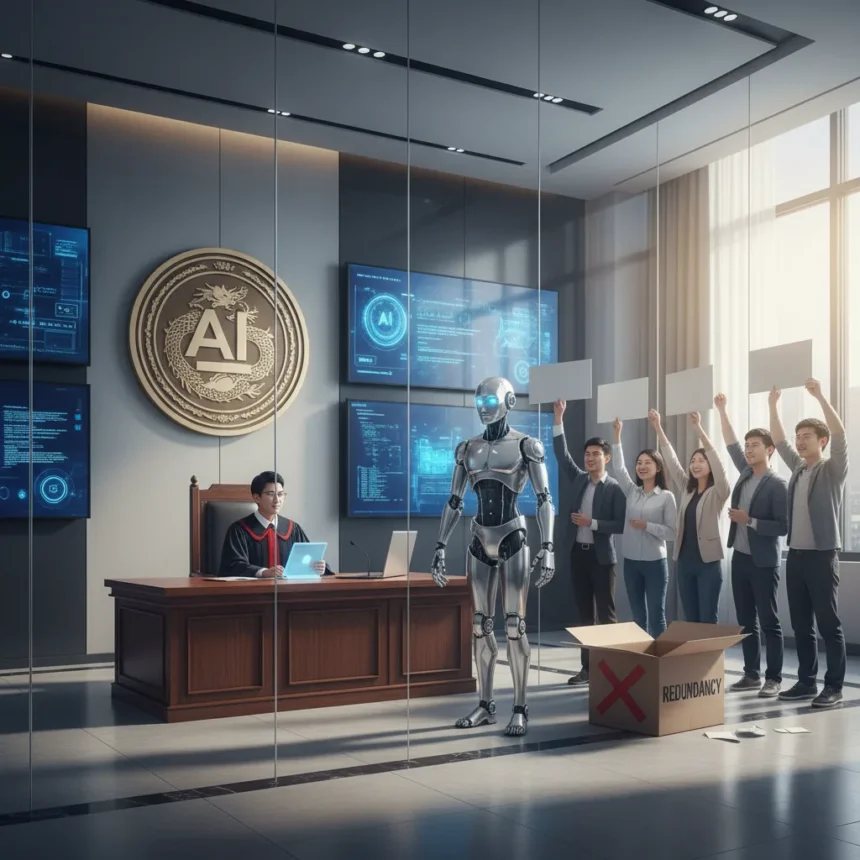
China has established a legal precedent that AI-induced job displacement cannot justify firing workers, according to two separate court rulings that fundamentally challenge how companies approach automation. The courts determined that implementing artificial intelligence is a strategic business decision, not an unforeseeable event that permits termination under China’s Labour Contract Law.
Key Takeaways
- Chinese courts ruled twice that AI-induced job displacement does not justify worker termination under labour law.
- Rulings based on Article 40 of Labour Contract Law, which permits termination only for force majeure or regulatory changes, not business decisions.
- In the Hangzhou case, a worker handling AI content moderation was offered demotion and pay cut instead of termination; court ruled against the company.
- 78,000 tech workers globally were laid off in early 2026, with nearly half attributed to AI adoption.
- US and EU lack equivalent legal protections against AI-related layoffs, making China’s approach globally unique.
How China’s Courts Are Redefining AI-Induced Job Displacement
Two separate rulings in Hangzhou and Beijing established that companies cannot fire workers solely to replace them with AI systems. The courts interpreted Article 40 of China’s Labour Contract Law narrowly: termination is permitted only for events beyond employer control—force majeure, government relocations, or regulatory suspensions—not for business decisions like implementing new technology. This interpretation treats AI adoption as a foreseeable strategic choice rather than an objective circumstance justifying contract termination.
The Hangzhou case involved a worker surnamed Zhou who performed content moderation for AI systems, matching user queries with large language models and filtering illegal or privacy-violating content to improve model accuracy. When the employer introduced AI to automate this role, it offered Zhou a demotion with a salary cut rather than termination. Both trial and appeals courts upheld an arbitration ruling against the company, ordering it to pay compensation. The decision signals that companies must restructure job roles or redeploy workers—they cannot simply eliminate positions because automation makes them redundant.
The second ruling, published in early May 2026, followed the first within six months, suggesting courts are applying consistent legal logic across multiple cases. State media highlighted the Hangzhou decision on April 30, 2026, the day before China’s Labour Day, underscoring the government’s emphasis on worker protections in the AI era.



Why This Matters Amid a Global AI Layoff Wave
The timing of these rulings is significant. In early 2026, approximately 78,000 tech workers globally were laid off, with nearly half attributed to AI adoption. Most of these layoffs occurred in the US and Europe, where no equivalent legal protections exist to prevent AI-induced job displacement. China’s rulings create a stark contrast: workers there have explicit legal recourse if employers attempt to use AI as justification for termination.
This divergence raises questions about how multinational tech companies will manage workforce strategies across regions. A company operating in China must maintain or redeploy workers when introducing AI, while the same company in the US or EU can make layoff decisions based on automation efficiency. The legal framework forces Chinese employers to treat AI adoption as a business challenge requiring workforce adaptation, not a cost-cutting opportunity justifying mass termination.



The Limits of China’s Protection Against AI-Induced Job Displacement
While China’s approach is globally unique, the rulings do not prohibit AI adoption or prevent companies from restructuring roles. Courts explicitly stated that companies may use AI but must adjust job structures within foreseeable business risks, not terminate contracts. This means employers can still reduce headcount through attrition, voluntary buyouts, or role consolidation—they simply cannot cite AI productivity gains as grounds for involuntary termination.
The practical effect is that workers gain leverage: employers must negotiate transitions, offer retraining, or redeploy staff rather than issue termination notices. For workers in moderation, data entry, or other roles vulnerable to automation, this creates a buffer that does not exist in other jurisdictions. However, the protection is not absolute. Companies can still restructure, reduce wages, or eliminate positions through other legal mechanisms—they simply cannot frame it as an unavoidable consequence of AI implementation.
What This Precedent Means for Global AI Regulation
These rulings arrive as governments worldwide grapple with AI’s labour impact. The US and EU have not enacted equivalent protections, leaving workers there vulnerable to AI-driven layoffs. Some jurisdictions are exploring retraining programmes or wage insurance, but none have taken the approach of making AI-induced termination illegal. China’s Labour Contract Law interpretation essentially treats AI adoption as a business decision that workers cannot bear the full cost of—costs must be shared through adjustment, retraining, or compensation.
Whether other countries adopt similar frameworks remains unclear. European labour law is generally more protective than US law, but no EU court has yet ruled that AI-induced job displacement violates employment contracts. The US, with its at-will employment doctrine in most states, is unlikely to follow China’s approach. However, China’s precedent may influence how tech companies manage global layoffs, particularly if they face regulatory scrutiny or reputational pressure for inconsistent treatment across markets.


Can AI adoption justify firing workers in China?
No. Chinese courts ruled that AI adoption is a strategic business decision, not an unforeseeable circumstance that permits termination under the Labour Contract Law. Companies may implement AI but must adjust job structures, redeploy workers, or negotiate transitions—they cannot use AI productivity gains as grounds for involuntary termination.
What is the difference between China’s approach and the US or EU?
China has established legal protections against AI-induced job displacement through court rulings; the US and EU have no equivalent laws or precedents. In the US and EU, companies can lay off workers to implement AI without legal restriction, whereas in China, workers can challenge such terminations in court and seek compensation.
What happened in the Hangzhou case?
A worker handling content moderation for AI systems was offered a demotion and salary cut when the employer introduced automation. The court ruled against the company, determining that AI adoption does not justify contract modification or termination, and ordered compensation.
China’s stance on AI-induced job displacement represents a fundamental shift in how labour law addresses automation. Rather than treating AI as an inevitable force that workers must absorb, the courts have positioned it as a business choice with labour law consequences. Whether this approach spreads globally remains to be seen, but for now, it stands as the world’s most explicit legal protection against being fired because a machine can do your job cheaper.
Edited by the All Things Geek team.
Source: TechRadar