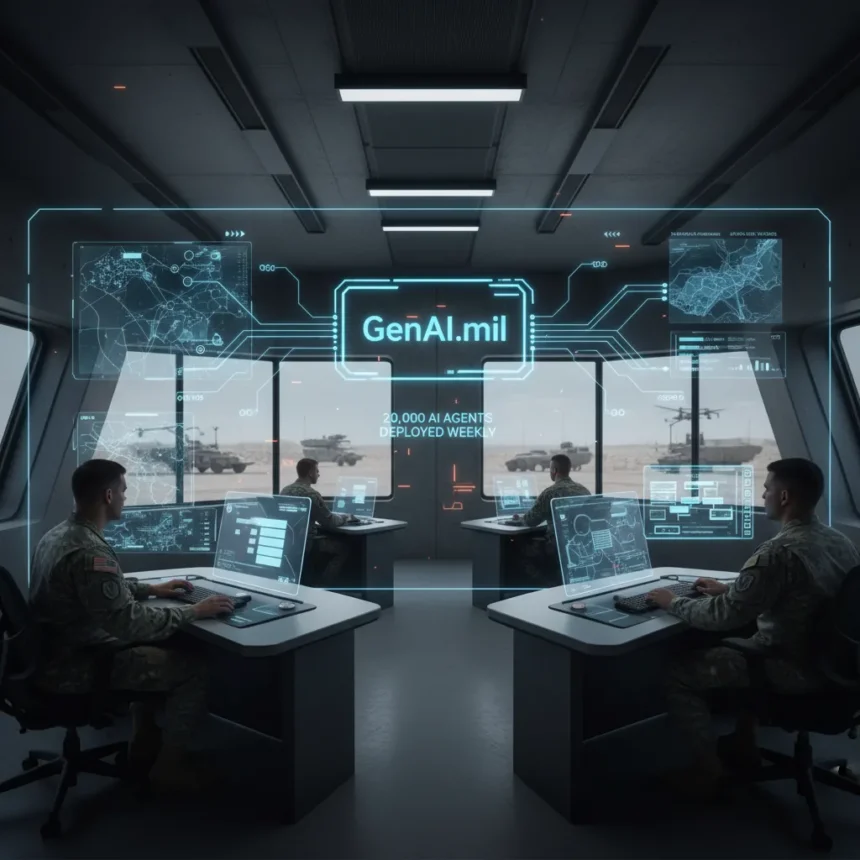
The Pentagon’s GenAI.mil platform is fundamentally reshaping how the U.S. military operates by enabling Pentagon AI agents deployment at an unprecedented scale. Since launching in December 2025, the platform has empowered over 1.3 million Department of Defense personnel to create and deploy custom AI agents without writing a single line of code, generating tens of millions of prompts and hundreds of thousands of autonomous tools across unclassified military networks. The scale is staggering: military personnel now deploy over 20,000 AI agents per week, with these autonomous tools handling approximately 25,000 sessions per day on average.
Key Takeaways
- GenAI.mil launched December 2025, enabling no-code AI agent creation for 3 million DoD personnel across unclassified networks
- Over 1.3 million military users have generated tens of millions of prompts and deployed hundreds of thousands of AI agents in five months
- Pentagon AI agents deployment reaches 20,000 agents weekly, handling 25,000 sessions daily on average
- Agent Designer tool automates routine tasks, cutting processing time from months to days for data synthesis and decision-making
- May 2026 expansion approves classified network deployment with eight tech firms including OpenAI, Google, and Microsoft
How Pentagon AI Agents Are Transforming Military Workflows
The Pentagon’s approach to Pentagon AI agents deployment centers on eliminating what military staff call “boring” work—manual data entry, routine analysis, and repetitive administrative tasks that consume warfighter attention. The Agent Designer tool, integrated into GenAI.mil, allows approximately 3 million DoD personnel to design custom AI assistants for multi-step tasks without any coding experience. These agents ingest diverse data sources including Controlled Unclassified Information images, financial records, and operational logs, then generate outputs like after-action reports, synthesized memos, and analytical summaries that teams can immediately deploy and share.
The efficiency gains are measurable. Warfighters, civilians, and contractors are cutting many tasks from months to days by using these autonomous tools for data synthesis, situational understanding, and decision-making. A military planner who previously spent weeks synthesizing intelligence from multiple sources can now configure an AI agent to perform that work in hours. This acceleration directly supports Secretary Pete Hegseth’s AI Acceleration Strategy, which aims to establish the U.S. military as an “AI-first fighting force” capable of maintaining decision superiority across all domains of warfare.
What makes this deployment model distinct is its accessibility. “Vibe coding”—intuitive, no-code agent design—removes the traditional barrier of requiring specialized technical skills. A logistics officer, intelligence analyst, or operations planner can now build custom AI assistants tailored to their specific workflow without waiting for IT support or software engineers. This democratization of AI agent creation is driving the explosive adoption rates: over 100,000 AI agents created, with more than 20,000 deployed weekly since the platform’s launch.



Pentagon AI Agents Expansion to Classified Networks Reshapes Military AI Strategy
On May 1, 2026, the Pentagon announced agreements with eight technology firms to deploy AI on classified military networks, representing a critical escalation in Pentagon AI agents deployment. The approved vendors are Amazon Web Services, Google, Microsoft, NVIDIA, OpenAI, SpaceX, Reflection (a NVIDIA-backed startup), and Oracle. These agreements authorize AI deployment on Impact Level 6 (secret data) and Impact Level 7 (highest classification) networks, vastly expanding the scope beyond the unclassified GenAI.mil environment.
The Pentagon’s statement on classified deployment emphasizes that integrating secure frontier AI capabilities will “streamline data synthesis, elevate situational understanding, and augment warfighter decision-making in complex operational environments”. However, the Pentagon has not disclosed specific payment amounts, deployment timelines, or which vendors have already begun integration work versus those still finalizing contracts. Some firms are already on contract; others are completing final negotiations.



One notable exclusion shapes the competitive landscape: Anthropic, maker of Claude, was excluded from the classified network agreements due to disputes over unrestricted use, AI ethics, surveillance capabilities, and lethal autonomous systems. The Pentagon gave itself six months to develop a replacement for Anthropic’s Claude within the classified environment. This exclusion reflects deeper tensions within the defense AI ecosystem—while most approved vendors offer flexible terms for various military applications, the Pentagon’s criteria for classified deployment appear stricter regarding ethical guardrails and weapons system integration.
Why Pentagon AI Agents Deployment Matters Now
The timing of this expansion reflects global military dynamics. The Pentagon is racing to embed AI across all operational levels as peer competitors invest heavily in autonomous systems and decision-making algorithms. By democratizing Pentagon AI agents deployment through no-code tools and rapidly scaling to classified networks, the U.S. military aims to compress decision cycles and amplify human judgment at every command level.
The vision articulated by Pentagon leadership is explicit: “human-machine teams capable of handling immense volumes of data to make better decisions faster”. GenAI.mil’s unclassified deployment has already validated this model with 1.3 million users, tens of millions of prompts, and hundreds of thousands of deployed agents in just five months. The May 2026 classified network agreements suggest the Pentagon believes this model works and is ready to scale it into the highest-sensitivity military environments.
Yet questions remain about long-term sustainability and oversight. The Pentagon has not publicly disclosed how it will monitor the behavior of hundreds of thousands of autonomous agents operating across classified networks, nor has it detailed how it will prevent model drift, data contamination, or unintended interactions between agents and human operators in time-critical scenarios. The absence of Anthropic—which has emphasized AI safety and alignment—from classified deployments may reflect Pentagon confidence in its own oversight capabilities, or it may indicate a willingness to prioritize speed and capability over certain safety considerations.


What Does Pentagon AI Agents Deployment Mean for Military Personnel?
For the 3 million DoD personnel with access to GenAI.mil, Pentagon AI agents deployment is already reshaping daily work. An intelligence analyst no longer manually cross-references reports; an agent does it. A logistics coordinator no longer hand-enters inventory data across systems; an agent synchronizes it. A commander no longer waits weeks for synthesized briefings; an agent generates them overnight. This is not hypothetical—warfighters, civilians, and contractors are already using these capabilities to cut task completion time dramatically.
For defense contractors and technology vendors, the Pentagon’s approval of eight firms for classified deployment signals that AI integration into military operations is now an operational reality, not a future capability. Vendors like Microsoft, Google, and OpenAI now have direct pathways to embed their models into the highest-classification military networks, fundamentally altering the defense technology supply chain.
Is Pentagon AI agents deployment sustainable at this scale?
The Pentagon has not publicly disclosed resource allocation, training requirements, or oversight mechanisms for managing hundreds of thousands of autonomous agents across classified and unclassified networks. The scale—20,000 agents deployed weekly, 25,000 sessions daily—suggests the infrastructure can handle current demand, but long-term sustainability depends on factors the Pentagon has not detailed publicly, including agent lifecycle management, security monitoring, and integration with human decision-making workflows.
Why was Anthropic excluded from Pentagon AI agents deployment on classified networks?
Anthropic was excluded due to disputes over unrestricted use, AI ethics, surveillance, and lethal autonomous systems. The Pentagon gave itself six months to develop a replacement for Claude within classified environments. This reflects a fundamental disagreement over how AI should be integrated into military operations—Anthropic has emphasized alignment and safety, while the Pentagon’s approved vendors appear willing to offer broader capabilities with fewer restrictions.
What is vibe coding in the context of Pentagon AI agents deployment?
Vibe coding refers to intuitive, no-code agent design that enables rapid creation and deployment of autonomous tools without traditional programming. The Agent Designer tool on GenAI.mil exemplifies this approach, allowing any of the 3 million DoD personnel to build custom AI assistants for multi-step tasks through visual, conversational, or template-based interfaces rather than writing code.
The Pentagon’s Pentagon AI agents deployment strategy is redefining military efficiency and decision-making speed, but it also raises critical questions about oversight, safety, and the long-term implications of embedding hundreds of thousands of autonomous agents into classified military networks. The scale is real, the adoption is rapid, and the strategic intent is clear—the U.S. military is betting heavily that AI-first operations will deliver decision superiority. Whether that bet pays off depends on execution, oversight, and the Pentagon’s ability to manage the complexity it is creating.
Edited by the All Things Geek team.
Source: TechRadar