





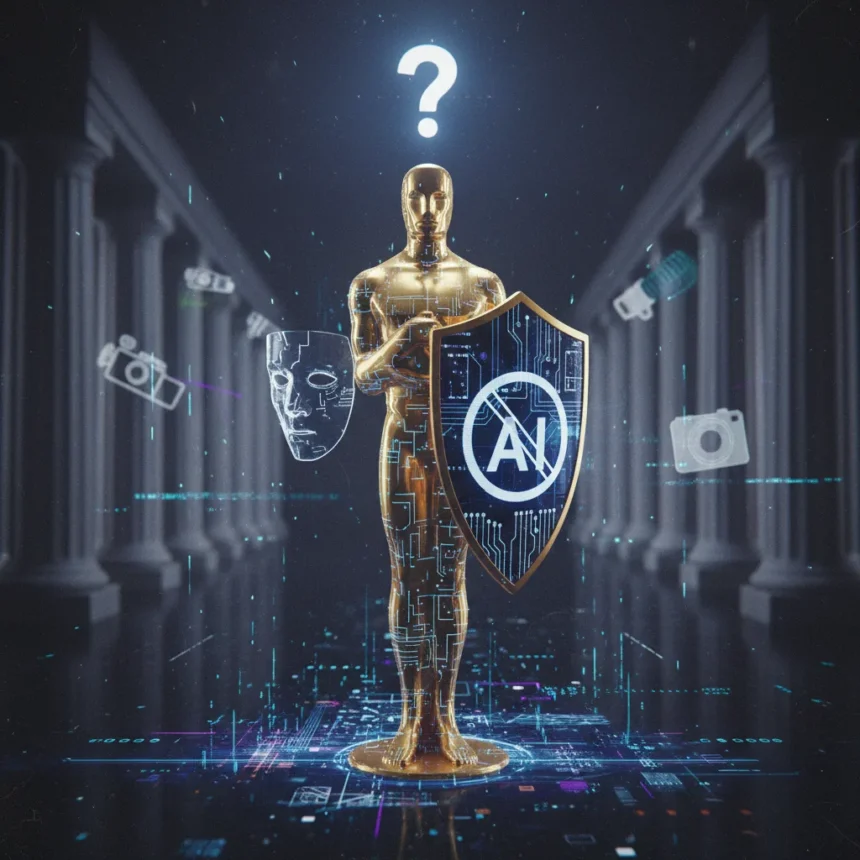
The Oscars AI ban arrived with fanfare but without teeth. The Academy announced a policy prohibiting AI-generated images, visuals, or voice replacers in films submitted for consideration, yet the Oscars AI ban permits AI as a tool if it does not compromise the filmmaker’s original vision. Enforcement? Self-disclosure. That gap between policy and practice is where the real debate lives.
Key Takeaways
- The Academy bans AI-generated images and voice replacers but allows AI tools if human creativity remains central.
- Enforcement relies on filmmakers self-reporting AI use, with no independent verification mechanism.
- Late Night with the Devil faced backlash for AI-generated title cards featuring anatomical errors like disconnected skeleton fingers.
- Artists remain divided: some call it insufficient protection against AI replacing human jobs, others see it as a necessary first step.
- The term AI slop describes low-effort generative content perceived as lacking quality, a growing concern in award submissions.
Why the Oscars AI ban Matters Right Now
The Oscars AI ban arrived in response to concrete incidents. Late Night with the Devil (2024) included AI-generated interstitials that drew immediate criticism for low-quality execution. The title cards featured anatomical errors—disconnected fingers on a skeleton—that exposed the gap between AI capability and professional filmmaking standards. This was not a theoretical concern. It was a film in theaters, competing for attention, using AI slop to save production time or budget.
The policy emerged amid a broader reckoning. Post-2024 strikes in Hollywood created space for AI integration conversations that had been suppressed. The Academy’s move signals that award bodies now view AI as a significant enough threat to codify restrictions. Yet the framing matters. The ban does not prohibit AI entirely—it prohibits AI-generated content. A filmmaker can use AI to enhance, composite, or assist, as long as humans remain the primary authors.
The Self-Disclosure Problem
Here is where the Oscars AI ban becomes a policy theater. The Academy requires filmmakers to disclose any AI use in visual effects. Disclose, not prove. This creates an honor system in an industry where competitive advantage matters enormously. A filmmaker who uses AI but does not disclose it faces no independent verification process. No third-party audit. No forensic analysis. Just trust.



This mirrors SAG-AFTRA’s approach to AI voice replication, which also relies on disclosure and consent agreements rather than technical enforcement. The difference is scale. Voice actors can monitor their own likenesses. A visual effects supervisor overseeing hundreds of shots has far more latitude to slip undisclosed AI assistance into the final cut. The Oscars AI ban acknowledges this asymmetry by requiring disclosure, but offers no mechanism to catch violations.
What Artists Actually Think
The Oscars AI ban has fractured the creative community. Some artists describe it as a half measure—insufficient protection against AI displacing human labor in visual effects, animation, and voice work. Others, like art curator Francesco D’Isa, push back against the framing entirely. D’Isa argues that dismissing all AI output as slop is unfair, noting that human production has always generated vast quantities of derivative or forgettable work, with only the best surviving as canon. The real question, by this logic, is not whether AI produces slop but whether the Oscars AI ban actually prevents low-quality work from winning.



That distinction matters. The policy does not ban low-quality filmmaking. It bans AI-generated content. A filmmaker can submit a traditionally shot film with sloppy editing, weak performances, or lazy cinematography. The Oscars AI ban does not stop that. It only stops the filmmaker from generating those problems with AI tools. Whether that protects artistic integrity or simply protects traditional labor is a question the policy never answers.
Does the Oscars AI ban Actually Work?
Effectiveness depends on what you measure. If the goal is to eliminate AI-generated content from award consideration, the policy fails because self-disclosure is unverifiable. If the goal is to signal that the Academy takes AI seriously and wants filmmakers to think carefully about when and how they use it, the policy succeeds. It creates a formal record. A filmmaker who discloses AI use faces scrutiny from peers and critics. A filmmaker who does not disclose and is later discovered faces credibility damage.
The real test comes in 2026 when the first Oscars cycle operates under this policy. Will submissions include AI use disclosures? Will any films be flagged as violating the ban? Will the industry develop tools to detect undisclosed AI, or will the honor system hold? The Oscars AI ban is a beginning, not a solution. It acknowledges a problem and sets a boundary. Whether that boundary actually protects filmmaking or simply creates a checkbox for compliance remains to be seen.
How does the Oscars AI ban compare to other industry rules?
The Oscars AI ban is less restrictive than SAG-AFTRA’s union rules, which explicitly prohibit AI voice replication without consent and compensation. The Academy allows AI as a tool; the union prohibits it as a replacement. This creates an odd dynamic where a film can use AI to generate backgrounds or composite effects but cannot use AI to replicate an actor’s voice without their explicit agreement. The inconsistency suggests that different industries are moving at different speeds, with unions leading and award bodies following.


What counts as AI-generated content under the Oscars AI ban?
The policy targets AI-generated images, visuals, and voice replacers specifically. This means a filmmaker can use AI to upscale footage, remove artifacts, enhance color grading, or assist in rotoscoping, as long as the final output reflects human creative direction. The line between AI-as-tool and AI-as-creator is fuzzy. The policy relies on filmmakers to draw that line honestly. A visual effects supervisor using AI to accelerate a traditionally designed sequence looks different from a filmmaker generating entire scenes with Midjourney or Runway. The Oscars AI ban acknowledges this distinction but does not define it precisely.
Will the Oscars AI ban actually stop low-quality AI submissions?
Not directly. The policy bans AI-generated content, not low-quality content. If a filmmaker submits a film with AI-generated title cards that feature anatomical errors similar to those in Late Night with the Devil, the Oscars AI ban would disqualify it—but only if the filmmaker discloses the AI use. If they do not, the film competes. The policy is a disclosure mechanism, not a quality filter. It assumes that transparency will lead to better decisions, not that the Academy will enforce aesthetic standards. That assumption may be optimistic.
The Oscars AI ban represents a threshold moment for Hollywood: the industry is now formally acknowledging AI as a tool that requires governance. Whether that governance actually protects filmmakers or simply creates the appearance of protection will depend on how seriously the Academy enforces it and how honestly filmmakers report their methods. For now, the policy is a signal. What it signals to different people remains contested.
This article was written with AI assistance and editorially reviewed.
Source: Creativebloq