





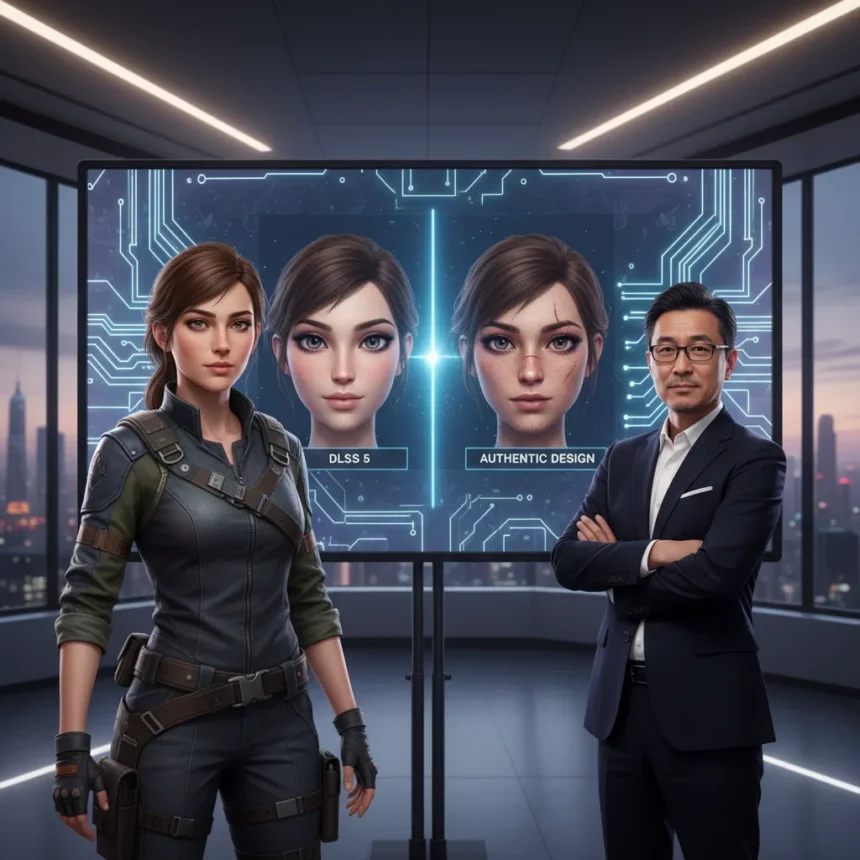
Resident Evil Requiem producer Masato Kumazawa recently reframed the viral backlash to Nvidia’s DLSS 5 character design alterations as proof that Capcom nailed Grace Ashcroft’s intended aesthetic. When Nvidia showcased the upcoming horror game using DLSS 5, an AI upscaling technology, the demo revealed a starkly different version of Grace—smoother skin, exaggerated makeup, and an overall hyper-feminized appearance that players quickly mocked as “yassified.” Rather than dismiss the complaints, Kumazawa argued the negative reaction actually validates the studio’s grounded artistic vision.
Key Takeaways
- Nvidia’s DLSS 5 demo of Resident Evil Requiem altered Grace Ashcroft’s appearance with AI smoothing and glamorization effects.
- Player backlash erupted on social media over the “yassified” character model diverging from the base game’s grounded design.
- Producer Masato Kumazawa views the controversy as confirmation that Grace’s realistic design resonates with players.
- DLSS 5 requires RTX 50-series GPUs and applies aggressive facial reconstruction that can over-smooth character textures.
- Resident Evil Requiem launches in 2026 on PC, PS5, and Xbox Series X/S without DLSS 5’s cosmetic alterations to characters.
How DLSS 5 Transformed Grace Ashcroft
The contrast between Capcom’s original Grace and Nvidia’s DLSS 5 version became impossible to ignore once the demo circulated. Grace’s base design emphasizes tactical practicality—weathered features, minimal makeup, and functional gear suited to a grounded survival-horror narrative. The DLSS 5 interpretation smoothed away these deliberate imperfections, applying AI-driven facial reconstruction that rendered her with poreless skin, enhanced symmetry, and an overall aesthetic closer to stylized anime than photorealistic horror. Players immediately flagged the uncanny valley effect, with social media flooded with memes and complaints about AI ruining Resident Evil’s character authenticity.
This wasn’t a subtle enhancement. The DLSS 5 model fundamentally altered Grace’s visual identity in ways that contradicted Capcom’s established tone for the character. Where the original conveyed survivalism and grit, the AI version conveyed glamorization. The backlash reflected genuine concern that AI upscaling tools, despite their technical prowess, could inadvertently distort artistic intent when applied to character-driven narratives.
DLSS 5 Character Design Validation Through Backlash
Kumazawa’s interpretation of the negative reaction offers a counterintuitive but defensible perspective. He argued that players’ strong rejection of the DLSS 5 version proved they recognized and valued Grace’s authentic design in the base game. If her original appearance had been poorly conceived or unconvincing, the AI-altered version might have felt like an improvement rather than a corruption. The fact that players vocally preferred the grounded, less polished version demonstrated that Capcom’s art direction succeeded in establishing a character players connected to as genuinely realized, not as a template waiting for AI enhancement.


Kumazawa stated that seeing the backlash to the DLSS version confirmed for Capcom that Grace’s design hits the mark—players recognize the real her versus the AI-glam version. The contrast itself became evidence. Rather than interpreting criticism as a failure, he reframed it as proof that the studio’s commitment to realistic, grounded character aesthetics resonated deeply enough that players actively resisted AI-driven beautification.
The Broader Tension: AI Upscaling vs. Artistic Intent
This controversy exposes a growing friction between AI upscaling technologies and game developers’ carefully crafted visual identities. DLSS 5’s strength—its ability to reconstruct fine facial details through neural networks—becomes a liability when applied to characters whose imperfections are intentional. Unlike AMD’s FSR 3 or Intel XeSS, which apply more neutral upscaling without aggressive facial reconstruction, DLSS 5 interprets character models through a lens optimized for photorealism and smoothness. For a grounded horror game where weathered, practical appearances serve the narrative, this over-optimization becomes a distortion.


The modding community has already begun creating DLSS fix patches to reduce yassification effects in games using the RE engine, signaling that player concern extends beyond social media complaints to active technical intervention. Capcom’s decision to release Resident Evil Requiem in 2026 on PC, PS5, and Xbox Series X/S without DLSS 5’s cosmetic character alterations suggests the studio is protecting its vision from unintended AI reinterpretation.
What This Means for DLSS 5’s Future in Gaming
Kumazawa’s comments don’t dismiss DLSS 5’s technical achievements—the technology genuinely improves performance and visual fidelity in many contexts. Rather, they highlight the need for developers to maintain control over when and how AI upscaling applies to character-critical assets. DLSS 5 excels at reconstructing environmental details and maintaining frame rates, but its aggressive facial reconstruction should remain optional for character models where artistic intent depends on visual authenticity.
The Resident Evil Requiem case study will likely influence how future AAA titles integrate DLSS 5. Developers may implement granular toggles allowing players to disable AI character reconstruction while keeping performance benefits elsewhere, or restrict DLSS 5 to non-character elements entirely. The backlash wasn’t a rejection of the technology itself but a defense of artistic autonomy against inadvertent AI-driven homogenization.
Is DLSS 5 character design a problem for all games?
Not necessarily. DLSS 5’s facial reconstruction works well for games prioritizing photorealism and visual polish, such as racing sims or photorealistic action titles where enhanced smoothness aligns with the aesthetic goal. The problem emerges when AI beautification contradicts a game’s established tone—particularly in horror, grounded narratives, or stylized designs where imperfection carries meaning.


Will Resident Evil Requiem use DLSS 5 at launch?
Resident Evil Requiem will support DLSS 5 for performance upscaling on RTX 50-series GPUs, but Capcom is likely to disable or heavily modify DLSS 5’s facial reconstruction for Grace and other main characters to preserve their intended appearance. Environmental and non-character elements may retain full DLSS 5 benefits.
Can modders disable DLSS 5’s yassification effect?
Yes. The modding community has already begun creating patches that reduce or disable DLSS 5’s aggressive facial smoothing in RE engine games. These mods allow players to enjoy DLSS 5’s performance gains without the unwanted character alterations, reflecting broader player demand for control over AI upscaling behavior.
The Resident Evil Requiem controversy ultimately reveals that AI upscaling is a tool, not a universal improvement. Kumazawa’s framing of backlash as validation is clever, but the real lesson is simpler: developers must retain the ability to say no to AI enhancement when it conflicts with their vision. Capcom did exactly that, and players noticed.
Edited by the All Things Geek team.
Source: TechRadar




