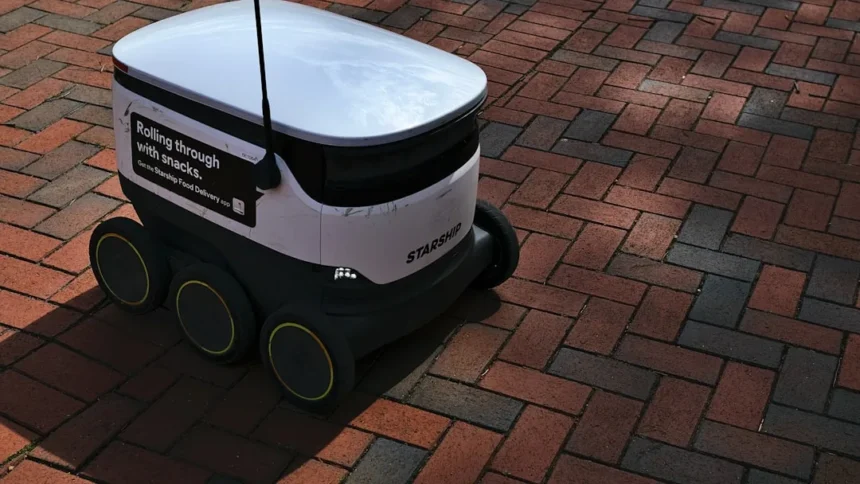
An autonomous delivery bot from a California startup is generating buzz in the logistics industry, but the cab-less vehicle represents a fundamentally different approach to last-mile delivery than what most companies are pursuing. The autonomous delivery bot concept challenges the assumption that autonomous vehicles must replicate traditional truck cabins, instead opting for a minimalist design purpose-built for cargo.
Key Takeaways
- California startup unveiled a cab-less autonomous delivery bot design for logistics
- The vehicle eliminates the driver cabin entirely, prioritizing cargo space and efficiency
- Autonomous delivery bots face regulatory and infrastructure challenges before market deployment
- Traditional autonomous truck developers are pursuing different design philosophies
- Last-mile delivery automation remains years away from mainstream adoption
Why the Autonomous Delivery Bot Design Matters
The autonomous delivery bot removes the cabin entirely, a radical departure from how established automakers envision autonomous trucks. Traditional approaches, pursued by companies developing autonomous semi-trucks and delivery vehicles, retain driver spaces or operator compartments even when human control is unnecessary. This startup’s autonomous delivery bot design prioritizes cargo capacity and operational efficiency over redundant infrastructure, suggesting the company is betting on full autonomy rather than a gradual transition period where human oversight remains common.
Removing the cabin reduces manufacturing complexity and vehicle weight, potentially lowering operating costs per delivery. The autonomous delivery bot’s minimalist architecture also means smaller turning radius and easier integration into urban environments where traditional trucks struggle. However, this design choice creates vulnerabilities. Without a cabin, the autonomous delivery bot lacks a protected space for electronics, batteries, or other critical systems that typically sit behind reinforced driver areas.
The Autonomous Delivery Bot Faces Real-World Obstacles
Regulatory approval represents the largest barrier for any autonomous delivery bot entering service. Most jurisdictions lack clear frameworks for fully driverless commercial vehicles operating on public roads. The autonomous delivery bot’s unusual shape and lack of traditional vehicle features may trigger additional scrutiny from safety regulators who are accustomed to evaluating human-operated trucks. Insurance companies have not yet developed pricing models for autonomous delivery bot operations, creating financial uncertainty for early adopters.

Infrastructure compatibility is another challenge. The autonomous delivery bot must navigate roads designed for human drivers, but it cannot communicate with traffic signals, pedestrians, or other vehicles in the way humans do. Weather presents a particular problem—heavy rain, snow, and fog degrade the lidar and camera systems that autonomous delivery bot navigation depends on. Urban environments with construction, parked cars, and pedestrians create edge cases that the autonomous delivery bot’s software may struggle to handle safely.
How the Autonomous Delivery Bot Compares to Alternatives
Traditional autonomous truck developers like Waymo and Aurora are building vehicles with cabs, arguing that redundancy and human oversight will be necessary during the transition to full autonomy. These companies are targeting long-haul trucking where autonomy can operate on highways with fewer variables. The autonomous delivery bot takes the opposite bet—it assumes last-mile delivery will be fully autonomous from day one, with no provision for human takeover. This is a higher-risk, higher-reward strategy that could either prove prescient or catastrophically naive depending on how quickly autonomous systems actually improve.



Smaller autonomous delivery platforms using wheeled robots and drones target sidewalk-level deliveries, avoiding road traffic entirely. Those systems operate at a different scale and risk profile than the autonomous delivery bot, which must share road space with cars and pedestrians. The autonomous delivery bot sits in an awkward middle ground—too large and complex for sidewalk systems, but lacking the redundancy and proven technology of traditional autonomous trucks.
When Will the Autonomous Delivery Bot Actually Launch?
The startup has not announced a specific deployment date or testing timeline. Without regulatory approval or partnerships with major logistics companies, the autonomous delivery bot remains a prototype. Even if the company secures permits for limited testing in California, scaling to commercial operations would require solving the regulatory and technical challenges outlined above. Industry observers estimate that fully autonomous last-mile delivery vehicles of any design are likely five to ten years away from mainstream use, assuming regulatory frameworks finally catch up.
The autonomous delivery bot’s success will depend on whether the company can demonstrate safety equivalent to human drivers in real-world conditions, secure insurance coverage, and convince regulators that a driverless commercial vehicle is acceptable. Those are not trivial hurdles. Many autonomous vehicle startups have overpromised and underdelivered timelines by years.
Is the autonomous delivery bot a real threat to trucking jobs?
Not immediately. The autonomous delivery bot would only affect last-mile delivery drivers if it reaches commercial deployment and proves cost-effective. That is at least five years away, and regulatory uncertainty could extend that timeline indefinitely. Human drivers will remain essential for most logistics operations during that period.



What makes the autonomous delivery bot different from other self-driving vehicles?
The cab-less design eliminates redundant infrastructure, prioritizing cargo space and manufacturing simplicity. Traditional autonomous vehicles retain driver areas even when fully autonomous, whereas the autonomous delivery bot assumes humans will never be needed on board. This is a philosophical and practical difference that affects everything from safety systems to cost structure.
Can the autonomous delivery bot handle bad weather?
Current autonomous systems struggle in heavy rain, snow, and fog because lidar and camera sensors degrade in those conditions. The autonomous delivery bot would face the same limitations as any autonomous vehicle. Heavy-weather operation remains an unsolved problem across the industry, not a unique weakness of this design.
The autonomous delivery bot represents genuine innovation in vehicle design, but innovation alone does not guarantee market success. The startup has built something that looks different and challenges conventional thinking about autonomous trucks. Whether that design translates into a viable commercial product depends on factors far beyond engineering—regulatory approval, insurance, real-world performance in edge cases, and ultimately whether the economics actually work. For now, the autonomous delivery bot is a bold bet that full autonomy is closer than most people think. The evidence suggests otherwise.
Edited by the All Things Geek team.
Source: TechRadar