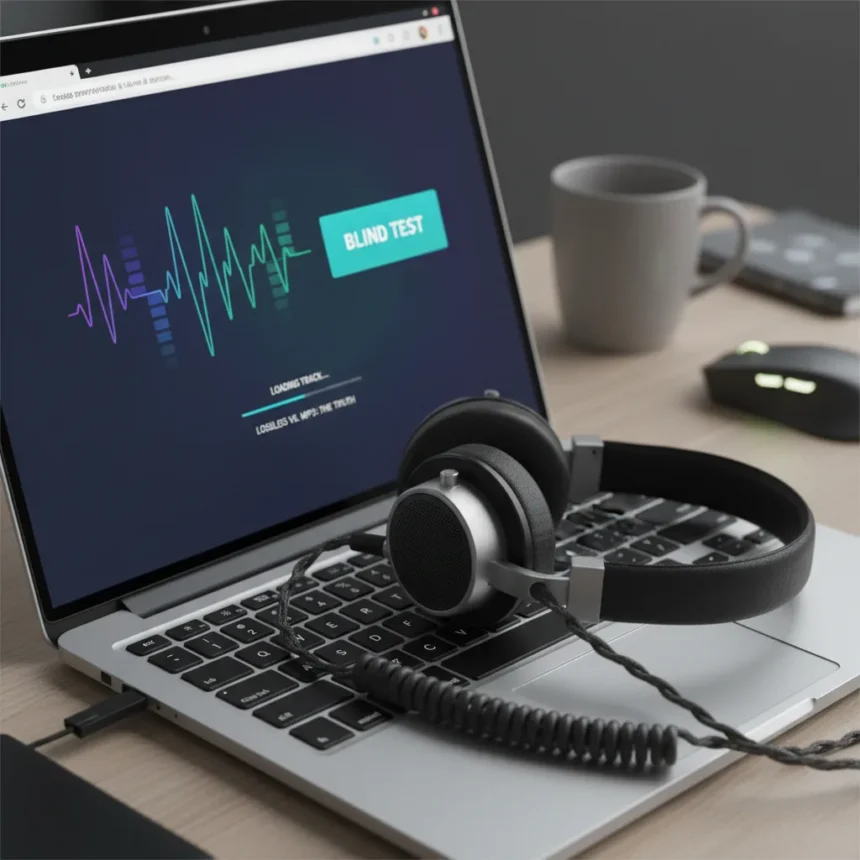
A lossless audio test built by a Redditor is quietly demolishing the audiophile claim that you can always hear the difference between lossless and lossy formats. The tool lets you upload your own FLAC file, automatically generates MP3 copies at four different bitrates, and switches between them mid-song with randomized labels so you don’t know which is playing.
Key Takeaways
- Free browser-based lossless audio test requires only a FLAC file and good playback equipment.
- Tool generates MP3s at 16kbps, 64kbps, 128kbps, and 320kbps for blind comparison.
- Both the tool creator and the article author failed to reliably distinguish higher bitrates from lossless.
- Famed producer Steven Wilson states he cannot hear differences between CDs and high-resolution audio.
- Sound engineers have long disputed claims that compressed audio differences are perceptible to human ears.
How the Lossless Audio Test Actually Works
The lossless audio test operates entirely in your browser with no cloud upload or third-party data collection. You supply a FLAC file—the lossless format that preserves every bit of the original recording—and the tool generates four lossy MP3 versions at increasingly higher bitrates. The interface randomizes the labels, so you’re comparing A, B, C, and D without knowing which is the uncompressed original.
The real trick is that switching happens mid-song without jumping back to the start. You can skip forward to a vocal passage, switch formats, and immediately hear the same moment in a different version. This excerpt-based approach is far more revealing than comparing full songs end-to-end, where your brain fills in gaps and memory plays tricks. The tool then reveals which version you were listening to, letting you see how often your ears actually matched your guesses.
For best results, the tool’s creator recommends using a decent DAC—whether a hi-fi system, powered speakers, a portable DAC, or quality wired headphones. Cheap earbuds or phone speakers will mask the differences you’re theoretically trying to hear, making the test pointless.


What Happens When Real People Take the Lossless Audio Test
The tool creator tested their own creation and failed spectacularly. After going through the blind comparison, they jokingly admitted: “turns out I’m deaf I guess” after being unable to distinguish between 128kbps MP3, 320kbps MP3, and the original FLAC file. This wasn’t a careless result—it was a careful, randomized test on their own equipment.
The article author who tried the lossless audio test reported similar findings. Even with good playback gear and careful listening, they couldn’t reliably hear differences at higher bitrates. The 16kbps and 64kbps versions were obviously degraded—tinny, compressed, lifeless. But once you hit 128kbps and above, the differences became murky. Sometimes the MP3 sounded identical to lossless. Sometimes a subtle harshness emerged, but was it real or imagined?



This uncertainty is the opposite of what audiophile forums claim. The lossless audio test doesn’t prove you’re deaf—it proves that human hearing has limits, and those limits are closer to 128kbps than the audio industry wants to admit.
What the Numbers Actually Say About Lossless Audio
CD-quality audio runs at roughly 1,400 kilobits per second using 16-bit depth and a 44.1 kHz sample rate. None of the MP3 options in the lossless audio test reach that threshold. The highest bitrate available is 320kbps, which is less than a quarter of CD quality.
Yet here’s the uncomfortable part: even comparing FLAC lossless files to 320kbps MP3 proved difficult for the tool creator and the article author. If you can’t hear the gap between lossless and 320kbps in a blind test, why would you pay extra for lossless streaming when 320kbps lossy MP3 is substantially cheaper or unavailable on most platforms?
Famed music producer Steven Wilson, whose work spans progressive rock and high-resolution audio mastering, stated plainly: “I can’t tell the difference between CDs and high-res audio any more.” Wilson isn’t a casual listener—he’s spent decades in studios listening to the finest equipment money can buy. If someone with his trained ear can’t distinguish the formats, the lossless audio test results start to make sense.


Why Sound Engineers Have Doubted This for Decades
The lossless audio test didn’t invent skepticism about format differences. Sound engineers have long claimed that differences between high-quality compressed audio and lossless formats are imperceptible to human listeners. The science of psychoacoustics—how humans actually perceive sound—suggests that once you reach a certain bitrate threshold, further increases don’t translate to audible improvements.
The lossless audio test makes this abstract claim concrete. You can test it yourself on music you actually listen to, on your own equipment, without anyone telling you what to hear. That’s dangerous for the audiophile industry, which has built an entire ecosystem around the promise that lossless audio is objectively better and that trained ears can detect the difference.
Tidal offers a similar blind test at test.tidalhifi.com, comparing 320kbps AAC lossy audio against FLAC CD-quality lossless. The existence of these tools suggests that even streaming services know their claims about format superiority need independent verification.
What the Lossless Audio Test Means for Your Listening
If you can’t hear the difference in a blind lossless audio test, does that mean lossless is pointless? Not entirely. Lossless files preserve the original recording exactly, which matters for archival purposes and for people who want to re-encode or process audio later. If you’re a musician, sound engineer, or producer, lossless is non-negotiable.
For casual listeners, the picture is murkier. Streaming services like Apple Music and Tidal HiFi now offer lossless audio as a selling point. But if the lossless audio test reveals you can’t hear the difference at bitrates above 128kbps, paying extra for lossless might be money spent on a placebo effect rather than an audible improvement.
The lossless audio test also highlights the importance of equipment. A cheap Bluetooth speaker will destroy any format advantage before it reaches your ears. If your playback chain is weak, the format war becomes academic.
Can you really tell the difference in a lossless audio test?
Most people cannot reliably distinguish lossless FLAC from high-bitrate MP3 (320kbps and above) in a blind lossless audio test, according to both the tool creator and the article author’s own results. Lower bitrates like 64kbps and 128kbps are noticeably degraded, but the gap narrows dramatically at higher compression levels.
What bitrate do I need for lossless audio quality?
CD-quality audio requires approximately 1,400 kilobits per second at 16-bit/44.1 kHz. The lossless audio test’s highest MP3 option is 320kbps, which is less than a quarter of that standard. However, blind testing suggests most listeners struggle to hear differences above 128kbps in real-world conditions.
Do I need expensive equipment to hear lossless audio differences?
Yes. The lossless audio test creator recommends a decent DAC, quality wired headphones, powered speakers, or a hi-fi system for meaningful results. Cheap Bluetooth earbuds or phone speakers will mask any format differences before the sound reaches your ears, making the test pointless on poor equipment.
The lossless audio test cuts through years of audiophile marketing and reveals a simpler truth: most listeners, even with good equipment, cannot consistently hear the difference between lossless and high-bitrate lossy formats in blind testing. That doesn’t mean lossless is worthless—it means the gap between theory and perception is wider than the audio industry admits. If you’re curious where your own ears stand, the test is free and private. Upload a FLAC file, randomize the playback, and find out whether you’re actually hearing differences or just hearing what you expect to hear.
Edited by the All Things Geek team.
Source: TechRadar