






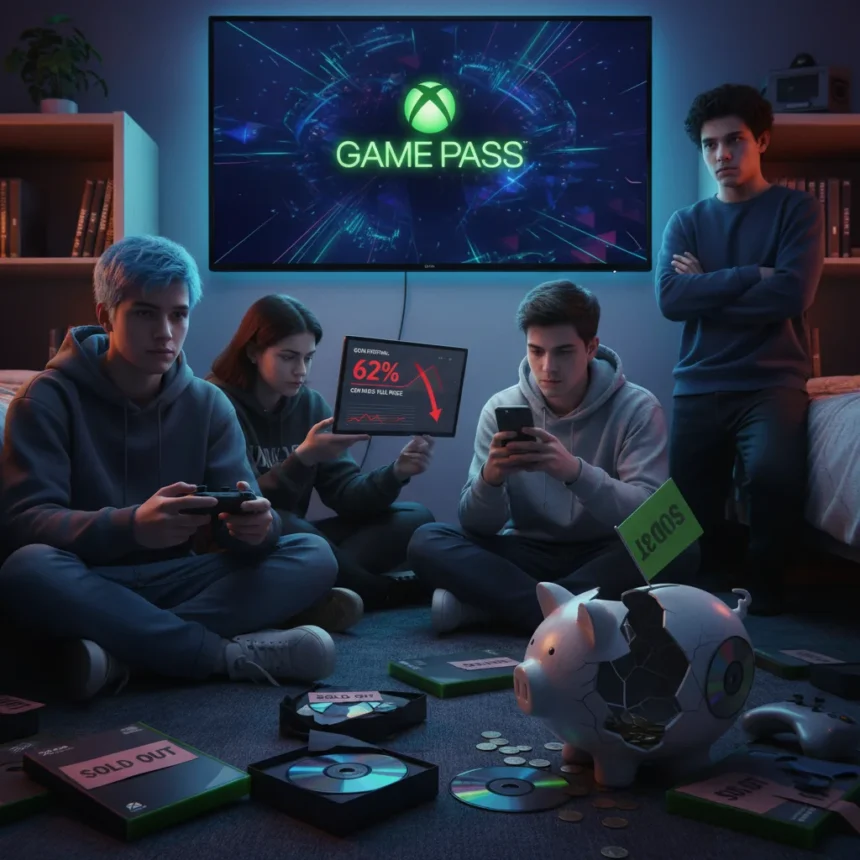
The Gen Z gaming spending shift is reshaping how the entire industry thinks about monetization. A new study found that 62% of Gen Z won’t pay full price for video games, signaling a rejection of the $70–$80 AAA pricing model that publishers have defended for years.
Key Takeaways
- 62% of Gen Z refuse to pay full price for video games, choosing subscriptions instead
- Xbox Game Pass costs $360 annually, nearly equivalent to five new AAA games at $70 each
- Xbox CEO’s leaked memo admits Game Pass has become too expensive for players
- Gaming is the discretionary spending category Gen Z has cut most aggressively
- Amazon Luna and other cloud services are positioning themselves as cheaper alternatives
The Gen Z Gaming Spending Shift Is Real
The data is unambiguous. Beyond the 62% resistance to full-price games, 71% of Gen Z have stopped buying physical music, and 70% no longer purchase physical media at all. But gaming stands out as the discretionary spending category Gen Z has cut back on most—more than clothing, furniture, or entertainment subscriptions. This isn’t price sensitivity in isolation; it’s a generational rejection of the premium pricing tier itself.
What makes this shift significant is the timing. Publishers spent years justifying $70 and $80 price tags as necessary for development costs. Gen Z’s response has been simple: we’ll buy elsewhere. The Gen Z gaming spending shift reveals that the traditional full-price model no longer competes on value perception, even when the math says it should.
Why Game Pass Suddenly Looks Reasonable
Here’s where the pricing math gets interesting. Five AAA games at $70 each cost approximately $350. Xbox Game Pass costs $360 annually. On pure unit economics, Game Pass is nearly price-equivalent—yet it offers hundreds of titles instead of five. That advantage should make Game Pass an obvious choice. Instead, the service is struggling with its own pricing perception.



Xbox CEO Asha Sharma acknowledged the problem in a leaked memo: Game Pass has become too expensive for players. The service saw a 50% price increase to $30 per month in the last year, pricing it beyond what many Gen Z players consider reasonable for a subscription. The irony is sharp: Game Pass was designed to capture price-sensitive gamers, yet it has drifted into premium pricing territory itself. If Game Pass—the subscription alternative to full-price games—is now too expensive, what does that say about the industry’s entire value proposition?
The Subscription Stacking Problem Nobody Talks About
Gen Z gamers don’t live in a world where they buy only Game Pass. They also consider PlayStation Plus, cloud gaming services, and other entertainment subscriptions. Stack Game Pass at $360 per year with PlayStation Plus and other services, and the annual cost balloons well beyond $700. That’s not a subscription; that’s a second mortgage.


Amazon Luna is repositioning itself with a newly revamped cloud gaming service, betting that players will abandon traditional subscriptions for a cheaper alternative. Luna’s pitch is simpler: lower barrier to entry, no console required, cloud-based access. Whether Luna succeeds or not, its existence proves that competition on price is intensifying. The Gen Z gaming spending shift has created an opening for services that undercut Game Pass.
What Happens to AAA Games?
The Gen Z gaming spending shift doesn’t mean AAA games disappear. It means they move to Game Pass faster, their retail price drops quicker, or they’re bundled into subscription tiers at launch. Publishers will resist this transition—it flattens revenue per player. But Gen Z has already voted with their wallets. If a game isn’t on a subscription service within months of launch, a significant portion of the target audience simply won’t buy it at full price.
The real winners in this shift are AA and indie developers. These studios have never relied on $70 price tags. They thrive on Game Pass, where a $20 game reaches millions of players instantly. As Gen Z gravitates toward subscription services, mid-tier and independent games become the default experience, not the alternative.
Is the $25 Game Pass price floor real?
Speculation exists around a potential $25-per-month Game Pass tier, positioning it as a reduction from the current $30 pricing. If Xbox moves to $25, it signals acknowledgment that the current model has failed to resonate with price-conscious players. However, this remains unconfirmed speculation rather than official policy. What’s certain is that the Gen Z gaming spending shift has forced Xbox to reconsider whether its current pricing is sustainable.


What does this mean for console gaming’s future?
The Gen Z gaming spending shift is not a temporary trend—it’s a structural change in how younger players perceive gaming value. Consoles sold at a loss with the expectation of software sales no longer works if software is consumed via subscription. Hardware margins compress. Game Pass becomes the primary revenue driver. Publishers lose the upfront revenue spike from launch-day sales.
This is why the leaked memo from Xbox’s CEO matters. It’s not just about Game Pass pricing; it’s about the entire console ecosystem’s viability. If Gen Z won’t pay for games, and subscriptions can’t sustain current pricing, then the business model that funded AAA development for two decades is broken. The industry is scrambling to find the next model before it’s too late.
The Gen Z gaming spending shift has already won. The question now is whether publishers, platform holders, and subscription services can adapt fast enough to survive it.
Edited by the All Things Geek team.
Source: Windows Central