





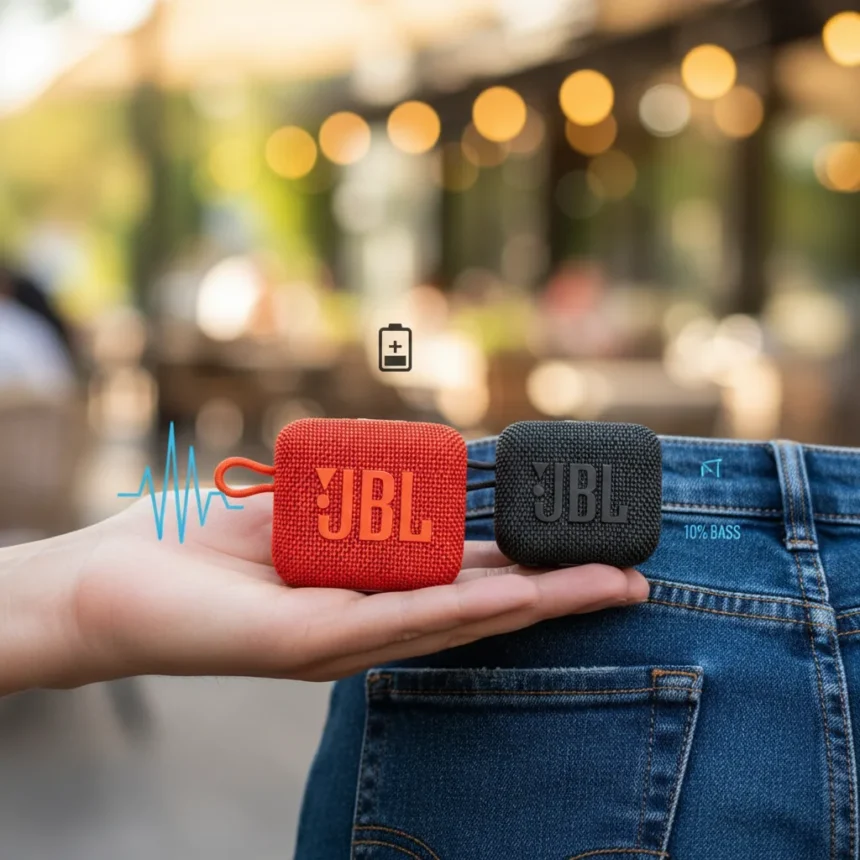
The JBL Go 5 pint-sized pocket speaker is a compact Bluetooth speaker made by JBL, recently launched as the successor to the Go 4, priced at $49.95 (£39.99 in the UK), and available globally at major retailers. After testing dozens of budget portable speakers, this tiny device stands out as the best value under $50—not because it reinvents the category, but because JBL nailed the incremental upgrades that matter most to people who actually use these things daily.
Key Takeaways
- JBL Go 5 delivers 10% more bass and 10% higher volume than the Go 4 predecessor.
- Battery life extends by 1 hour over Go 4, plus a new EQ preset adds 2 more hours of listening time.
- Tap two Go 5 speakers together for stereo pairing without requiring an app.
- Rugged, waterproof design matches JBL’s outdoor speaker durability standards.
- At $49.95, it matches Go 4 pricing while outperforming the previous generation.
The JBL Go 5 Pint-Sized Pocket Speaker Fixes What the Go 4 Got Wrong
The Go 4 was already a solid pick for pocket-sized audio, praised for punchy, clear sound and a waterproof build. But it had friction points. Stereo pairing required an app. Battery life, while decent, felt short on extended trips. The volume ceiling was respectable but not commanding. JBL addressed all three with the Go 5.
The upgrades sound modest on paper—10% more bass, 10% higher volume—but in real use, they matter. A speaker that already sounded clear now has warmth. One that was adequately loud is now genuinely impressive for its size. The battery bump is more substantial than the spec sheet suggests. JBL claims an extra hour of runtime, plus a new EQ preset called PlaytimeBoost that extends listening by another 2 hours. That’s not marketing fiction; it’s a real feature built into the companion app.
Stereo pairing is the killer feature nobody asked for but everyone wants. Tap two Go 5 speakers together and they sync instantly for stereo playback—no Bluetooth menu hunting, no app fumbling, no pairing codes. For people buying a second unit to double their sound, this alone justifies the upgrade.


How the JBL Go 5 Compares to Rivals in the Under-$50 Space
The Go 5 does not compete in isolation. The Tribit StormBox Micro 3 sits at $64.99 (£62.99 in the UK) and offers 24-hour battery life, 13W output, and military-grade drop resistance. It is a legitimate alternative if you prioritize extreme durability and all-day listening. But it is bulkier, costs 30% more, and lacks the Go 5’s simplicity. For true pocket portability, the Go 5 wins.
The JBL Clip 5 and JBL Grip occupy nearby niches. Both offer longer battery life (12 hours) and rugged designs, but they cost more and solve different problems. The Clip 5 is for minimalists who want something tiny to attach to a bag. The Grip is for people who prioritize high-volume playback for podcasts and outdoor activities. The Go 5 is for everyone else—the person who wants a speaker that fits in a pocket, sounds good, lasts long enough, and does not require a PhD to pair.



Design, Durability, and Real-World Performance
Pint-sized does not mean fragile. The Go 5 inherits the rugged, waterproof build quality that JBL’s outdoor speakers are known for, matching IP rating standards and surviving drops, splashes, and beach sand. This is not a speaker you babysit; it is one you throw in a backpack and forget about until you need it.
The companion app is feature-rich without being bloated. You get EQ adjustment, stereo pairing controls, Auracast support for linking with other JBL speakers, and PlaytimeBoost for battery extension. If you hate apps, you can ignore all of this and just press play. The speaker works fine without the app. But the app exists if you want to tweak things.
At $49.95, the Go 5 matches the Go 4’s price point while delivering measurable improvements. That is rare in consumer tech. Most upgrades come with a price bump. JBL kept the cost the same and added value. For budget shoppers, that is the difference between a good purchase and a no-brainer.
Should You Upgrade from the JBL Go 4?
If you already own a Go 4, the upgrade is optional. The Go 4 is still an excellent speaker. But if you are buying new, the Go 5 is the smarter choice. The extra bass, louder volume, longer battery, and tap-to-pair stereo justify the modest jump in capability. You are not paying more; you are just getting more.



The real question is whether the Go 5 is worth buying instead of the Tribit StormBox Micro 3 or waiting for a sale on something pricier. The answer depends on your priorities. If you want maximum battery life and durability, go Tribit. If you want the smallest, lightest speaker that still sounds good and lasts a reasonable time, the Go 5 is unbeatable. For most people, that is the right call.
Is the JBL Go 5 worth the upgrade from the Go 4?
Yes, if you are buying new. The 10% bass and volume increase, longer battery with EQ boost, and tap-to-pair stereo make the Go 5 a noticeably better speaker at the same $49.95 price. If you already own a Go 4, upgrading is optional unless you specifically want stereo pairing or the extra battery life.
How does the JBL Go 5 battery life compare to competitors?
The Go 5 adds 1 hour over the Go 4 and includes a PlaytimeBoost EQ preset for 2 additional hours. The Tribit StormBox Micro 3 offers 24-hour battery life, which is double the Go 5, but costs $15 more and is bulkier. For pocket-sized speakers in the same size class, the Go 5’s battery is competitive.
Can you pair two JBL Go 5 speakers for stereo?
Yes. Simply tap two Go 5 speakers together and they sync for stereo playback without requiring an app or manual pairing. This is one of the Go 5’s standout features and a major upgrade over the Go 4’s app-dependent stereo pairing.
The JBL Go 5 pint-sized pocket speaker proves that you do not need to spend a fortune on portable audio to get something genuinely good. At under $50, it delivers better bass, louder volume, longer battery, and smarter pairing than its predecessor while staying at the same price. For anyone who values portability, durability, and simplicity over premium features, it is the speaker to buy.
Where to Buy
$54.95 at Amazon | $54.95 at Amazon | $54.95 at Amazon
Edited by the All Things Geek team.
Source: TechRadar