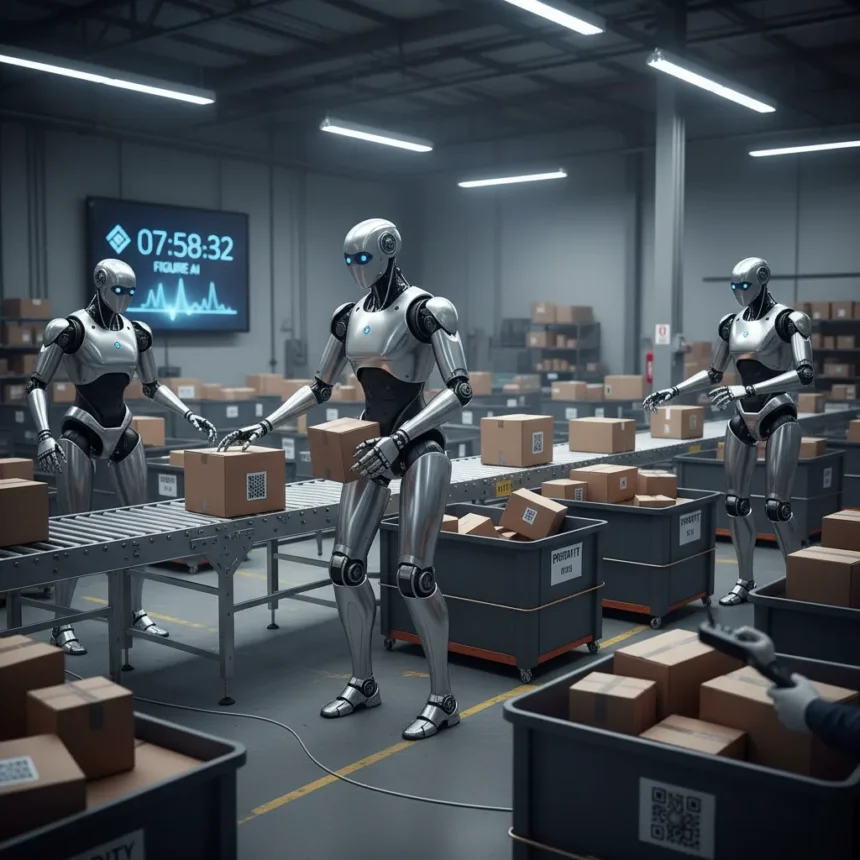
Humanoid robot autonomy just hit a milestone that Figure AI wants the world to celebrate—and scrutinize. The Silicon Valley startup livestreamed its Figure 03 humanoid robots sorting packages for a full 8-hour shift, powered by the Helix-02 AI system, with CEO Brett Adcock claiming the robots operated at human performance levels without human intervention. But the internet’s reaction split between awe and skepticism, with viewers questioning whether the demo was genuinely autonomous or a carefully orchestrated performance.
Key Takeaways
- Figure AI livestreamed humanoid robots completing an 8-hour warehouse shift autonomously, up from 1-hour tests just months prior.
- Robots processed packages at 4.05–4.31 seconds each, approaching the ~3-second human baseline while maintaining accuracy.
- Multi-robot failover system: robots self-diagnose issues and autonomously request replacements without human intervention.
- Barcode scanning success improved to ~95% correct orientation, up from ~70% in earlier iterations.
- Skeptics flagged the demo as potentially staged, with questions about hidden teleoperation or selective editing during the livestream.
What Figure AI Claims About Humanoid Robot Autonomy
Figure AI’s humanoid robot autonomy demonstration centers on three core claims: full autonomy, human-level performance, and scalability. Adcock posted on X that the robots were “running a full 8-hr shift at human performance levels. This is fully autonomous running Helix-02”. The robots handled varied package types—rigid boxes, deformable poly bags, and flat envelopes—with adaptive behaviors like gently patting plastic mailers to flatten wrinkles for better barcode reads. The livestream showed three robots taking turns, with one robot walking up and assuming sorting duties at the 1-hour mark, suggesting a coordinated fleet rather than a single machine.
The performance metrics are the headline story. Humans process packages in roughly 3 seconds each; Figure’s robots achieved 4.05–4.31 seconds per package, representing a ~20% speed improvement from earlier ~5-second cycles while maintaining accuracy. Barcode scanning success climbed to ~95% correct orientation, a sharp jump from the ~70% baseline in earlier tests. By the 1-hour mark alone, the robots had sorted at least 1,500 packages, according to YouTube analysis. These numbers suggest rapid progress: the previous testing limit was 1 hour of continuous operation, and Figure scaled to 8 hours in just three months.
The Failover System and Autonomous Decision-Making
A lesser-known but critical component of the humanoid robot autonomy claim is the multi-robot failover architecture. Adcock explained the system’s logic: “If a robot detects an issue — it will self diagnose itself and if there’s an issue it autonomously walks to maintenance and requests a replacement from the fleet — no humans in the loop”. This is not a simple error-handling routine. The robot must detect a problem, diagnose its severity, navigate to a maintenance station, and request a replacement from the available fleet—all without human instruction. If true, this represents a step beyond individual robot autonomy into fleet-level coordination.



The livestream did not clearly show this failover in action, which is both a limitation and a reason for skepticism. Viewers analyzing the YouTube clips noted no visible signs of teleoperation, but the absence of evidence is not evidence of absence. Without independent observation of the failover system or third-party validation, the claim remains an engineering assertion rather than a verified capability.
Why Skeptics Are Not Convinced
The skepticism surrounding the humanoid robot autonomy demo centers on three points: selective editing, hidden teleoperation, and the lack of independent verification. YouTube analyses of the livestream found no obvious signs of remote control, yet commenters flagged the possibility of off-camera intervention or edited segments that masked human control. An 8-hour livestream is long, but livestreams can be edited, paused, or restarted without viewers noticing if the edits are seamless. The fact that Figure chose to livestream rather than invite independent observers raises a red flag for skeptics who expect third-party validation of breakthrough claims.



The promotional framing also matters. Brett Adcock’s X post and Figure’s blog announcement emphasize the achievement without acknowledging limitations or failure rates during the 8-hour run. Did any robots malfunction? Did the failover system actually activate? How many packages were rejected or mishandled? These details are absent from the public narrative, which is typical of company announcements but atypical of peer-reviewed research or independent testing. The skepticism is not that the robots failed—it is that the company’s presentation is incomplete.
Humanoid Robot Autonomy vs. Traditional Industrial Automation
The humanoid robot autonomy claim gains context when compared to traditional bolted-down industrial robots. Conventional warehouse automation relies on fixed arms mounted to conveyor systems, with carefully choreographed motion sequences and minimal variation tolerance. Figure’s humanoid robots, by contrast, move freely, adapt to different package shapes, and coordinate as a team. This is a fundamentally different category of machine—mobile, flexible, and capable of handling unstructured tasks.
However, this flexibility comes with a cost: reduced predictability and higher failure rates in real-world conditions. A bolted-down robot can run the same operation 10,000 times with identical precision. A humanoid robot must interpret its environment, make decisions, and adjust its grip strength based on package material. The fact that Figure’s robots achieved 4.05–4.31 seconds per package—within 35% of human speed—is genuinely impressive, but it is not yet a replacement for human workers in unpredictable environments. The 8-hour demo proves that humanoid robot autonomy can sustain a controlled task, not that it can handle the chaos of a real warehouse.
What This Means for the Robotics Race
Figure AI’s livestream is a signal, not a solution. The company demonstrated that humanoid robot autonomy can scale from 1-hour tests to 8-hour shifts in three months—a pace that suggests either rapid engineering progress or aggressive claims. The Helix-02 AI system, which powers the robots, is clearly the bottleneck and breakthrough. Without knowing how Helix-02 works—whether it uses large language models, reinforcement learning, or classical robotics algorithms—it is hard to assess how replicable Figure’s approach is or how quickly competitors can catch up.


The livestream also reveals what investors want to see: a roadmap from prototype to production. Figure is not claiming the robots are ready for deployment tomorrow. Rather, the company is showing that the engineering path from 1-hour demos to 8-hour shifts is real, not theoretical. For venture capital and enterprise customers evaluating Figure’s commercial potential, this is the key message. Skepticism about full autonomy is warranted, but dismissing the progress as fake is equally unfair.
Is Figure AI’s humanoid robot autonomy claim credible?
The claim is partially credible but incomplete. Figure demonstrated that robots can execute a warehouse task for 8 hours with minimal human intervention—that much is real. Whether the system is “fully autonomous” depends on how you define autonomy. If it means no human touches the robots during the 8-hour run, the claim holds. If it means the robots made all decisions without any pre-programming or remote oversight, the claim is harder to verify and likely false.
How does Figure AI’s robot speed compare to human workers?
Figure’s robots process packages in 4.05–4.31 seconds each, compared to the ~3-second human baseline. This means robots are roughly 35% slower than humans but approaching parity. The gap narrows further when considering that humans take breaks, vary in performance, and require wages; robots can run continuously and cost nothing to operate per hour once deployed.
What happens if a Figure robot breaks down during a shift?
According to Figure, the robot self-diagnoses the issue, walks to maintenance, and requests a replacement from the fleet without human intervention. This failover system is central to the humanoid robot autonomy claim, but it was not visibly demonstrated in the 8-hour livestream, leaving the capability unverified by independent observers.
Figure AI’s 8-hour robot demo is a genuine engineering achievement wrapped in promotional language and skepticism. The robots worked. They sorted packages. They lasted the full shift. But the question of whether they were truly autonomous or expertly controlled remains open. The company has shown the direction of progress; it has not yet proven that humanoid robot autonomy is ready for the real world.
Edited by the All Things Geek team.
Source: TechRadar