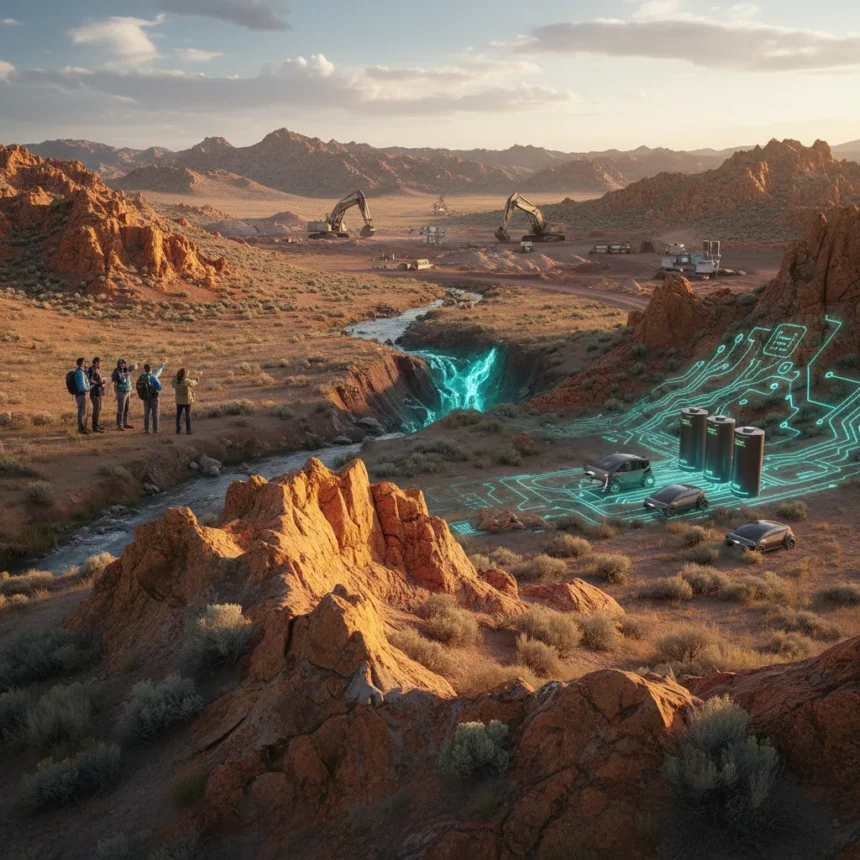
The Oregon lithium deposit represents one of the largest lithium discoveries ever identified in the United States, with an estimated in-ground value of approximately $1.5 trillion. Located beneath the McDermitt Caldera near the Oregon-Nevada border, this vast cache of lithium-rich claystone could fundamentally reshape how America manufactures batteries for smartphones, electric vehicles, and grid storage. The find arrives at a critical moment: as global demand for lithium surges and supply-chain vulnerabilities expose US dependence on foreign sources, domestic production could offer strategic independence. Yet the deposit sits atop sensitive high-desert ecosystems and lands of cultural significance, triggering fierce debate between economic opportunity and environmental protection.
Key Takeaways
- The Oregon lithium deposit is valued at approximately $1.5 trillion in-ground worth.
- The deposit lies beneath the McDermitt Caldera, an ancient volcanic basin near the Oregon-Nevada border.
- Domestic lithium production could reduce US reliance on foreign battery supply chains.
- Environmentalists and local communities oppose rapid development due to ecological and cultural risks.
- Mining claystone deposits is more complex than extracting lithium from salt brines in South America.
Why the Oregon lithium deposit matters for US manufacturing
Securing lithium domestically addresses a structural vulnerability in American manufacturing. Currently, the US imports the vast majority of refined lithium and battery components, leaving domestic electronics and EV production dependent on global supply chains that span from South America to China. A large-scale Oregon operation would enable US companies to build batteries closer to factories and consumers, reducing transportation costs, lead times, and geopolitical risk. For smartphones, data-center infrastructure, and military applications, domestic lithium means less exposure to supply shocks or trade restrictions.
The $1.5 trillion valuation reflects the sheer scale of the deposit. This is not speculative geology—the resource sits in proven claystone formations with documented lithium content. Yet valuation and actual recovery are different things. The figure represents in-ground potential, not guaranteed profit or production timeline. Mining, refining, and bringing lithium to market requires years of permitting, infrastructure investment, and technological execution. The deposit could reshape battery economics if developed, but development itself remains uncertain.
Environmental and cultural opposition to rapid extraction
Environmentalists and local communities have raised serious concerns about mining the McDermitt Caldera. The area supports sensitive wildlife, including sage-grouse and pronghorn antelope, and contains water resources crucial to the high-desert ecosystem. Indigenous groups have flagged cultural and spiritual significance of the caldera landscape. Large-scale mining of claystone—unlike brine extraction in South America’s salt flats—requires extensive earthmoving, processing facilities, and water management that could disrupt habitat and contaminate groundwater.


These are not hypothetical risks. Mining operations of this scale generate dust, noise, and chemical runoff. The caldera’s hydrology is delicate; disrupting it could harm the broader region’s water supply. Proponents argue that domestic lithium production is essential for clean energy and American competitiveness, but opponents counter that sacrificing an irreplaceable ecosystem for battery minerals repeats historical patterns of resource extraction that prioritize short-term gain over long-term sustainability. The tension is genuine and unresolved.
Oregon lithium deposit versus foreign supply chains
The deposit’s strategic importance becomes clear when compared to existing global sources. South America dominates current lithium production through salt-brine extraction in Chile, Argentina, and Bolivia—a method cheaper and less disruptive than claystone mining but geographically concentrated and politically unreliable. Australia mines hard-rock lithium but exports most of it to China for processing. By contrast, an Oregon operation would allow the US to control extraction, refining, and battery manufacturing within its borders, reducing reliance on countries that may restrict exports or demand higher prices.



However, this advantage comes with a cost. Claystone mining is more complex and energy-intensive than brine extraction, which means higher production costs and potentially higher environmental impact per ton of lithium recovered. The US would gain supply independence but not necessarily cost leadership. For manufacturers choosing between cheap foreign lithium and more expensive domestic supply, the decision hinges on whether they value security and sustainability over raw price—a calculation that varies by industry and market.
What happens next with the Oregon deposit?
The discovery does not automatically trigger mining. Federal and state permits, environmental reviews, and public hearings will determine whether extraction ever begins. Companies interested in developing the deposit must navigate complex regulatory frameworks designed to protect water, wildlife, and cultural resources. Permitting alone could take years. Even if approved, financing and building a large-scale mining and refining operation requires billions of dollars and decades of operation to justify the investment.
Political will matters too. A federal government committed to domestic battery production might fast-track permits; one prioritizing environmental protection might block them. The outcome will likely reflect a compromise—limited mining in certain zones, strict environmental controls, revenue-sharing with local communities, and investment in restoration. The deposit’s value is real, but so are the obstacles to realizing it.
Could the Oregon deposit change global lithium markets?
If fully developed, the Oregon lithium deposit could add significant supply to global markets, potentially moderating prices and reducing scarcity concerns that have driven EV and battery costs upward. Lower lithium costs would accelerate adoption of electric vehicles and renewable energy storage worldwide. However, this outcome depends on successful mining, refining, and export—not guaranteed given the complexities involved. More likely, the deposit becomes one of several new sources (including other US finds, Australian expansions, and emerging operations in Africa) that collectively ease supply constraints without dramatically upending global markets.



Is the Oregon lithium deposit definitely going to be mined?
No. The deposit’s existence and value are well-documented, but mining requires permits, financing, and public acceptance. Environmental reviews and community opposition could block or significantly delay development. Even if approved, economic factors—lithium prices, mining costs, and availability of competing sources—will influence whether companies actually invest in extraction.
How does the Oregon deposit compare to other US lithium sources?
The Oregon deposit is among the largest ever identified in the US, but it is not alone. Other lithium-bearing formations exist in Nevada, California, and other western states. However, the McDermitt Caldera’s size and concentration make it strategically significant. If developed alongside other domestic sources, it could substantially reduce US import dependence.
What are the main environmental risks of mining the Oregon deposit?
Large-scale claystone mining could disrupt water supplies, harm wildlife habitat, generate air pollution, and damage cultural sites. The high-desert ecosystem is fragile, and mining operations would introduce industrial infrastructure into a relatively pristine landscape. Mitigation is possible but requires strict oversight and significant investment in restoration.
The Oregon lithium deposit embodies a genuine dilemma: economic security versus environmental stewardship. The US needs domestic lithium to build batteries and compete globally, but mining the McDermitt Caldera carries real ecological costs. The path forward requires honest assessment of both the opportunity and the risks, not cheerleading for extraction or reflexive opposition to development. How policymakers and companies navigate this tension will shape not just US battery production but also the precedent for balancing resource security with environmental protection in the clean-energy transition.
Edited by the All Things Geek team.
Source: TechRadar