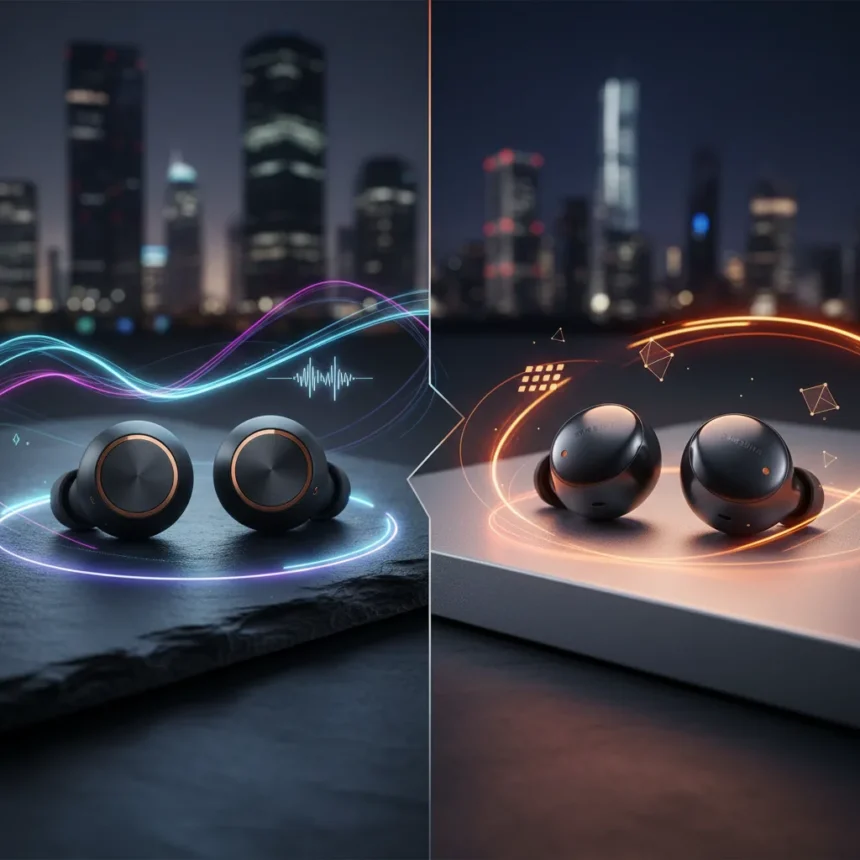
Sony WF-1000XM6 vs Samsung Galaxy Buds 4 Pro is not a straightforward win-or-lose matchup—it’s a story of two earbuds built for different priorities. Sony’s $330 WF-1000XM6 leads in audio fidelity and noise cancellation, while Samsung’s Galaxy Buds 4 Pro dominate if you live inside the Galaxy ecosystem. The real question is which tradeoff aligns with how you actually listen.
Key Takeaways
- Sony WF-1000XM6 deliver superior ANC and audio quality with LDAC codec support.
- Samsung Galaxy Buds 4 Pro excel in ecosystem integration with Auto Switch across Galaxy devices.
- Sony offers 8 hours of playback with ANC on; Samsung delivers 6 hours with ANC on.
- Sony supports both Android and iOS; Samsung Galaxy Buds 4 Pro require Android.
- Sony charges at $330; Samsung’s pricing positions it as a direct competitor in the premium space.
Sound Quality and Codec Support: Where Sony Pulls Ahead
The Sony WF-1000XM6 vs Samsung Galaxy Buds 4 Pro comparison reveals a clear audio hierarchy. Sony’s 8.4mm driver paired with LDAC codec support gives it a technical advantage for audiophiles who stream high-resolution content. LDAC preserves roughly three times more data than standard Bluetooth codecs, translating to noticeably richer detail in vocals and instruments. Samsung’s 2-way driver system—an 11mm Super Wide Woofer plus 5.5mm Planar Tweeter—is engineered for a different approach: a wider soundstage and punchier bass presentation. Both philosophies have merit, but Sony’s LDAC support is a feature Samsung cannot match. Samsung does offer SSC HiFi and SSC UHQ codecs, but these are restricted to Samsung devices, limiting their utility for cross-platform listeners.
Sony also includes DSEE Extreme, which upscales compressed audio in real time. This matters if you stream from Spotify or YouTube Music, where most listeners spend their time. The 10-band EQ in Sony’s app gives you surgical control over the sound signature, while Samsung‘s 9-band EQ is nearly equivalent but locked to Android-only devices. For someone bouncing between an iPhone for work and an Android phone for personal use, Sony’s dual-platform support is invaluable.
Noise Cancellation: Sony’s Strongest Card
Sony WF-1000XM6 vs Samsung Galaxy Buds 4 Pro becomes most lopsided when comparing active noise cancellation. Sony claims 25% better noise cancellation than the previous XM5 generation, targeting real-world distractions like voices and chatter. The improvement is tangible in open offices and public transit, where human speech is the primary noise culprit. Sony’s 8 microphones (versus Samsung’s 6) allow for more precise ambient sound capture and faster ANC response. The result is a tighter, more controlled isolation that makes Samsung’s ANC feel slightly looser by comparison.



Samsung’s Galaxy Buds 4 Pro still deliver competent noise cancellation, but they prioritize a lighter touch. If you want complete isolation, Sony wins decisively. If you prefer to hear ambient sound when you need it, Samsung’s approach may feel less aggressive and fatiguing during extended wear. This distinction matters less for short commutes and more for eight-hour workdays.
Ecosystem and Convenience: Samsung’s Territory
Here is where Samsung Galaxy Buds 4 Pro reclaim ground. Auto Switch is a killer feature for Galaxy ecosystem loyalists—the earbuds instantly jump between your phone, tablet, and smartwatch without manual reconnection. If you own multiple Samsung devices, this alone justifies the purchase. Sony’s multipoint support works across any two Bluetooth devices, but it requires manual switching via the app, which is clunkier. Samsung’s onboard voice and gesture controls, including head gestures to answer or end calls, add convenience that Sony does not replicate. These small frictions compound over months of daily use.



The app experience mirrors this split. Samsung’s app is optimized for Galaxy devices with deeper integration into Samsung’s ecosystem. Sony’s app works on both Android and iOS, but neither platform gets the deep system-level hooks that Samsung enjoys on its own hardware. For someone committed to the Galaxy ecosystem, Samsung Galaxy Buds 4 Pro feel like a natural extension. For someone platform-agnostic, Sony’s broader compatibility is the safer bet.
Battery Life and Charging
Sony WF-1000XM6 deliver up to 8 hours of playback with ANC on, extending to 12 hours with ANC off, for a total of 30 hours with the case. Samsung Galaxy Buds 4 Pro offer 6 hours with ANC on and 7 hours with ANC off, reaching 26 hours total with the case. Sony’s advantage here is significant—two extra hours per charge translates to fewer mid-week charging sessions. Both support USB-C and wireless charging, which is standard for this price tier. Sony’s fast charging—5 minutes for 60 minutes of playback—is a practical edge for commuters who forget to charge overnight.
Design, Colors, and Physical Differences
Sony WF-1000XM6 come in Black and Platinum Silver, while Samsung Galaxy Buds 4 Pro offer Black, White, and Pink Gold (online exclusive). Both feature IPX4 waterproofing, suitable for sweat and light rain but not submersion. Sony’s industrial design is more understated, while Samsung’s is slightly more sculptural. Neither has a clear aesthetic advantage—this is personal preference territory. The real difference is that Samsung’s Pink Gold option appeals to buyers seeking distinctive color choices, whereas Sony’s palette is more conservative.
Frequently Asked Questions
Which earbuds have better microphone quality for calls?
Sony WF-1000XM6 have 8 microphones compared to Samsung’s 6, giving Sony a technical advantage for call clarity and wind noise rejection. If you take frequent calls in noisy environments, Sony’s extra microphones make a measurable difference.



Can you use Samsung Galaxy Buds 4 Pro with an iPhone?
No. Samsung Galaxy Buds 4 Pro require Android and do not officially support iOS. Sony WF-1000XM6 work smoothly on both Android and iOS, making them the choice for cross-platform users.
What is the price difference between these two earbuds?
Sony WF-1000XM6 retail for $330. Samsung Galaxy Buds 4 Pro pricing was not specified in the comparison, but both sit in the premium segment competing against AirPods Pro and Bose QuietComfort Ultra earbuds.
The Sony WF-1000XM6 vs Samsung Galaxy Buds 4 Pro decision hinges on a single question: do you prioritize audio quality and platform flexibility, or ecosystem convenience and gesture controls? If you stream high-resolution audio, switch between iOS and Android, or demand the best noise cancellation available, Sony wins. If you own multiple Galaxy devices and value seamless switching, Samsung delivers. Neither choice is wrong—they are simply optimized for different listeners.
Where to Buy
$328 at Amazon | $239.99 at Amazon
Edited by the All Things Geek team.
Source: Android Central