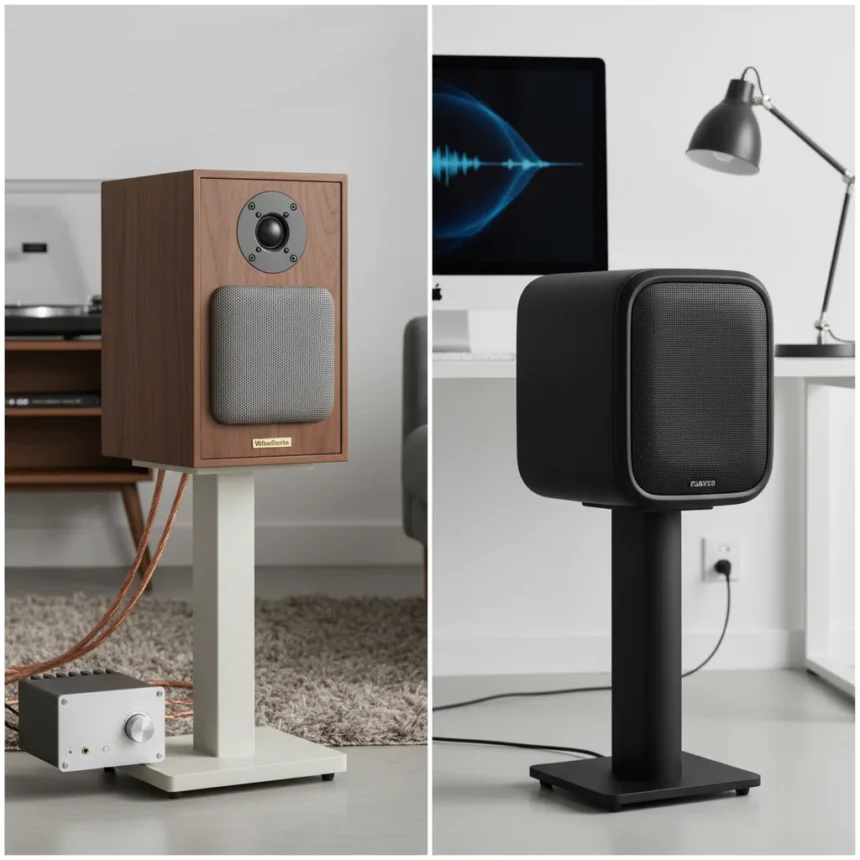
Two established hi-fi manufacturers have just announced curved stereo speakers that challenge the false choice between traditional passive hi-fi and all-in-one active systems. Wharfedale’s Denton 1S and Fyne Audio’s Cubit 5 represent fundamentally different philosophies for compact speaker design, giving buyers genuine options rather than compromises.
Key Takeaways
- Wharfedale Denton 1S is a passive speaker requiring a separate amplifier for operation.
- Fyne Audio Cubit 5 is an active speaker with built-in amplification and no external amp needed.
- Both speakers feature curved cabinet designs for aesthetic appeal and acoustic performance.
- The choice between passive and active determines your entire signal chain and room setup requirements.
- Curved stereo speakers from both brands aim to deliver powerful sound in compact form factors.
Passive vs Active: Understanding the Fundamental Difference
The split between Wharfedale’s Denton 1S and Fyne Audio’s Cubit 5 hinges on a single architectural decision: where amplification lives. The Denton 1S is a passive speaker, meaning it requires you to source a separate amplifier—whether that’s a vintage integrated amp, a modern Class D module, or a full receiver stack. This approach appeals to hi-fi enthusiasts who enjoy building systems, swapping components, and tailoring their signal chain to personal taste. Passive speakers historically offer flexibility that active designs cannot match. The Cubit 5, by contrast, is an active speaker with amplification built directly into the cabinet. You connect your source—a turntable, streamer, or DAC—directly to the speaker and you’re done. No amp hunt, no cable management nightmare, no second-guessing whether your amplifier matches your speakers’ impedance.
This architectural choice cascades through everything else: cost, setup complexity, upgrade path, and sound character. Passive speakers force you to make amplifier decisions independently, which can be daunting for newcomers but liberating for veterans. Active speakers remove that variable entirely, trading flexibility for simplicity. Neither approach is objectively superior—they serve different listeners with different priorities and different rooms.
Why Curved Stereo Speakers Matter Beyond Aesthetics
Both manufacturers emphasize curved designs, and this is not merely cosmetic. Curved stereo speakers offer acoustic advantages alongside visual appeal. The curved cabinet geometry can influence how sound disperses into a room, potentially reducing harsh reflections and standing waves that plague boxy speakers in small spaces. Curved designs also signal that these are not budget afterthoughts—they represent intentional engineering choices. For buyers tired of the ubiquitous rectangular speaker box, curved stereo speakers from Wharfedale and Fyne Audio suggest that compact hi-fi can be both sonically serious and visually distinctive.



The aesthetic dimension matters more than some audiophiles admit. A speaker spends its entire life visible in your room. If the curved stereo speakers from either brand appeal to your space, that emotional connection influences how often you actually listen to music rather than streaming passively in the background. Design and sound are not enemies—they reinforce each other when a product respects both.
Which Curved Stereo Speaker Suits Your Situation?
Choose the Wharfedale Denton 1S if you already own an amplifier, enjoy exploring amplifier options, or plan to build a multi-source system over time. Passive speakers reward patient system builders who view their hi-fi as an evolving project rather than a finished product. They also appeal to listeners who want to experiment with different amplifier voicings without replacing the speakers themselves. The Denton 1S positions you in the traditional hi-fi ecosystem where amplifiers and speakers are independent variables.



Choose the Fyne Audio Cubit 5 if you want to minimize setup friction and maximize sound quality per dollar spent on equipment. Active speakers like the Cubit 5 eliminate the amplifier variable, which is liberating if you simply want to listen to music without researching impedance curves and Class A versus Class D tradeoffs. Active designs also suit smaller rooms and apartments where space and cable clutter matter. The Cubit 5 represents the modern approach to hi-fi: fewer decisions, faster setup, more listening.
The Broader Context: Compact Hi-Fi’s Moment
These announcements reflect a quiet shift in hi-fi. Manufacturers increasingly recognize that not every listener has room for floor-standing speakers and a separate amp stack. Compact curved stereo speakers from serious brands like Wharfedale and Fyne Audio validate the idea that smaller does not mean compromised. Both companies bring decades of acoustic expertise to these designs, which distinguishes them from mass-market Bluetooth speakers that prioritize convenience over fidelity. This is hi-fi miniaturized, not hi-fi abandoned.
The choice between Wharfedale’s passive Denton 1S and Fyne Audio’s active Cubit 5 is ultimately a choice about how you want to engage with your music system. One path invites tinkering and customization. The other prioritizes simplicity and immediate gratification. For the first time in years, hi-fi buyers can choose between these two approaches without accepting massive trade-offs in sound quality or aesthetics. That is genuine progress.
Should I buy passive or active curved stereo speakers?
Passive speakers suit listeners who own or want to own a separate amplifier and enjoy system building. Active speakers suit listeners who want to connect a source and start listening immediately. Neither is objectively better—your answer depends on whether you value flexibility or simplicity more.



Do curved stereo speakers sound better than rectangular ones?
Curved cabinets can reduce certain acoustic reflections and may offer smoother off-axis response in some cases. However, sound quality depends far more on driver quality, crossover design, and room placement than cabinet shape. Curved aesthetics and acoustic benefits often align, but the shape alone does not guarantee superior sound.
What is the main difference between the Wharfedale Denton 1S and Fyne Audio Cubit 5?
The Denton 1S is passive and requires a separate amplifier, while the Cubit 5 is active with built-in amplification. This single difference shapes everything about setup, flexibility, and cost. Both deliver compact, powerful sound in curved designs, but serve different listener priorities and room situations.
Curved stereo speakers from Wharfedale and Fyne Audio prove that compact hi-fi need not be a compromise. Whether you choose passive flexibility or active simplicity, both represent genuine engineering excellence in a form factor that fits modern living spaces. The real victory here is choice itself—hi-fi listeners finally have options that do not require sacrificing sound quality, aesthetics, or practicality.
Edited by the All Things Geek team.
Source: TechRadar