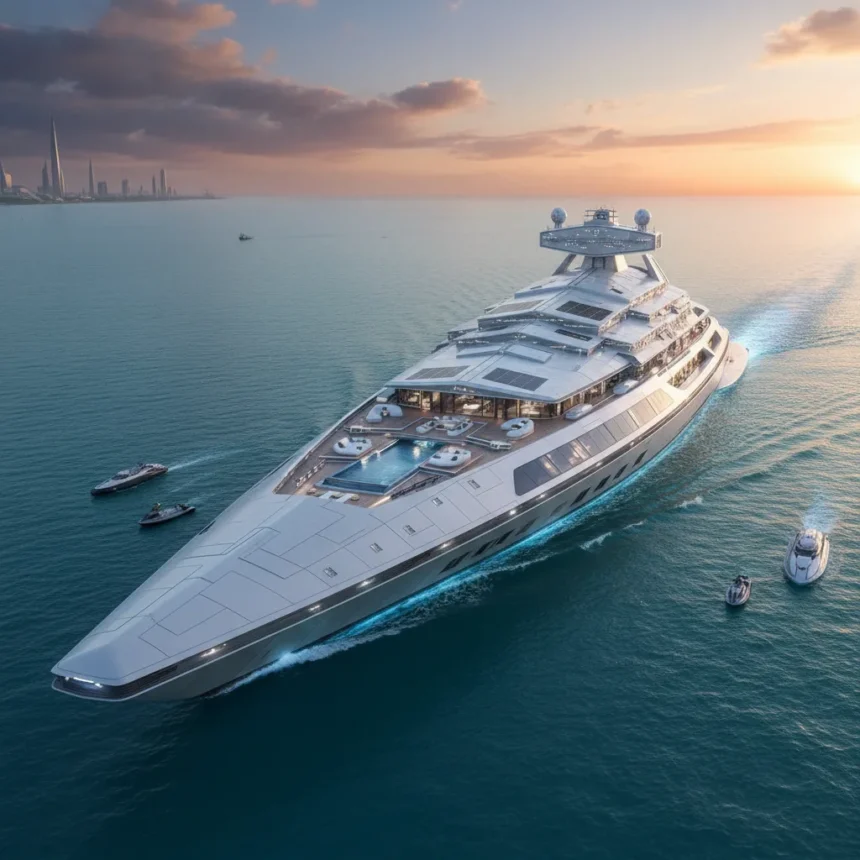
The Star Destroyer gigayacht is a 492-foot monohull concept designed by British studio ThirtyC, inspired by the Imperial Star Destroyer warship from Star Wars. Rather than a mass-produced luxury vessel, this is speculative naval architecture—a digital-only concept that pushes the boundaries of what superyacht design can be when unshackled from conventional constraints.
Key Takeaways
- ThirtyC’s Star Destroyer gigayacht measures 492 feet and exists only as digital renders, not a built vessel.
- The design uses extensive glass paneling on the exterior to preserve the menacing silhouette while flooding interiors with natural light.
- A forward helipad, elevated captain’s quarters, and hidden aft hangar for tenders define the layout.
- The wedge-shaped delta outline and sharp angular lines directly reference the Imperial Star Destroyer’s silhouette.
- ThirtyC has created Star Wars-inspired yacht concepts annually around May the 4th for over a decade.
The Design That Breaks the Superyacht Mold
Conventional superyachts rely on steel, aluminum, or GRP (fiberglass-reinforced plastic) hulls—materials chosen for durability, weight distribution, and cost efficiency. The Star Destroyer gigayacht concept abandons this playbook entirely. Instead, ThirtyC specified extensive glass paneling across the exterior, a choice that fundamentally challenges how a luxury vessel looks and functions. The glass is not merely decorative; it serves a dual purpose: it preserves the wedge-shaped, menacing profile that makes the design unmistakably Star Wars while allowing interiors to flood with natural light—a luxury feature that typically requires sacrificing the dramatic silhouette.
The delta outline and sharp angular lines run continuously from bow to stern, mimicking the Imperial Star Destroyer’s iconic wedge shape. This is not subtle fan service. Every geometric surface follows the same geometric logic as the fictional warship, creating a vessel that would be instantly recognizable from any angle. The bridge placement mirrors the original Star Destroyer’s command position, positioning the captain’s quarters high in the superstructure on the bridge deck where sightlines dominate the surrounding seascape.
Layout and Functional Features of the Star Destroyer Gigayacht
A forward helipad anchors the bow, offering the kind of rapid access and departure capability expected of ultra-luxury superyachts serving high-net-worth owners. The captain’s quarters occupy a premium position in the elevated superstructure, a deliberate architectural choice that gives commanding views rather than burying crew quarters below deck as traditional designs do.


The most clever functional detail is the hidden aft hangar, designed to store tenders and jet skis out of sight—preserving the clean, angular silhouette while maintaining the practical amenities superyacht owners demand. This hidden storage is not incidental; it solves a real design problem. Conventional superyachts display tenders on davits or in open bays, compromising the visual profile. By concealing these vessels entirely, ThirtyC keeps the Star Destroyer gigayacht’s menacing presence intact.
Why Concept Designs Matter More Than You Think
The Star Destroyer gigayacht exists exclusively in digital space—no physical hull has been laid, no owner has commissioned a build. Yet its significance lies precisely in that freedom. Concept designs function as thought experiments, testing what becomes possible when designers ignore cost constraints, material limitations, and market demand. They ask: what if we stopped building yachts the way we always have?



ThirtyC has been creating Star Wars-inspired superyacht concepts for over a decade, typically unveiling them around May the 4th (Star Wars Day). This annual tradition has evolved into a form of speculative design criticism—using beloved fictional vessels as a lens to interrogate the conventions of contemporary luxury yacht architecture. The Star Destroyer gigayacht is the studio’s most ambitious entry yet, scaling the concept to full superyacht proportions and solving real spatial and material challenges that would confront an actual build.
Compared to traditional superyachts, which prioritize conventional aesthetics, stability, and proven construction methods, the Star Destroyer gigayacht sacrifices none of these in theory—it simply reimagines them through a science-fiction lens. A conventional superyacht might feature a sleek, curved hull with tinted glass windows. The Star Destroyer gigayacht flips this: aggressive geometry paired with expansive glass surfaces. Both achieve luxury, but only one makes you feel like you’re commanding a space fleet.
The Glass Question: Aesthetic vs. Engineering
The extensive use of glass raises legitimate engineering questions that the concept does not fully address. Structural integrity, thermal regulation, maintenance, and safety protocols all become more complex with glass-heavy exteriors. Conventional superyachts use tinted or frosted glass strategically; full-coverage glass paneling would require novel approaches to insulation, privacy, and weather resistance. This is where the concept’s speculative nature becomes most apparent—it showcases an aesthetic ideal without committing to the engineering trade-offs required to realize it.
That said, the design philosophy is sound: marry futuristic aesthetics with advanced naval architecture and luxury at sea. The glass concept is not a flight of fancy but a genuine design argument—that light and transparency can coexist with menacing geometry, that function and fan service need not conflict.



Is the Star Destroyer Gigayacht Ever Becoming Reality?
No announced build timeline, commissioning process, or price exists for the Star Destroyer gigayacht. ThirtyC has not indicated plans to move the concept from renders to a shipyard. The project remains what it was designed to be: a digital exploration, a conversation starter, and a celebration of Star Wars fandom at a scale most enthusiasts would never imagine possible.
For superyacht owners seeking something genuinely distinctive, the concept raises an uncomfortable question: why do most superyachts look so similar? The Star Destroyer gigayacht proves that scale, materials, and bold aesthetic vision can coexist. Whether the luxury market has the appetite for such radical departure from convention remains untested.
Could This Design Actually Float?
The concept is presented as a functional monohull, which means the underlying naval architecture presumably follows established principles of buoyancy, stability, and displacement. The wedge shape poses no inherent seaworthiness problem—naval vessels have used delta and angular hulls for decades. The real question is whether the glass paneling could be engineered to meet maritime safety standards, structural requirements, and practical maintenance demands. The concept does not address these specifics, leaving them as future engineering challenges rather than solved problems.
FAQ
What is the Star Destroyer gigayacht’s actual length?
The concept measures 492 feet from bow to stern, making it a true gigayacht by modern standards (vessels over 180 feet are classified as superyachts; gigayachts typically exceed 300 feet).
Can you actually buy this yacht?
No. The Star Destroyer gigayacht exists only as digital renders created by ThirtyC. There is no construction timeline, commissioning process, or price. It is a concept design, not a product available for purchase.
Why does ThirtyC keep designing Star Wars yachts?
ThirtyC has created Star Wars-inspired yacht concepts annually around May the 4th for over a decade, using the fictional universe as a creative framework to explore speculative superyacht design and push conventional luxury aesthetics.
The Star Destroyer gigayacht proves that fan passion and serious design thinking are not mutually exclusive. ThirtyC has created something that satisfies both the Star Wars enthusiast and the naval architect—a vessel that looks like it belongs in a galaxy far, far away while solving real problems of light, storage, and commanding presence that conventional superyachts struggle to balance. Whether it ever touches water is almost irrelevant; as a design argument, it already sails.
Where to Buy
Edited by the All Things Geek team.
Source: T3