





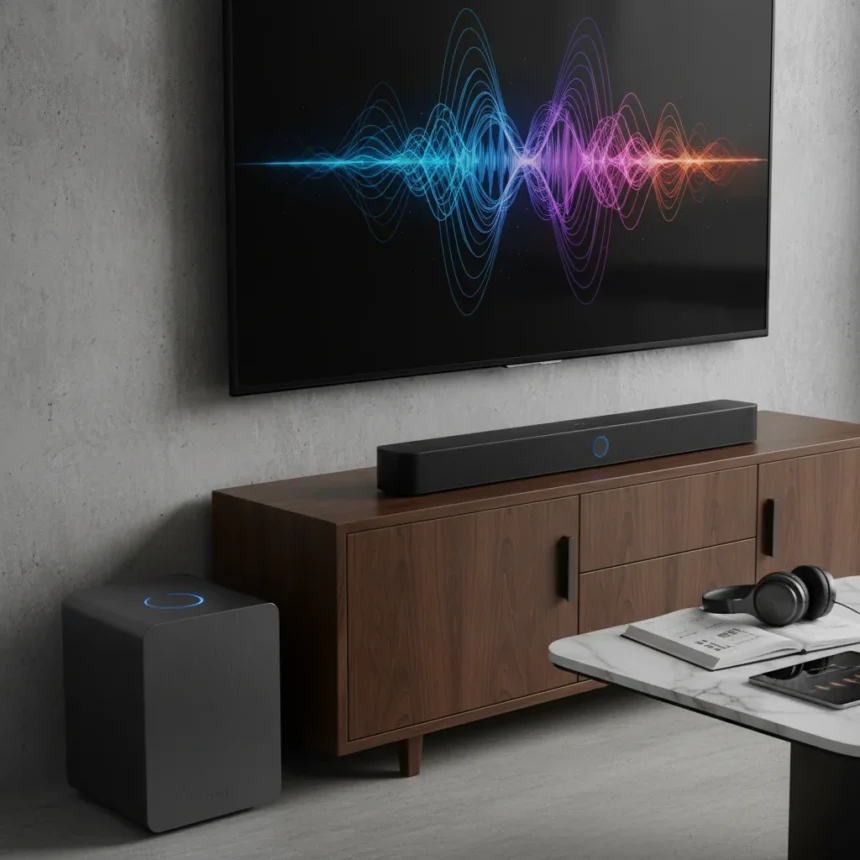
Whether a soundbar subwoofer belongs in your living room depends entirely on what you watch, where you sit, and how much bass you actually want. The short answer: it’s optional, but often essential.
Key Takeaways
- A subwoofer reproduces low frequencies that standalone soundbars struggle to deliver effectively.
- Action movies and bass-heavy music benefit most from dedicated subwoofer bass.
- An overpowering subwoofer can muddy mids and treble, requiring careful calibration.
- Sealed subwoofers suit most home listening; ported models are larger and pricier.
- Sonos subwoofers only work with Sonos speakers—they’re useless as universal add-ons.
What a soundbar subwoofer actually does
A soundbar subwoofer’s core job is straightforward: reproduce bass frequencies that a soundbar’s built-in drivers cannot handle well alone. Soundbars are inherently compromised by their shape and size. They prioritize dialogue and midrange clarity because that is where TV soundtracks live. Bass gets squeezed out or rendered thin. A dedicated subwoofer fills that gap by delivering the deep thump and rumble that action sequences, explosions, and bass-heavy music demand.
The difference is immediate. A soundbar with a subwoofer produces deeper, more powerful bass than a standalone bar. This matters when you are watching a film with intentional low-frequency impact or listening to hip-hop and electronic music where bass is structural, not decorative. Without a subwoofer, you hear the soundtrack. With one, you feel it.
When you actually need one
Not every soundbar setup requires a subwoofer. If you watch mostly talk shows, news, and light comedies, a quality soundbar alone handles those frequencies adequately. But if your diet includes action blockbusters, sci-fi films, or bass-centric music, a subwoofer transforms the experience. The decision hinges on three factors: content type, room size, and bass expectations.


Space is the practical constraint. A subwoofer occupies floor real estate—sometimes significant real estate. If your living room is already cramped or you are renting and cannot justify a permanent addition, a soundbar alone may be your only option. But if you have room and you care about impact, a dedicated subwoofer is worth considering.
Sonos users face a different constraint: ecosystem lock-in. The Sonos Sub and Sub Mini are only usable with Sonos products because Sonos uses a proprietary network. Without a compatible Sonos soundbar or at least one other Sonos Wi-Fi speaker, these subwoofers are just very large paperweights. This is not a limitation of the hardware itself—it is a business decision that limits flexibility.



The subwoofer balance problem
Here is where many people go wrong: they assume bigger and louder is better. It is not. A subwoofer that is too large or too overpowering tilts the entire sound signature warm and risks overwhelming the mids and treble. You end up with a boomy, muddy soundscape where dialogue disappears into bass rumble and clarity vanishes.
This is why calibration matters. Sound customization features such as channel-specific adjustment, subwoofer-level adjustment, graphic EQ, and room correction can help manage subwoofer balance. Some soundbar and subwoofer systems include room correction built in, which automatically tunes the subwoofer to your space. If your system lacks these tools, you will need patience and ear training to dial in the right level manually.
Sealed versus ported subwoofers
Subwoofer design splits into two camps: sealed and ported. Sealed subwoofers are fully sealed enclosures that help control the woofer’s sound precisely. They are compact, predictable, and work well in smaller rooms. Ported subwoofers use a tuned port or ports to generate extra output below what the driver itself can produce. This design extracts more bass volume from the same cabinet size, but at the cost of size and expense. Ported subs tend to be bigger and more expensive than sealed subs.
For home listening, a sealed subwoofer should be plenty powerful enough. You do not need the extra output or the extra footprint. Sealed designs are easier to integrate into a room without dominating it, and they integrate more naturally with a soundbar’s tonal balance.



Is a soundbar subwoofer worth the cost?
The real question is not whether a subwoofer is good—it is whether the improvement justifies the space, expense, and setup complexity. If you watch action films regularly or listen to bass-heavy music, yes. If you are content with your soundbar’s current bass response and have no room for an extra box, no. There is no universal answer because home audio is personal.
What matters is knowing what you are trading. A soundbar subwoofer is not a luxury upgrade—it is a targeted tool that solves a specific problem: thin, weak bass. If that problem bothers you, add one. If it does not, save your money and your floor space.
Can I use any subwoofer with my soundbar?
Most subwoofers are not universal. Sonos subwoofers require Sonos hardware. Many soundbar brands sell proprietary subwoofers designed for their specific models. Some systems use wireless pairing, others require HDMI or optical connections. Before buying a subwoofer, verify compatibility with your soundbar. A mismatch means a non-functioning, expensive paperweight.
How much bass is too much bass?
If dialogue becomes hard to hear, mids sound muddy, or the bass seems to overwhelm the room rather than enhance it, your subwoofer is set too loud. Start with the level at 50 percent and increase gradually while watching a film with clear dialogue and bass-heavy scenes. The goal is to feel the bass, not to drown out everything else. Use your soundbar’s EQ settings or subwoofer-level controls to dial this in.
Should I upgrade my soundbar or add a subwoofer?
If your soundbar is already high-quality and the only weakness is bass depth, a subwoofer makes sense. But if your soundbar struggles with dialogue clarity, lacks surround sound, or feels thin overall, upgrading the soundbar itself may be smarter. A better soundbar with a subwoofer is the ideal combination, but that is also the most expensive path. Start with the soundbar and add a subwoofer later if bass remains an issue.
The soundbar-subwoofer question ultimately comes down to your priorities. If you want deeper, more powerful bass and have the space and budget for it, a subwoofer is one of the best upgrades you can make to a soundbar setup. If you are happy with what you have, or if space is tight, a quality soundbar alone is perfectly adequate. The key is making an intentional choice based on your actual listening habits, not on marketing hype or what your neighbor bought.
Edited by the All Things Geek team.
Source: What Hi-Fi?