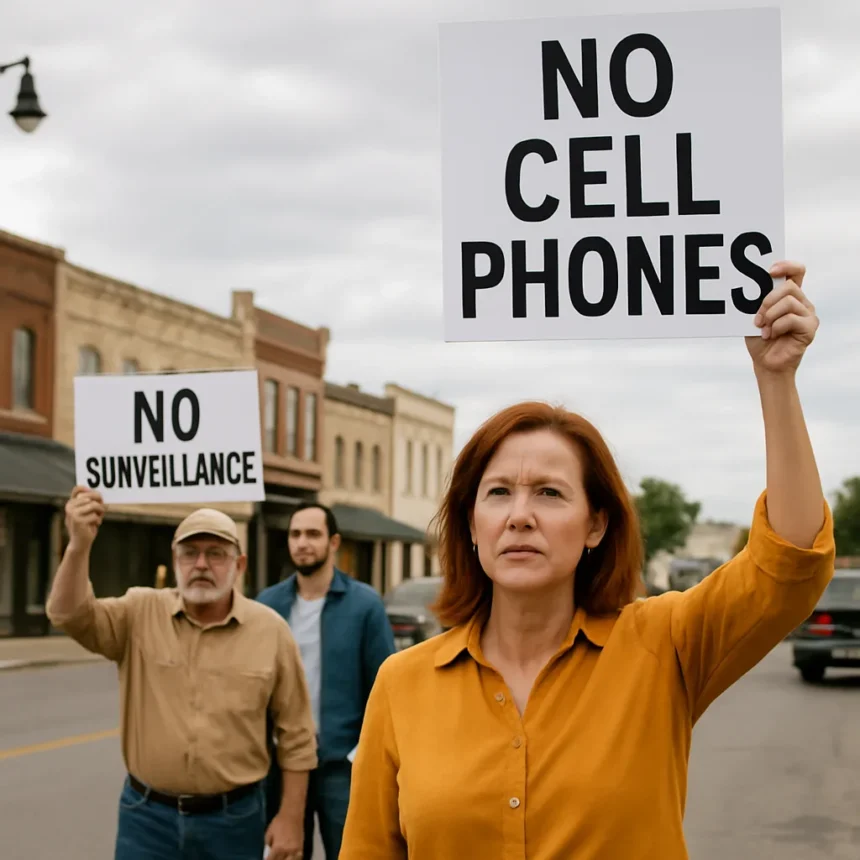
A surveillance technology ban proposal in Bandera, Texas has escalated a local dispute over AI-powered license plate readers into a stark confrontation about digital privacy and government oversight. After the town’s city council voted 3-2 to immediately end its contract with Flock, a surveillance company operating AI-powered cameras, a dissenting councilmember responded not with compromise but with a sweeping ordinance that would eliminate cellular devices, GPS, internet access, and electronic record-keeping from municipal operations.
Key Takeaways
- Bandera, Texas (population 900) voted to terminate its Flock AI license plate reader contract after sustained resident backlash.
- Councilmember Jeff Flowers proposed the “Bandera Declaration of Digital Independence” banning all cellular, GPS, and internet devices.
- Residents repeatedly vandalized camera poles and attended council meetings to oppose government surveillance.
- The town had installed eight Flock cameras funded by a state grant before voting to end the program.
- The proposal would require the town to return to “paper ledgers and cash only” operations.
How a Small Texas Town Rejected Surveillance Technology
Bandera, known as the “Cowboy Capital of the World,” deployed eight Flock Safety cameras across the town with funding from a state grant. The system uses artificial intelligence to recognize and store license plate data, ostensibly to help law enforcement track vehicles. But residents saw it differently. Over months of city council meetings, Bandera citizens voiced opposition to what they viewed as invasive government surveillance, and their resistance was not merely verbal—camera poles were repeatedly destroyed by vandals, forcing the town to replace them at its own expense.
The pressure worked. In a 3-2 vote, the city council decided to terminate the Flock contract immediately, rejecting the surveillance technology ban alternative. For most municipalities, that would end the story. Bandera’s dissenting councilmember Jeff Flowers, however, had other plans.
The Surveillance Technology Ban Goes Extreme
Flowers responded to the council’s decision by proposing what he called the “Bandera Declaration of Digital Independence”—a package of ordinances that would essentially ban modern technology from town operations. His proposal includes “a total ban on all cellular and GPS-capable devices for all operations within city limits,” according to statements made to the council. He also proposed “a total ban on outward facing cameras” and “a total termination of all internet services and electronic record-keeping.” The rhetoric is stark: “If we are to be truly ‘private,’ we must leave our smartphones at the city line. We are going back to 1880, paper ledgers and cash only”.



The proposal exposes a fundamental tension in modern privacy debates. Flowers appears to argue that residents cannot claim to value privacy while carrying smartphones and using digital services—a reductio ad absurdum that conflates government surveillance with consumer technology. Yet the distinction matters: one involves government tracking citizens without explicit consent, while the other involves voluntary participation in commercial ecosystems. A surveillance technology ban targeting government systems is not the same as banning all electronics from a town.
Why This Matters Beyond Bandera
The Bandera dispute reflects a growing national friction between privacy advocates and surveillance deployment. Flock Safety cameras have expanded across hundreds of municipalities, and residents in multiple communities have raised similar concerns about data collection and government overreach. Bandera’s initial rejection of the technology—achieved through sustained civic pressure—demonstrates that local opposition can reverse even state-funded programs. Flowers’s extreme counterproposal, meanwhile, reveals how polarized these conversations have become. Rather than debating the specific risks and benefits of license plate readers, the councilmember has pivoted to a wholesale rejection of modern technology itself.



The practical reality is that Flowers’s proposal will almost certainly fail. A town cannot function without cellular networks for emergency services, GPS for vehicle fleets, or internet access for basic municipal operations. What the proposal does accomplish, however, is force a conversation about what level of technological integration is acceptable and at what cost to privacy. Bandera residents wanted to reject one specific surveillance tool; Flowers’s response suggests that some see the problem as far deeper and more systemic.
What Happens Next?
Flowers has indicated he will formally propose these ordinances to the city council, but their passage is unlikely given the 3-2 vote that already rejected the Flock contract. The council’s majority has already signaled its preference for ending surveillance technology rather than banning all technology. Still, the proposal will force elected officials and residents to articulate exactly where they draw the line between privacy protection and practical necessity—a conversation many municipalities have avoided by simply deploying surveillance systems without robust public input.
Does the surveillance technology ban proposal have any chance of passing?
No. The city council voted 3-2 to end the Flock contract, meaning a majority already rejected Flowers’s approach. A proposal to ban all cellular and internet devices would face overwhelming practical and legal obstacles, and the council’s existing majority makes passage highly unlikely.
Why did Bandera residents oppose the Flock cameras?
Residents viewed the AI-powered license plate readers as invasive government surveillance. They attended multiple city council meetings to voice opposition and repeatedly vandalized camera poles, forcing the town to replace them at its own expense, until the council voted to end the contract.


What is the “Bandera Declaration of Digital Independence”?
It is the name Flowers gave to his proposed package of ordinances that would ban cellular and GPS devices, outward-facing cameras, internet services, and electronic record-keeping within city limits. The phrase invokes the spirit of rejecting external control, but applies it to technology rather than political governance.
The Bandera surveillance technology ban proposal reveals how local privacy disputes can escalate into extreme positions. What began as legitimate concerns about AI-powered government surveillance transformed into a proposal for near-total technological rejection. The real question is not whether Bandera will return to 1880, but whether other communities can find a middle ground between unchecked surveillance deployment and wholesale digital rejection.
Edited by the All Things Geek team.
Source: Tom's Hardware