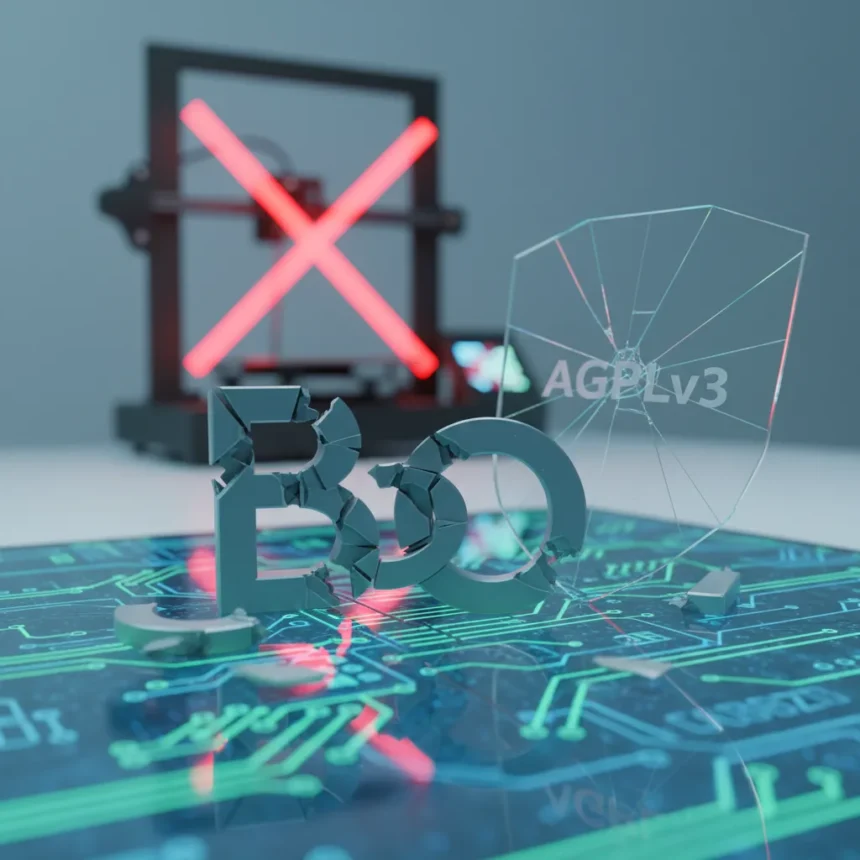
The Bambu Lab license violation claim from the Software Freedom Conservancy marks a significant escalation in the open-source 3D-printing ecosystem. The SFC, a nonprofit organization defending open-source software rights, alleges that Bambu Lab has violated the Affero General Public License version 3 (AGPLv3) in its Bambu Studio slicer software by bundling proprietary code with licensed open-source components.
Key Takeaways
- The Software Freedom Conservancy claims Bambu Lab violated AGPLv3 license terms in Bambu Studio software.
- The dispute centers on alleged mixing of proprietary code with AGPLv3-licensed open-source components.
- A cease-and-desist demand preceded the SFC’s public claim, tied to an OrcaSlicer fork restoring cloud printing without Bambu Connect.
- The OrcaSlicer fork bypassed Bambu Lab’s proprietary cloud service by restoring independent cloud-printing capabilities.
- The conflict reflects broader tensions between commercial 3D-printer manufacturers and the open-source community.
What the Bambu Lab license violation claim actually means
The AGPLv3 license requires that any software combining open-source code with proprietary components must provide corresponding source code to users. When Bambu Lab allegedly included proprietary code alongside AGPLv3 software in Bambu Studio without meeting these obligations, it created the licensing breach the SFC now contests. This is not a minor technical oversight—it strikes at the core principle that open-source software must remain transparent and modifiable by users.
Bambu Studio serves as the control software for Bambu Lab’s 3D printers. Users rely on it to prepare print files and communicate with their hardware. If the software violates open-source license terms, it raises questions about whether users actually own the right to inspect, modify, or fork the software they depend on. The SFC’s position is that proprietary restrictions undermine the open-source promise.
How the OrcaSlicer fork triggered the escalation
The immediate catalyst for the SFC’s public claim was Bambu Lab’s cease-and-desist demand against an OrcaSlicer fork that restored cloud-printing features without requiring Bambu Connect, Bambu Lab’s proprietary cloud service. OrcaSlicer is a community-maintained fork of Bambu Studio that had previously removed Bambu Connect integration. The fork developers restored independent cloud-printing functionality, allowing users to manage prints remotely without Bambu Lab’s infrastructure.


Bambu Lab’s legal demand against the fork developers escalated tensions. The SFC interpreted this move as evidence of a broader licensing problem: if Bambu Lab truly respected open-source principles, it could not simultaneously demand that developers remove features from a fork while allegedly violating the license itself. The cease-and-desist became the flashpoint that prompted the SFC to formalize its allegation publicly.
The broader stakes for 3D-printing open source
This dispute reflects a fundamental clash between commercial hardware manufacturers and the open-source community. Bambu Lab built its reputation partly on offering affordable printers with community-friendly software. Yet as the company scaled, it increasingly restricted features and demanded control over cloud services. The Bambu Lab license violation claim suggests that this restriction strategy may have crossed into legal territory.



Compare this to how other manufacturers approach open-source software: some fully embrace community forks and modifications, while others use proprietary wrappers around open components to maintain control. Bambu Lab’s approach—allegedly combining open and proprietary code without proper licensing—attempts to have both advantages: open-source credibility without open-source transparency. The SFC’s claim challenges whether that strategy is legally defensible.
The OrcaSlicer fork demonstrates what users want: cloud printing without mandatory Bambu Connect. If Bambu Lab’s proprietary restrictions violate AGPLv3, then the company may be forced to either fully open-source Bambu Studio or fundamentally restructure how it integrates proprietary services. Either path would reshape the ecosystem.
What happens next in the Bambu Lab license violation dispute
The SFC’s public claim does not automatically resolve the dispute. Bambu Lab can respond by arguing that it complies with AGPLv3, that its proprietary components are legally separate, or that users already have access to source code. The company may also negotiate with the SFC to reach a settlement that clarifies licensing terms without litigation.
If the dispute escalates to legal proceedings, courts would need to determine whether Bambu Lab’s code structure actually violates AGPLv3. This is not a trivial question—software licensing disputes often hinge on technical architecture and how components interact. However, the SFC’s willingness to name Bambu Lab publicly suggests the organization believes it has a substantive case.



Does this affect my Bambu Lab printer?
Users with existing Bambu Lab printers are unlikely to face immediate disruption. The dispute concerns licensing obligations, not printer functionality. However, if courts or negotiation forces Bambu Lab to restructure Bambu Studio, future updates could change how cloud printing works or what features remain proprietary versus open.
Can I use the OrcaSlicer fork without legal risk?
The OrcaSlicer fork itself is legally maintained by its community developers, who appear to respect open-source principles. However, Bambu Lab’s cease-and-desist demand signals the company will defend its intellectual property claims aggressively. Users choosing the fork should understand that Bambu Lab views it as unauthorized and may pursue further legal action against its developers.
Why does open-source licensing matter for 3D-printing software?
Open-source licensing ensures that users can inspect, modify, and fork software they depend on. In 3D printing, this transparency is critical—users want to understand how their printer communicates, what data is sent to the cloud, and whether they can modify the software to add features or fix bugs. Proprietary restrictions limit these freedoms. The Bambu Lab license violation claim raises the stakes by suggesting that Bambu Lab may have tried to bypass open-source obligations entirely.
The SFC’s claim against Bambu Lab represents a test case for how open-source licensing will be enforced in consumer hardware ecosystems. If the SFC prevails or negotiates a settlement, it could force other manufacturers to reckon with their own licensing practices. If Bambu Lab successfully defends its position, it may encourage other companies to adopt similar hybrid strategies. The outcome will shape open-source expectations in 3D printing for years to come.
Edited by the All Things Geek team.
Source: Tom's Hardware