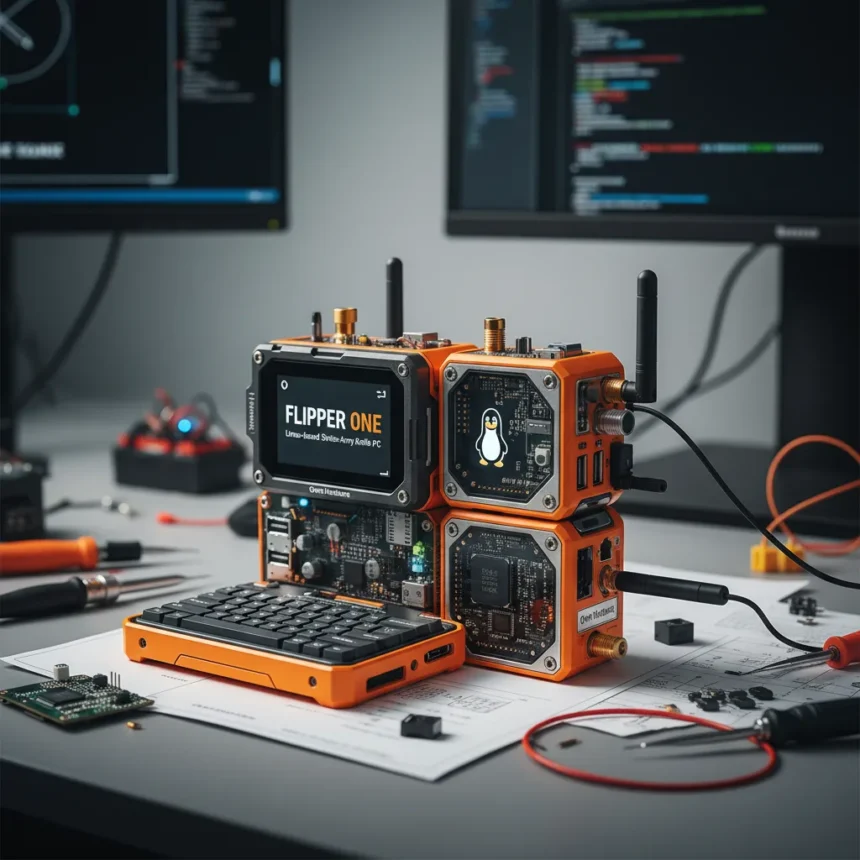
The Flipper One open source device marks a significant departure from the pocket-sized Flipper Zero, evolving into a larger, desktop-oriented platform built on Linux and designed with modularity at its core. The Flipper Zero creators have publicly revealed the Flipper One as more than an incremental upgrade, positioning it as a fully open-source platform that invites community participation in its development.
Key Takeaways
- Flipper One is a Linux-based, modular device expanding beyond Flipper Zero’s portable form factor.
- The platform prioritizes open-source architecture and community-driven development.
- Creators acknowledge uncertainty about the project’s scope, asking for external input to shape its direction.
- The swiss-army knife positioning suggests versatility across multiple use cases and workflows.
- Modularity distinguishes Flipper One from single-purpose gadgets and locked ecosystems.
What Is Flipper One Open Source, and Why It Matters
Flipper One open source represents a philosophical shift toward transparent, user-modifiable hardware. Unlike the Flipper Zero, which remains a compact, specialized tool, the Flipper One adopts a Linux kernel foundation and commits to open-source principles, allowing developers and users to inspect, modify, and extend the platform. This architectural choice directly challenges the trend of proprietary, black-box consumer devices that restrict user agency.
The emphasis on modularity is critical. Rather than a monolithic design where components are soldered and sealed, Flipper One’s architecture enables users to swap, upgrade, or customize hardware elements. This approach mirrors the philosophy of classic computing platforms where extensibility drove innovation and longevity. The creators’ decision to ask the community for help suggests the project remains in early stages, with its final form still malleable based on user feedback and real-world needs.
How Flipper One Differs from Flipper Zero
Flipper Zero established itself as a pocket-sized penetration testing and security research tool, compact enough to carry and intuitive enough for hobbyists. Flipper One abandons portability in favor of capability and openness. Where Flipper Zero operates as a closed ecosystem with firmware controlled by its creators, Flipper One commits to full open-source transparency, allowing the entire community to audit, contribute to, and fork the codebase if desired.


The form factor shift from handheld to desktop-class device reflects a different use case entirely. Flipper One targets scenarios requiring more processing power, larger displays, and expandable I/O—environments where a linux-based platform with modular hardware makes sense. This positioning avoids direct competition with Flipper Zero rather than cannibalizing it; the two devices serve different workflows and user skill levels.
Open Source and Modularity as Core Pillars
The Flipper One open source commitment extends beyond software to hardware schematics and design files. This level of transparency is rare in consumer electronics, where manufacturers typically guard PCB layouts and component sourcing as proprietary secrets. By opening these details, the creators enable independent repair, third-party component substitution, and community-driven hardware improvements.



Modularity transforms the device from a static product into a platform. Users can develop and integrate specialized modules for cryptography, networking, signal analysis, or other domains without waiting for official updates. This approach mirrors successful open-source projects in computing—Linux distributions thrive partly because modular architecture allows distributions and users to customize kernels and drivers. Flipper One applies that ethos to physical hardware.
Why the Creators Say They’re Terrified
The headline attribution of fear reflects genuine uncertainty about scope and ambition. Building a modular, open-source hardware platform is substantially more complex than releasing a polished, closed consumer gadget. The creators must balance hardware reliability, software stability, community governance, and long-term support—all while managing expectations across a potentially large and diverse user base.
The request for community help is not marketing rhetoric; it signals that design decisions remain open. Should Flipper One prioritize a specific use case, or remain deliberately general-purpose? How modular should it be—and at what cost to simplicity? What governance structure ensures the project remains open without fragmenting into incompatible forks? These questions lack obvious answers, and the creators’ willingness to admit uncertainty suggests intellectual honesty rather than false confidence.
What Community Input Could Shape
Asking the community for help early in development is strategic. User feedback can inform hardware specifications, software priorities, and ecosystem decisions before resources are locked into a fixed design. Early adopters and security researchers—Flipper Zero’s core audience—often have strong opinions about what features matter most, and integrating those views reduces the risk of building something the community doesn’t actually want.



This participatory approach also distributes the burden of ongoing development. Open-source projects thrive when contributors feel ownership and agency. By inviting input on design direction, the creators lay groundwork for a sustainable community that helps maintain, improve, and extend the platform beyond what a small core team could accomplish alone.
Does Flipper One Replace Flipper Zero?
No. Flipper One and Flipper Zero serve distinct purposes. Flipper Zero remains the portable, specialized security research tool—ideal for on-the-go testing and learning. Flipper One is a larger, more capable platform suited to stationary workflows, deeper customization, and users who value open-source philosophy and modularity. Many users will own both; they are complementary rather than competing products.
When Will Flipper One Launch?
The research brief does not specify a launch date, availability window, or pricing for Flipper One. The device has been revealed and teased, but the creators are still soliciting community input, suggesting the project remains in development. Interested users should monitor official channels for updates on timeline and availability.
What Makes Open-Source Hardware Important?
Open-source hardware democratizes technology by removing vendor lock-in and enabling user autonomy. Proprietary devices force users to accept whatever features and limitations manufacturers impose; open platforms empower users to inspect, repair, modify, and extend devices according to their own needs. In security and research contexts, this transparency is essential—users can verify that hardware does what it claims and doesn’t contain hidden functionality or backdoors.
The Flipper One open source approach signals a broader shift in how some hardware creators think about user trust and community participation. Rather than treating devices as finished products sold to passive consumers, open-source philosophy treats them as platforms that evolve through collaboration. For security researchers, hobbyists, and power users, that difference is fundamental.
Edited by the All Things Geek team.
Source: TechRadar