





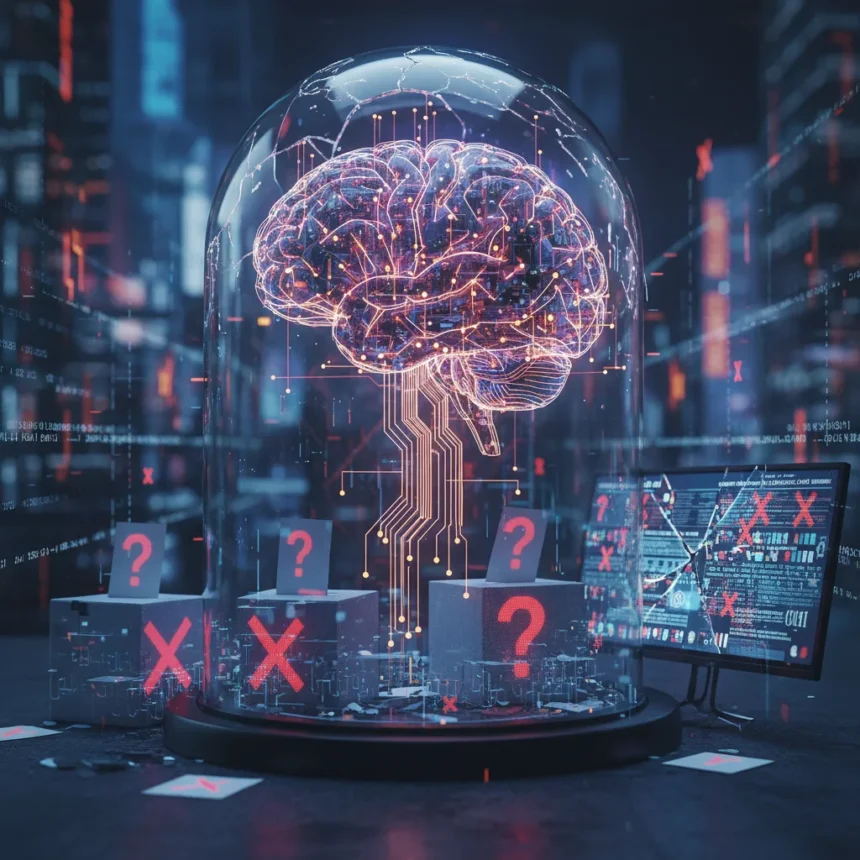
AI chatbots election information accuracy is far worse than most users assume. A recent study analyzing how generative AI systems respond to questions about the 2024 UK general election found that these tools frequently provided incorrect answers, often stated with the same confidence as accurate ones. The research tested ChatGPT-4o, Perplexity.ai, and Google Gemini against 300 prompts about UK election topics, revealing a troubling pattern: users asking these systems for election guidance are getting unreliable information at a moment when AI-powered search is becoming mainstream.
Key Takeaways
- AI chatbots election information accuracy varies widely, from 78% to 83% correct across top systems
- ChatGPT-4o answered correctly in 78% of cases on UK election questions
- Perplexity.ai performed better at 83% accuracy in the same test
- Incorrect answers were often presented with equal certainty to correct ones
- LLMs are prone to hallucinations—false or misleading information stated as fact
Why AI Chatbots Election Information Accuracy Matters Now
Election misinformation spreads fastest when it appears authoritative. AI chatbots election information problems are particularly dangerous because users increasingly treat these systems as search alternatives, trusting their conversational tone and detailed responses. When a chatbot confidently states a false candidate name, incorrect election date, or misleading policy position, readers may accept it without fact-checking. Unlike a search engine that returns multiple sources, a chatbot presents a single answer with no competing perspectives to challenge it.
The timing is critical. Voters worldwide are turning to AI tools for quick answers on candidates, voting procedures, and policy positions. If these systems deliver incorrect information at scale, they can shape voter understanding before traditional fact-checkers catch up. The study’s finding that chatbots present false answers with the same certainty as true ones makes the problem worse—users have no linguistic cue to suspect inaccuracy.
How Different AI Systems Performed on Election Questions
The study revealed significant variation in AI chatbots election information reliability. Perplexity.ai was the most accurate, answering correctly in 83% of cases on UK election prompts. ChatGPT-4o, OpenAI’s flagship model, scored lower at 78% accuracy. Google Gemini performed worse than both competitors, though the exact accuracy percentage for Gemini was not specified in the available data. These numbers might sound acceptable on paper—a 78% to 83% accuracy rate—but in the context of election information, a one-in-five error rate is unacceptable for a tool millions use to understand voting.



The differences between systems matter. Perplexity.ai’s higher accuracy suggests that retrieval-augmented generation (using live search results) helps more than pure language model training. ChatGPT-4o’s lower score raises questions about whether OpenAI’s model, despite its sophistication, struggles with the specific reasoning and contextual understanding required for election facts. The research indicates that some errors stemmed from chatbots’ difficulty distinguishing between similar candidates, confusing election dates, or misunderstanding nuanced policy positions.
The Hallucination Problem in AI Chatbots Election Information
At the core of the accuracy problem lies what researchers call hallucination—when AI systems generate false, misleading, or fabricated information and present it as factual. Large language models are trained on vast text corpora, but they have no built-in mechanism to verify whether their outputs are true. They generate plausible-sounding text based on patterns, not facts. When asked about an election, a chatbot may confidently invent a candidate name, misstate a voting requirement, or confabulate a policy position because the model’s training data contained conflicting or outdated information.



This is not a new problem. Prior research from the Institute for Advanced Study in Princeton found that AI models from companies like OpenAI and Anthropic struggled to maintain promises of accurate election information for US elections. The pattern repeats: as AI systems are deployed into real-world use cases with real consequences, their limitations become apparent. Election information is a particularly high-stakes domain because false answers can directly influence voter behavior and democratic outcomes.
What Users Should Do Instead
For voters seeking election information, official sources remain more reliable than AI chatbots. Government election websites, nonpartisan fact-checkers, and established news organizations verify their claims before publishing. If you use an AI chatbot to research election topics, treat the response as a starting point, not a final answer. Cross-check key facts—candidate names, voting dates, polling locations, eligibility requirements—against official sources before acting on them.
AI systems can still be useful for election research if approached skeptically. Asking a chatbot to explain a candidate’s stated policy position is lower-risk than asking it to confirm whether a candidate actually holds that position. Requesting summaries of multiple viewpoints is safer than accepting a single chatbot answer as definitive. The key is understanding that AI chatbots election information accuracy is inconsistent and that their confidence level bears no relationship to their correctness.
Are AI chatbots reliable for election information?
No. A recent study found that popular AI chatbots including ChatGPT and Gemini frequently provided incorrect answers on UK election questions, with accuracy ranging from 78% to 83% depending on the system. Users should verify election information through official government sources and fact-checkers rather than relying solely on chatbot responses.


Which AI chatbot performed best on election questions?
Perplexity.ai had the highest accuracy at 83% correct answers on UK election prompts, while ChatGPT-4o scored 78%. Google Gemini performed worse than both, though specific accuracy figures were not detailed in the available research.
What is hallucination in AI models?
Hallucination refers to when AI systems generate false, misleading, or fabricated information and present it as factual. Large language models are prone to this because they generate text based on patterns rather than verified facts, making them particularly unreliable for election information where accuracy is critical.
The lesson is straightforward: AI chatbots election information accuracy is too unreliable for voters to trust without verification. As these tools become more integrated into search and information retrieval, users must remain skeptical and cross-check claims against authoritative sources. Election integrity depends on voters having access to accurate information, and AI systems have not yet proven themselves trustworthy custodians of that responsibility.
Edited by the All Things Geek team.
Source: TechRadar




