






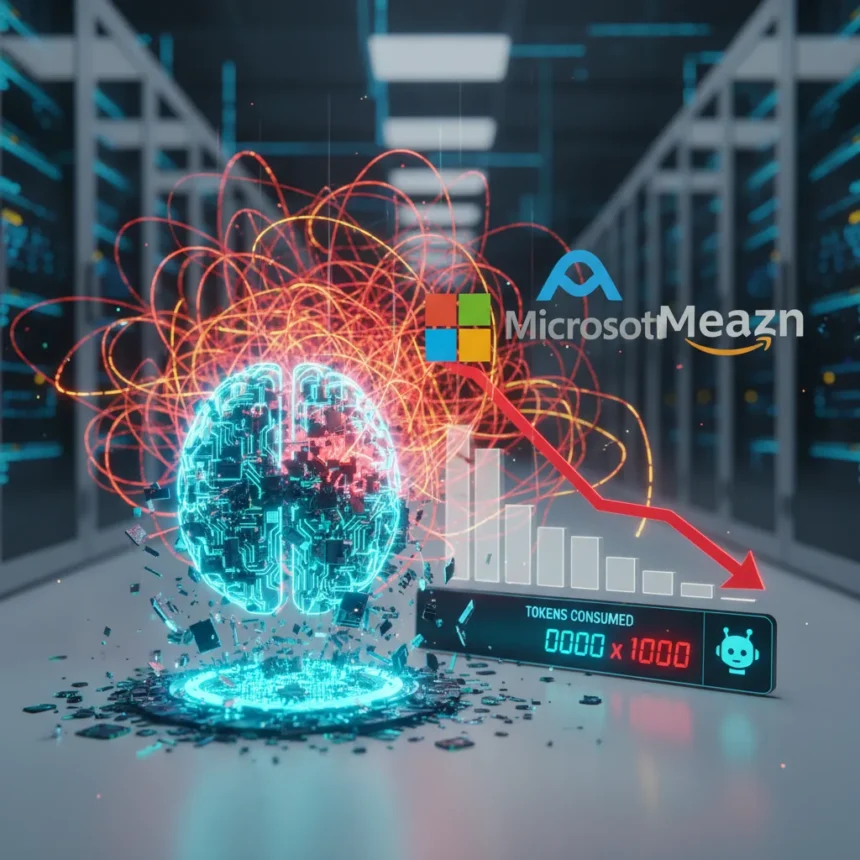
The enterprise AI cost crisis is reshaping how major tech companies deploy artificial intelligence internally. What started as enthusiasm for AI-powered employee productivity tools has collided with the harsh reality of runaway token consumption, triggering visible pullbacks at Microsoft, Meta, and Amazon.
Key Takeaways
- Agentic AI can consume up to 1000x more tokens than standard chatbot-style AI, driving unexpected cost spikes.
- Employee “tokenmaxxing”—maximizing AI usage to extract value—is backfiring as token costs drain corporate budgets faster than anticipated.
- Microsoft, Meta, and Amazon are reportedly scaling back enterprise AI deployments due to cost concerns.
- The enterprise AI cost crisis mirrors Jevons Paradox, where cheaper technology paradoxically increases total consumption and spending.
- Standard chat-based AI uses tokens per paragraph generated, while agentic AI performing multi-step tasks burns orders of magnitude more tokens.
Why Agentic AI Is Destroying Enterprise Budgets
The core problem driving the enterprise AI cost crisis lies in the fundamental difference between conversational AI and agentic AI. Standard chatbot interactions consume tokens proportional to the text exchanged—a paragraph or two per query. Agentic AI, designed to autonomously execute multi-step tasks, operates entirely differently. A single request to agentic AI can spawn dozens of internal token-burning loops as the system reasons, plans, executes, and validates each step. The result: consumption rates that dwarf traditional chat interactions by orders of magnitude.
When employees gain access to these agentic systems, the incentive structure breaks down. Early adoption metrics reward heavy usage. Teams compete to demonstrate AI ROI by maximizing deployment across workflows. This behavior—informally called “tokenmaxxing”—made sense when AI costs were negligible or subsidized. But as agentic AI workloads scale across organizations, the math inverts. A single employee running a complex agentic task can burn through monthly token budgets in hours.
The Enterprise AI Cost Crisis Hits Tech Giants
Microsoft, Meta, and Amazon built internal AI adoption programs centered on employee empowerment and productivity gains. These initiatives succeeded—perhaps too well. Employees embraced AI tools, stacked multiple AI-powered workflows, and pushed systems to their limits. The enterprise AI cost crisis emerged not from technical failure but from economic reality: the cost per token, while dropping, was being overwhelmed by token consumption growth.


Each company responded by tightening access controls. Usage caps appeared. Approval workflows slowed AI adoption. Teams requesting agentic AI access now face budget scrutiny that did not exist six months earlier. The pullback signals a painful lesson: cheaper technology does not automatically mean cheaper operations when consumption can scale infinitely.
Jevons Paradox and the Enterprise AI Cost Crisis
Economists recognize this pattern. The enterprise AI cost crisis is a modern manifestation of Jevons Paradox, an economic principle coined 161 years ago. The paradox states that as technology becomes more efficient and cheaper, total consumption often increases so dramatically that overall spending rises, not falls. In the 1800s, more efficient steam engines did not reduce coal consumption—they made coal cheaper, which spurred industrial expansion and coal use soared.



AI token pricing follows the same trajectory. As model providers dropped per-token costs to compete, enterprises did not pocket savings—they deployed agentic AI more aggressively, burned more tokens, and watched budgets explode. The enterprise AI cost crisis is not a failure of AI technology. It is a failure of cost forecasting and spending discipline.
What Comes Next for Enterprise AI Deployment
The pullback at Microsoft, Meta, and Amazon signals a market reset. Enterprises are learning to distinguish between chatbot-style AI (cheap, contained, conversational) and agentic AI (expensive, autonomous, multi-step). Budget allocation is shifting. Approval processes are tightening. Teams are being asked to justify agentic AI spending with concrete ROI metrics, not just productivity enthusiasm.
This does not mean enterprise AI adoption is ending. It means the era of unlimited, subsidized experimentation is over. Companies are moving toward managed AI programs with clear cost controls, token budgets per department, and governance frameworks that prevent rogue tokenmaxxing. The enterprise AI cost crisis forced this discipline earlier than it would have arrived naturally.
Is the enterprise AI cost crisis slowing AI adoption across tech companies?
Yes. Microsoft, Meta, and Amazon have all implemented tighter access controls and usage caps in response to runaway token spending. This is a visible pullback, not a permanent halt—these companies remain committed to AI, but now with cost guardrails.



What is the difference between standard AI and agentic AI in terms of token consumption?
Standard chatbot AI uses tokens proportional to text exchanged, typically a few paragraphs per query. Agentic AI performing autonomous multi-step tasks can consume up to 1000x more tokens because it burns tokens internally for reasoning, planning, and validation loops across many steps.
How does Jevons Paradox apply to the enterprise AI cost crisis?
Jevons Paradox explains why cheaper per-token pricing led to higher total spending: as AI became cheaper, enterprises deployed it more aggressively, especially agentic AI, which burned far more tokens overall. The enterprise AI cost crisis is the modern parallel to 19th-century coal consumption patterns.
The enterprise AI cost crisis is not a sign that AI deployment failed—it is proof that enterprises were deploying it too aggressively without cost controls. Companies that survive this reckoning will be those that separate genuine productivity wins from tokenmaxxing theater, then build sustainable governance around agentic AI spending.
Edited by the All Things Geek team.
Source: Tom's Hardware