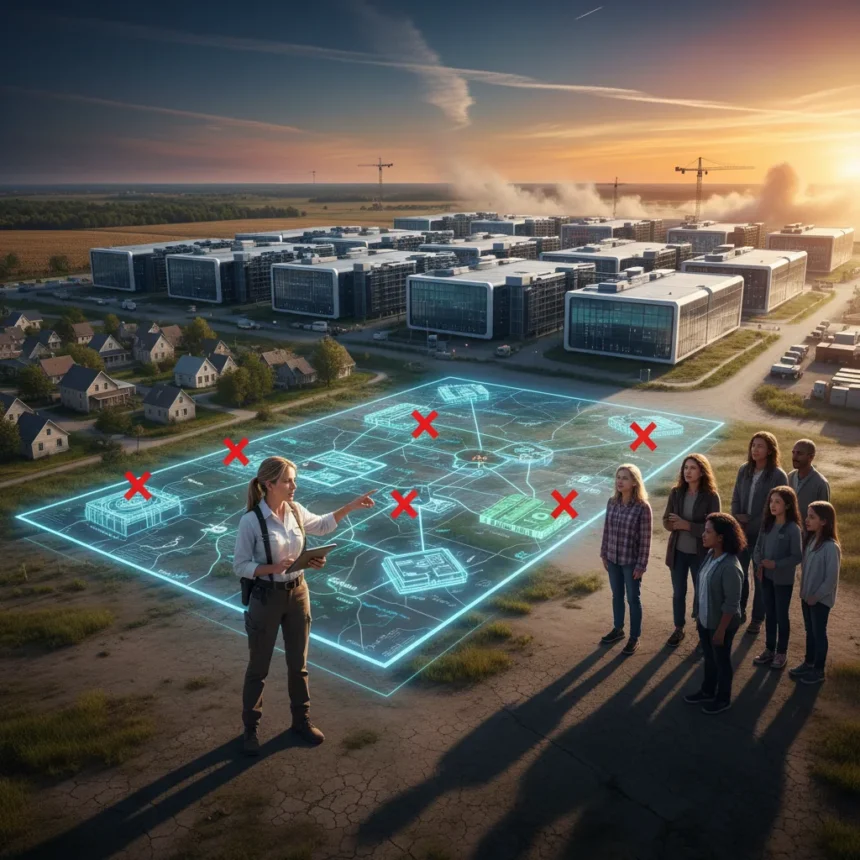
AI data center expansion is reshaping how American towns manage power, water, and land—often with minimal community input or permanent job creation. Erin Brockovich, the environmental activist and legal consultant, has launched a public reporting map to track major AI-focused and hyperscale data centers across the U.S., alongside community-submitted concerns about their impact.
Key Takeaways
- Brockovich’s map tracks operational and under-construction AI data centers overlaid with community complaints
- Data centers consume massive local resources but create very few permanent jobs
- Virginia, Texas, and California lead in hosting AI data center infrastructure
- Concerns include energy consumption, water depletion, e-waste, and natural disaster vulnerability
- Communities often lack planning capacity to manage rapid facility expansion
What the AI Data Center Expansion Map Actually Shows
The map at brockovichdatacenter.com gives a bird’s-eye view of where AI infrastructure is operating, under construction, and where residents are raising alarms. Each marker represents a publicly announced, major AI-focused data center, and clicking any location reveals details about facility type and community feedback. What emerges is a portrait of rapid, town-by-town deployment across the country—industrial parks, neighborhood edges, and sometimes sites near schools.
The tool is not a comprehensive environmental database with quantified impact metrics. Instead, it functions as a crowdsourced alert system, letting residents report concerns and making those concerns visible to others. This approach differs fundamentally from traditional data center directories like Data Center Map, which launched in 2007 as a global colocation and cloud infrastructure listing. Brockovich’s map narrows focus to AI workloads and community resistance, not general facility inventory.
Why Communities Are Struggling With AI Data Center Expansion
The core tension is simple: data centers consume huge amounts of local resources—power, water, land—yet create very few permanent local jobs. When a 50-megawatt facility arrives in a town of 20,000 residents, the construction boom is temporary, but the resource demand is permanent. Brockovich’s argument is direct: communities should ask developers how many permanent positions they are actually committing to, and demand it in writing.


The environmental concerns fall into five categories. Energy consumption increases grid demand and local environmental impact. Cooling systems require substantial water resources, straining local supplies and ecosystems. Frequent hardware replacement generates significant electronic waste. Facilities face risks from natural disasters, flooding, or geopolitical instability that can disrupt operations and affect surrounding infrastructure. Finally, rapid expansion outpaces community planning capacity, leaving local governments unable to assess or regulate the pace of development.
Virginia, Texas, and California have become the epicenters of this expansion, hosting the largest concentration of AI data centers. Companies choose these locations based on available power, water access, properly zoned land, and high-quality network infrastructure. The result is uneven geographic clustering rather than distributed development, concentrating both benefits and harms in a handful of regions.



The Question Tech Giants Are Avoiding
The article’s framing suggests that major technology companies are expanding AI data center footprints without transparent dialogue about community impact. Brockovich’s map attempts to create that transparency by making the infrastructure visible and giving residents a tool to document concerns. Whether tech companies will respond to this pressure—by reducing expansion speed, improving local job commitments, or investing in community mitigation—remains unclear.
The broader issue is whether AI infrastructure can scale without harming the communities that host it. A data center requires land, power, and water. Those resources come from somewhere. The question is whether local residents have a voice in the trade-off, or whether decisions are made by distant corporate boards and local zoning boards that lack expertise in assessing industrial-scale AI facility impacts.
How to Use Brockovich’s Data Center Map
The process is straightforward: visit brockovichdatacenter.com, check the map for facilities near your area, click any marker for details, and report what you are seeing. If you have concerns about a facility in your community, the map provides a channel to document them. The goal is to build a public record of community resistance and environmental concerns, making the invisible visible.
Is the AI data center expansion map free to use?
Yes, Brockovich’s map is publicly accessible at no cost. The site does not mention any subscription or premium features—it is designed as a community resource, not a commercial product.



Which states have the most AI data centers?
Virginia, Texas, and California lead in the number of AI data centers they house. These states offer the combination of power capacity, water access, and network infrastructure that hyperscale facilities require.
Why do data centers create so few permanent jobs?
Most data center work is automated. A facility with hundreds of megawatts of capacity might employ only a handful of full-time technicians and managers. The construction phase creates temporary jobs, but once the facility is operational, staffing is minimal. This is why Brockovich advises communities to demand written commitments on permanent positions before approving expansion.
The AI data center expansion is not slowing down. What Brockovich’s map does is make that expansion legible to the communities absorbing its costs. Whether that visibility translates into meaningful local power over infrastructure decisions depends on whether residents use the tool and whether policymakers listen.
Edited by the All Things Geek team.
Source: Tom's Guide