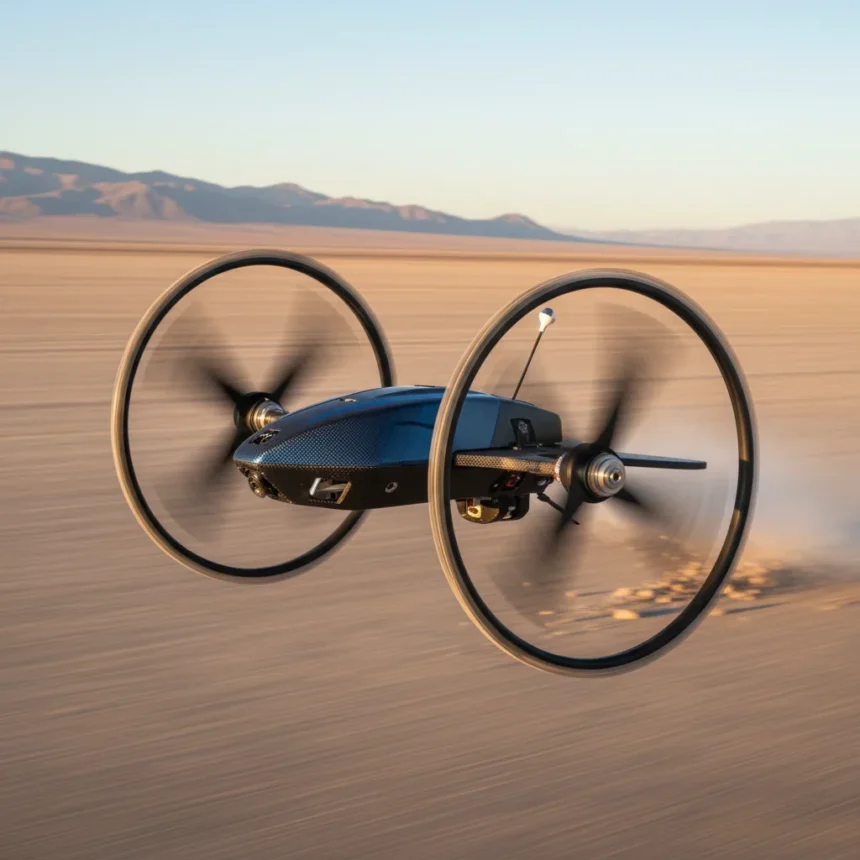
The fastest drone speed record just got a serious challenge. Custom drone makers recently pushed an experimental aircraft to 453 miles per hour, using hand-made sawtooth carbon fiber propellers as the critical breakthrough. While the fastest drone speed record remains officially unrecognized by governing bodies, the achievement signals where drone engineering can go when builders prioritize raw velocity over regulatory approval.
Key Takeaways
- Custom drone reached 453 mph in speed trials, though the record lacks official recognition.
- Hand-made sawtooth carbon fiber propellers proved essential to achieving the fastest drone speed record attempt.
- The unofficial achievement demonstrates advanced propeller design can unlock significant performance gains.
- Custom-built drones operate outside standard racing categories, making fastest drone speed record claims difficult to verify.
- Propeller geometry appears more critical than raw motor power for extreme drone velocity.
How the Fastest Drone Speed Record Attempt Unfolded
The fastest drone speed record attempt centered on a single engineering insight: propeller design matters more than most builders realize. Rather than relying on off-the-shelf components, the team hand-crafted sawtooth carbon fiber propellers specifically optimized for high-speed flight. This custom approach to the fastest drone speed record bypassed conventional wisdom that favored larger motors and heavier frames.
Sawtooth propeller geometry reduces turbulence at blade edges by creating a serrated pattern along the trailing surface. This design minimizes vortex formation, which typically bleeds energy at extreme speeds. For a fastest drone speed record attempt, even small efficiency gains compound dramatically. A propeller that recovers just 2-3 percent of wasted energy translates to measurable speed increases across the entire flight envelope.
The 453 mph figure represents a genuine engineering achievement, even without official sanction. Reaching that velocity requires solving multiple simultaneous problems: motor cooling, frame rigidity, aerodynamic balance, and power delivery stability. Most commercial drones max out around 80-100 mph because consumer regulations and safety standards prioritize control and stability. A fastest drone speed record attempt like this one abandons those constraints entirely.

Why Official Recognition Remains Elusive for the Fastest Drone Speed Record
The fastest drone speed record attempt will likely never receive official recognition, and that limitation reveals how drone racing governance actually works. Major racing organizations like the Fédération Aéronautique Internationale require standardized equipment, documented test conditions, and independent verification. A custom-built aircraft using hand-made propellers cannot meet those criteria, regardless of performance.
Custom drones also struggle with the fastest drone speed record because they exist outside established categories. Racing drones compete in fixed weight classes with approved motor and battery specifications. A bespoke build optimized purely for speed has no category to enter. This creates a paradox: the fastest drone speed record might be held by a machine that can never be officially certified to hold it.



That gap between engineering capability and regulatory recognition matters less than it sounds. The fastest drone speed record attempt proves what is technically possible, even if bureaucratic approval never follows. For drone manufacturers, this kind of experimental work informs next-generation designs. A propeller geometry that works at 453 mph can be scaled down and ruggedized for commercial racing drones, eventually trickling into consumer products.
Sawtooth Carbon Fiber Propellers vs. Conventional Designs
Standard drone propellers use smooth, curved blade surfaces optimized for balanced lift across a wide speed range. That generalist approach works well for typical flight scenarios but leaves energy on the table at extreme velocities. Sawtooth carbon fiber propellers sacrifice some low-speed efficiency to dominate at high speed, making them unsuitable for most practical applications but ideal for a fastest drone speed record attempt.
The hand-made construction process matters as much as the sawtooth geometry itself. Mass-produced propellers tolerate minor manufacturing variations because they operate within forgiving speed ranges. A fastest drone speed record attempt at 453 mph magnifies every imperfection. Blade imbalance that would cause imperceptible vibration at 100 mph becomes catastrophic resonance at 450 mph. Hand-crafting allows builders to tune each propeller individually, ensuring symmetry and rigidity that automated manufacturing struggles to achieve.
Carbon fiber provides the material foundation for this precision work. Compared to plastic or composite alternatives, carbon fiber offers superior stiffness-to-weight ratio and thermal stability. At 453 mph, blade flexing increases drag and reduces efficiency. Carbon fiber resists that flexing better than conventional materials, allowing the propeller to maintain optimal geometry even under extreme aerodynamic loads.



What the Fastest Drone Speed Record Means for Future Development
This fastest drone speed record attempt, unofficial as it stands, establishes a new benchmark for what custom engineering can achieve. The next wave of racing drones will incorporate lessons from sawtooth propeller design, even if they cannot match the 453 mph figure. Manufacturers will study the hand-made construction techniques and seek ways to automate them without sacrificing precision.
The fastest drone speed record also highlights a gap in consumer drone development. Most commercial manufacturers prioritize battery life, camera quality, and autonomous features. Speed remains a niche pursuit, limited to racing enthusiasts. Yet the engineering required to safely operate at 453 mph—frame rigidity, vibration dampening, power distribution—could improve reliability and durability across all drone categories.
Regulatory bodies will eventually need to address custom drones and unofficial records. As more builders push the boundaries, questions about safety, airspace management, and performance verification will demand answers. The fastest drone speed record, whether officially recognized or not, signals that drone engineering has matured beyond consumer products and into a territory where serious experimentation happens outside traditional approval channels.
Can Consumer Racing Drones Approach 453 mph?
Consumer racing drones currently max out around 100-120 mph in competition settings, constrained by weight limits, battery regulations, and safety requirements. Closing the gap to 453 mph would require wholesale changes to how racing drones are built and governed. Sawtooth propeller designs could help, but they alone cannot bridge a 300+ mph difference.
The fastest drone speed record attempt used custom electronics, unregulated motors, and unlimited power budgets—advantages unavailable to racers operating under standardized rules. A racing drone matching those specifications would be illegal to fly in most jurisdictions and impossible to control reliably in real-world conditions. The fastest drone speed record remains aspirational rather than practical.
Is the 453 mph fastest drone speed record verified by independent testing?
The fastest drone speed record was not officially verified by independent bodies or recognized racing organizations. The achievement is based on the builder’s own measurements and claims, which is why it remains unofficial. Without standardized test protocols and third-party validation, the 453 mph figure cannot be independently confirmed or challenged using established criteria.
What makes sawtooth carbon fiber propellers better for speed than standard designs?
Sawtooth edges reduce turbulence and vortex formation at blade tips, recovering energy wasted by conventional smooth designs at extreme speeds. Carbon fiber’s stiffness prevents blade flexing under aerodynamic load, maintaining optimal geometry throughout the flight envelope. These advantages compound at high velocity, where efficiency losses multiply rapidly.
Could sawtooth propellers improve commercial racing drone performance?
Yes, though the design trade-offs require careful consideration. Sawtooth propellers sacrifice some low-speed efficiency and maneuverability, making them less suitable for racing drones that need agility and control. Manufacturers could adapt the geometry for hybrid performance, gaining some speed benefits while preserving the handling characteristics racers demand. The fastest drone speed record proves the concept works; scaling it to practical applications requires different engineering priorities.
The fastest drone speed record, even without official recognition, represents a milestone in drone engineering. Hand-made sawtooth carbon fiber propellers delivered the breakthrough that pushed a custom aircraft to 453 mph, proving that unconventional design choices can unlock performance gains that standard approaches miss. Whether this achievement ever receives formal sanction matters less than what it teaches the broader drone community about what is possible when builders prioritize innovation over regulation.
Edited by the All Things Geek team.
Source: TechRadar