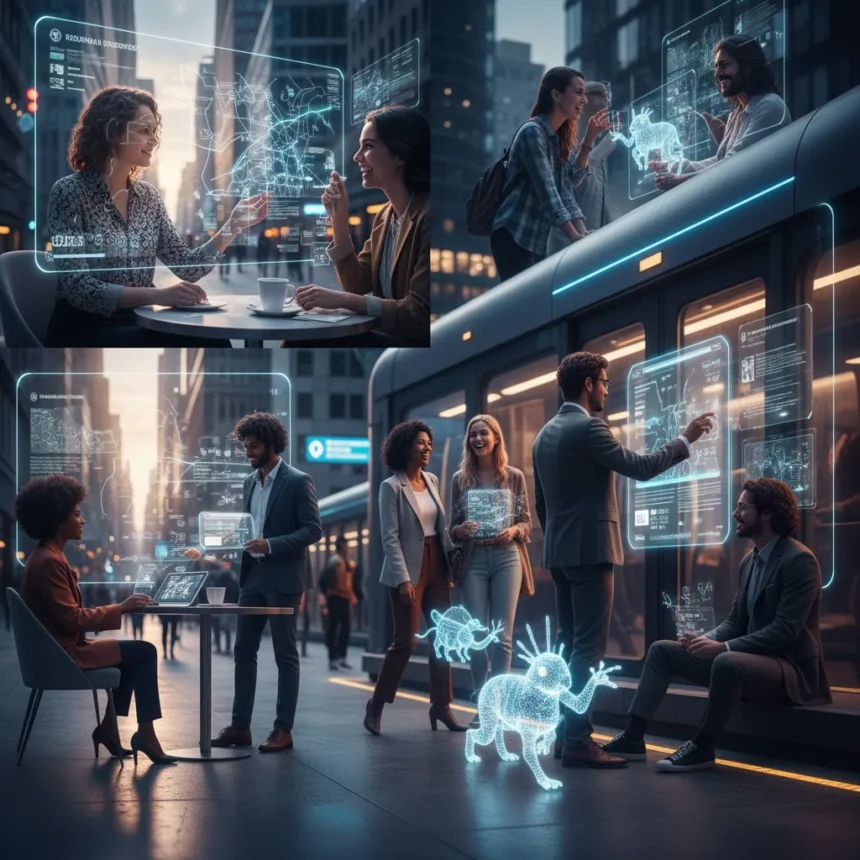
Immersive tech visual experiences are no longer confined to bulky headsets gathering dust on shelves. The next phase of spatial computing is embedding immersive visuals directly into everyday devices through AI-driven interfaces that blend smoothly with how we already work and consume content.
Key Takeaways
- Immersive tech is shifting from standalone headsets to AI-assisted visual computing integrated into daily devices.
- Spatial Scenes use AI to create computational depth from flat images, working with virtually any photo source.
- Native apps like YouTube on Vision Pro now support immersive playback including 360, 3D, and VR180 formats.
- Spatial video capture on iPhone 15 Pro and Pro Max extends immersive content creation beyond dedicated headsets.
- The trend emphasizes persistent, useful visual experiences rather than novelty demonstrations.
From Novelty to Necessity: The Immersive Tech Shift
For years, immersive tech meant strapping on a headset for occasional entertainment or enterprise demos. That era is ending. The current evolution treats immersive visual experiences as functional computing layers that enhance everyday tasks rather than replace them. Apple Vision Pro exemplifies this shift by raising the bar on visual quality, eye tracking, and gesture recognition, allowing users to overlay apps onto the real world or replace surroundings entirely with immersive environments. This is not about gaming anymore—it is about making spatial computing feel as natural as checking email.
What distinguishes this phase is AI’s central role. Rather than requiring users to manually construct immersive scenes or rely on pre-recorded content, AI now generates spatial depth computationally. visionOS 2.6 introduces Spatial Scenes, which use artificial intelligence to create depth from flat images. This capability works with virtually any photo source, constrained mainly by the original image’s resolution. The practical implication is massive: billions of existing photos instantly become candidates for immersive playback, eliminating the friction that once required dedicated 3D content creation.
How Immersive Tech Visual Experiences Are Becoming Everyday
The integration of native apps proves this shift is real. YouTube arrived as a native app on visionOS for Apple Vision Pro, available as a free download in the App Store. The app supports floating-window viewing and a custom theater mode, enabling playback of long-form, short-form, 3D, 360, and VR180 videos. This is not a gimmick—it is Netflix-level entertainment infrastructure adapted for spatial displays. When mainstream streaming platforms prioritize immersive playback, the technology stops being fringe.



Equally important is content creation democratization. Spatial video capture on iPhone 15 Pro and iPhone 15 Pro Max means immersive content is no longer locked behind expensive cinema equipment. Users can record spatial video on phones they already own. When you play this content on Vision Pro, immersive playback erases borders, making the video appear almost like a cloud with no clear edge between the real world and the media. This closes the loop: creation, distribution, and consumption are now accessible to ordinary users, not just studios.
Why Immersive Tech Visual Experiences Matter Now
The timing is critical because AI-driven interfaces are reshaping device behavior across the entire tech ecosystem. Immersive tech is not competing for attention—it is becoming a default layer in how we interact with information. Smart glasses, spatial displays, and AI phones are converging on the same principle: visual experiences should feel natural, persistent, and useful rather than obvious or intrusive.



Vision Pro’s capabilities, difficult to find in other headsets, demonstrate what becomes possible when immersive tech is treated as a computing platform rather than a novelty device. The headset does not just display content; it contextualizes it spatially, allowing multiple apps to coexist in three-dimensional space. This architectural advantage compounds as developers build more native apps and experiences optimized for spatial interaction.
What Comes Next for Immersive Tech
The trajectory is clear: immersive tech visual experiences will become invisible infrastructure. You will not think about whether an experience is immersive—you will simply use it because it works better than flat screens for that particular task. AI will continue generating spatial depth from existing media, reducing the need for specialized content. Native apps will proliferate. Spatial video will become as common as regular video. The headset itself may eventually shrink or disappear entirely, replaced by smart glasses or integrated displays.
The question is not whether immersive tech will matter. It is whether traditional 2D interfaces will seem quaint by comparison.
Will immersive tech visual experiences replace traditional screens?
Not completely. Traditional screens excel at focused, quick tasks like reading text or browsing. Immersive tech is strongest for entertainment, spatial work, and contextual information. The future is hybrid—immersive layers will coexist with flat displays, each used where it makes sense.


How much does immersive tech cost to get started?
Apple Vision Pro is priced at $3,500, making it a premium entry point. However, spatial video capture is available on iPhone 15 Pro and Pro Max, and YouTube is free on Vision Pro. The cost barrier exists but is not absolute—you can create immersive content on phones you may already own.
Can immersive tech work without AI?
Technically yes, but AI is what makes it practical at scale. Features like Spatial Scenes, which generate depth from flat images, depend entirely on AI. Without computational depth generation, immersive experiences would remain limited to professionally produced 3D or spatial video, which is expensive and time-consuming to create.
Immersive tech visual experiences are no longer a distant future. They are here, woven into devices you can buy today, powered by AI that makes them feel natural rather than exotic. The headset was just the beginning—the real revolution is making immersive visuals feel like they were always part of how we compute.
Edited by the All Things Geek team.
Source: TechRadar