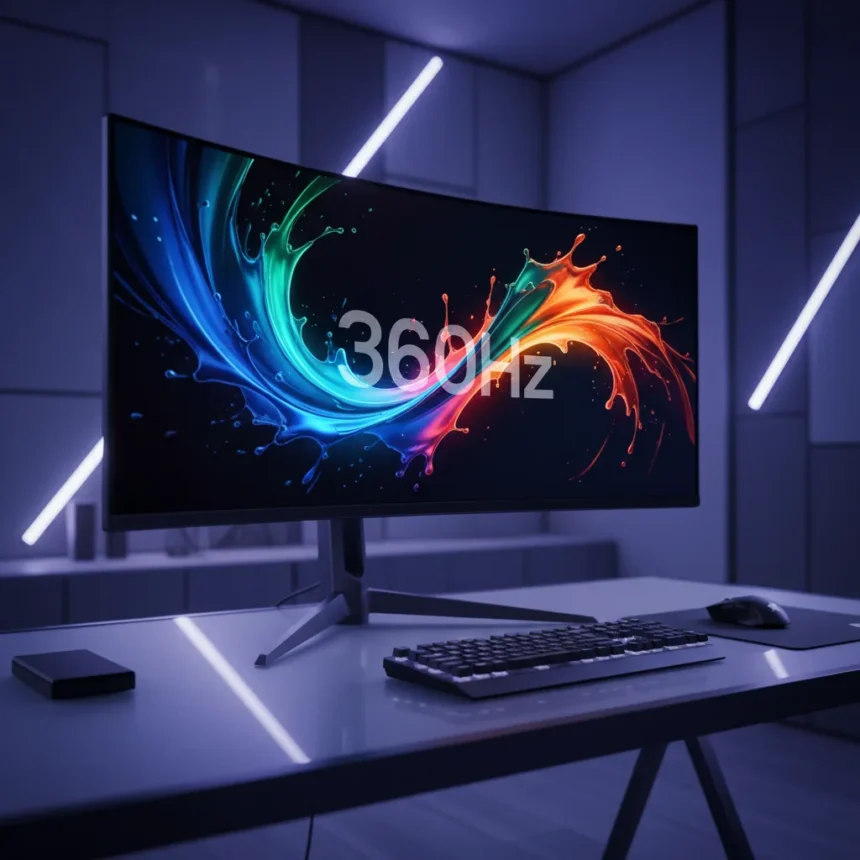
Samsung’s 4K 360Hz QD-OLED monitor represents a watershed moment for gaming displays. For years, the gaming monitor market has forced buyers to choose: either go for sharp 4K resolution at 240Hz, or accept lower resolution to hit 360Hz. Samsung is ending that compromise by combining quantum-dot OLED technology with a 360Hz refresh rate at 4K resolution, a pairing that didn’t exist in the premium gaming space until now.
Key Takeaways
- Samsung’s 4K 360Hz QD-OLED monitor merges quantum-dot color precision with extreme refresh rates for the first time in gaming displays
- The monitor outpaces existing premium OLED gaming displays like the ASUS ROG Swift OLED PG32UCDM, which maxes out at 240Hz
- QD-OLED technology combines quantum dots with organic light-emitting diodes for superior color accuracy and contrast compared to standard OLED panels
- High refresh rates (360Hz) reduce input lag and motion blur, critical for competitive gaming and fast-paced titles
- Samsung positions the Odyssey line as suitable for gaming, graphic design, photo and video editing, and general office work
What Makes the 4K 360Hz QD-OLED Monitor a significant shift
The 4K 360Hz QD-OLED monitor solves a technical problem that has plagued high-end gaming displays for the past three years. Quantum-dot OLED panels deliver exceptional color volume and HDR performance because the quantum dots amplify light output while maintaining the infinite contrast of OLED. But earlier 4K OLED gaming monitors topped out at 240Hz due to bandwidth and thermal constraints. Samsung’s new monitor breaks through that ceiling, delivering both the visual fidelity gamers demand and the responsiveness competitive players require.
The significance lies in the combination itself. A 4K 360Hz QD-OLED monitor is not simply a faster version of existing models—it represents a fundamental shift in what gaming displays can deliver. Gamers no longer face a tradeoff between image quality and performance. The monitor supports high refresh rates, low response times, and adaptive sync technologies such as G-Sync and FreeSync, the standard features that define modern gaming displays. But now those features arrive with quantum-dot color precision and OLED’s unmatched contrast.
How Samsung’s Monitor Compares to the ASUS ROG Swift OLED
The closest competitor in the premium OLED gaming space is the ASUS ROG Swift OLED PG32UCDM, a 32-inch 4K QD-OLED display that has dominated the high-end market since its launch. The ASUS monitor delivers stunning color and contrast, but it maxes out at 240Hz. Samsung’s new monitor doubles down on speed while maintaining the same resolution and panel technology, making it the natural next step for gamers who already own OLED displays and want more responsiveness.


This is not a marginal upgrade. The jump from 240Hz to 360Hz reduces input lag by approximately 30 percent, a difference that is immediately noticeable in first-person shooters, fighting games, and other titles where milliseconds matter. For casual gamers, the difference is subtle. For esports competitors, it is decisive. Samsung is betting that the market is ready to pay a premium for both visual excellence and extreme speed in a single panel.
Samsung’s Odyssey Line and the Gaming Monitor Market
Samsung’s Odyssey gaming monitor line already includes OLED, 4K, ultrawide, and 240Hz models, establishing the brand as a serious player in the high-end gaming display space. The new 4K 360Hz QD-OLED monitor is the logical flagship of that lineup, the product that demonstrates Samsung’s technical capability and ambition. Samsung markets its gaming monitors as tools for gaming performance, but also acknowledges their value for graphic design, photo and video editing, and general office work. A monitor with OLED’s color accuracy and quantum-dot precision is genuinely useful across creative disciplines, not just gaming.



The broader market context matters here. OLED gaming displays have moved from niche to mainstream over the past two years, with multiple manufacturers competing on resolution, refresh rate, and panel size. Samsung’s entry into the 4K 360Hz segment signals that OLED is no longer confined to 240Hz or 1440p—the technology can scale to the highest performance tiers. That shift will likely push competitors to develop their own 360Hz OLED options, accelerating the transition away from traditional LCD gaming monitors.
What Gamers Should Expect
A 4K 360Hz QD-OLED monitor demands a powerful graphics card. Reaching 360 frames per second at 4K resolution requires either an NVIDIA RTX 4090 or an AMD Radeon RX 7900 XTX, and even then, only in optimized or esports titles. Most mainstream games will run at 100–240Hz at 4K on high-end hardware. The monitor’s value lies in providing headroom: gamers can push settings higher, enable ray tracing, and still maintain high refresh rates. The monitor also serves as future-proofing, remaining relevant as next-generation graphics cards arrive.
OLED technology introduces considerations that LCD gamers may not be familiar with. Burn-in risk exists but is minimal on modern OLED displays with proper use. Brightness can be lower than LCD in bright rooms, though quantum-dot OLED mitigates this limitation. Response times on OLED are exceptional—often 0.1ms or faster—eliminating ghosting and motion blur that plague LCD panels. For gamers upgrading from a traditional 240Hz LCD monitor, the OLED experience will feel transformative.
Is a 4K 360Hz QD-OLED Monitor Worth the Investment?
The answer depends on your use case and budget. If you are a competitive esports player with a high-end graphics card, the 4K 360Hz QD-OLED monitor is the best gaming display money can buy. If you play narrative-driven single-player games or work in creative fields, the quantum-dot color accuracy and OLED contrast matter more than the 360Hz refresh rate—a 240Hz OLED monitor may be sufficient. If you are a casual gamer on a budget, a traditional 1440p 240Hz LCD monitor remains the better value.



The real story is that Samsung is pushing the entire gaming monitor market forward. By proving that 4K, 360Hz, and OLED can coexist, Samsung is setting a new standard for what premium gaming displays should deliver. Competitors will follow, prices will eventually fall, and in three years, a 4K 360Hz OLED monitor may be considered the default choice for serious gamers. For early adopters, that premium comes with the satisfaction of owning the cutting edge.
What is a QD-OLED panel?
QD-OLED combines quantum dots—tiny semiconductor particles that emit pure colors—with organic light-emitting diodes. The result is a panel with superior color volume and brightness compared to standard OLED, while retaining OLED’s infinite contrast and fast response times. Quantum-dot OLED is used in premium gaming monitors from multiple manufacturers because it balances visual excellence with the performance demands of high-speed gaming.
Can a 4K 360Hz monitor actually hit 360Hz in games?
Most games cannot maintain 360 frames per second at 4K resolution, even on the most powerful graphics cards. The monitor’s 360Hz capability is most useful in esports titles like Counter-Strike 2, Valorant, and fighting games, which are optimized for high frame rates. In AAA games with ray tracing and high visual fidelity, expect 100–240Hz at 4K. The monitor’s value is providing the ceiling to push performance as high as possible.
How does Samsung’s monitor improve gaming visuals?
The 4K 360Hz QD-OLED monitor delivers sharp detail at 4K resolution, quantum-dot color accuracy for vibrant visuals, OLED’s infinite contrast for true blacks, and 360Hz refresh rate for smooth motion and reduced input lag. Together, these features create a display where games look visually stunning and feel responsive. The combination is rare in gaming monitors and represents Samsung’s commitment to eliminating compromises at the high end.
Samsung’s 4K 360Hz QD-OLED monitor is not an incremental upgrade—it is a category-defining product that proves OLED gaming displays can be both beautiful and fast. For gamers with the hardware and budget to match, it is the monitor to buy right now.
Where to Buy
Edited by the All Things Geek team.
Source: T3