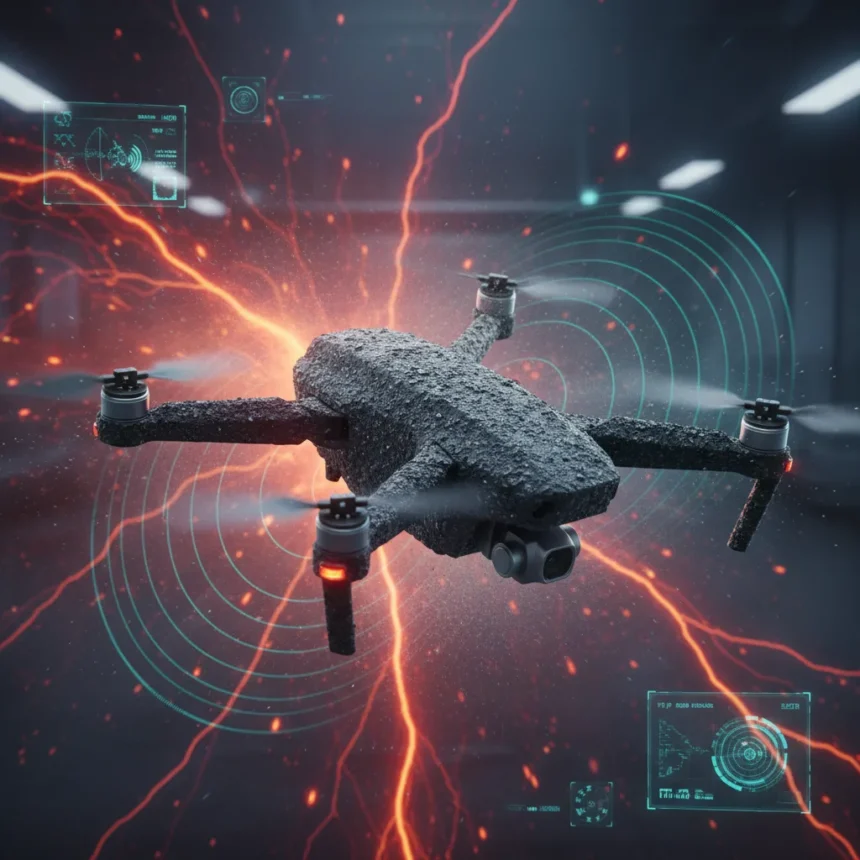
A spray-on stealth coating for drones using volcanic materials could fundamentally challenge how militaries and commercial operators detect unmanned aircraft. The technology, called Kürşat 3.0, represents seven years of research into applying volcanic basalt and pumice to airframes as a retrofit-friendly radar-absorbing material. If validated and scaled, it could make billion-dollar radar detection systems less relevant for low-cost drone operations.
Key Takeaways
- Kürşat 3.0 spray coating claims to reduce radar return signals by up to 43 dB, compared to 20–30 dB for typical radar-absorbent materials
- The coating uses volcanic rock’s microscopic porous structure to trap and absorb electromagnetic waves
- The technology is spray-applied, making it retrofit-friendly for existing drone airframes
- Research took more than seven years to develop
- Third-party validation has not yet been completed; claims remain unverified
How Spray-On Stealth Coating for Drones Works
The spray-on stealth coating for drones operates by exploiting the microscopic porous characteristics of volcanic rock. When applied to a drone’s surface, the material traps incoming electromagnetic waves and converts the residual radar energy into heat—the same principle used by traditional radar-absorbent materials (RAM) applied to military aircraft. The volcanic basalt and pumice composition allows the coating to achieve claimed attenuation levels of up to 43 dB, substantially higher than the 20–30 dB reduction typical of existing broadband radar-absorbent coatings.
What distinguishes this approach from conventional stealth technology is its simplicity and retrofit capability. Traditional stealth aircraft rely on airframe shaping—angled surfaces and curved designs—to deflect radar waves away from detection systems. This requires expensive redesign and manufacturing from the ground up. Kürşat 3.0, by contrast, can be sprayed onto an existing drone airframe without structural modification, making it accessible to operators of cheap, off-the-shelf UAVs. The coating does not make drones invisible to radar; rather, it makes detection and tracking harder, especially when combined with other stealth techniques.
Real-World Applications and Trade-Offs
The practical appeal of spray-on stealth coating for drones lies in its potential to democratize stealth capabilities. Low-cost commercial drones and small military UAVs could gain radar evasion properties without the expense and lead time of designing new airframes. This could reshape how militaries approach drone procurement and how commercial operators manage detection risks in congested airspace.

However, the researchers acknowledge significant trade-offs. Added weight from the coating reduces payload capacity and flight endurance. Surface drag increases, potentially lowering speed and efficiency. Durability remains uncertain—how the volcanic material performs under environmental stress, UV exposure, and thermal cycling has not been disclosed. These factors could limit adoption in weight-sensitive applications where every gram matters, such as small reconnaissance drones or long-endurance platforms.
Comparing Spray-On Stealth Coating for Drones to Existing Radar Detection
The competitive landscape for radar-absorbent materials is narrow but established. Existing broadband RAM coatings, used on military and commercial aircraft for decades, typically reduce radar return signals by 20–30 dB. The claimed 43 dB attenuation of Kürşat 3.0 represents a significant leap—roughly doubling the performance of conventional materials. However, this comparison assumes the testing conditions, frequency ranges, and measurement methodologies are equivalent, which has not been independently verified.



Traditional stealth systems—like those found on F-35 fighters or B-2 bombers—combine airframe shaping, RAM coatings, and advanced materials to achieve detection ranges measured in miles rather than tens of miles. A spray-on coating alone cannot replicate this integrated approach. Instead, Kürşat 3.0 targets a different market segment: cheap drones that currently have zero stealth properties. For these platforms, even a 43 dB reduction could extend detection avoidance from seconds to minutes, a meaningful advantage in tactical scenarios.
The Validation Gap and Path Forward
The most critical limitation is that third-party experts have not yet validated the claimed 43 dB performance. The research team’s testing environment, measurement standards, and frequency bands remain undisclosed. Until independent validation occurs—ideally by defense research institutes or academic partners—the coating’s real-world effectiveness remains speculative.
Manufacturing scale and cost have also not been revealed. A spray-in-a-can product sounds cheap, but production complexity, yield rates, and supply chain constraints could push final pricing far higher than initial marketing suggests. Coating thickness, application procedures, and quality control standards will determine whether the material performs consistently across thousands of drones or fails in field conditions. These details are essential for military procurement and commercial adoption, yet none have been disclosed.
Why This Matters Now
The timing of this technology is significant. Drone proliferation in military conflicts has exposed the limitations of traditional radar systems at detecting small, cheap UAVs. Operators worldwide are searching for cost-effective ways to make drones harder to intercept. If Kürşat 3.0 delivers on its claims and reaches production, it could shift the economics of drone warfare and detection, favoring low-cost operators over expensive radar infrastructure.



Can spray-on stealth coating make drones completely invisible to radar?
No. The coating reduces radar return signals but does not eliminate them. It makes detection and tracking harder, not impossible. Combined with other stealth techniques like flight patterns and timing, it could extend evasion windows, but radar systems with sufficient power and frequency diversity can still detect coated drones.
How long does the spray-on stealth coating last on a drone?
Durability data has not been disclosed by the researchers. Environmental performance under UV exposure, moisture, temperature cycling, and physical wear remains unknown. Field testing would be required to determine coating lifespan and whether reapplication is necessary.
What’s the cost of spray-on stealth coating for drones?
Pricing has not been announced. The researchers have not disclosed production costs, application costs, or retail pricing. Until manufacturing processes are scaled and supply chains established, accurate cost estimates cannot be made.
The spray-on stealth coating for drones represents a genuinely novel approach to radar evasion, but it remains an unproven concept awaiting independent validation. If the 43 dB claims hold up under third-party testing and manufacturing scales successfully, the technology could reshape drone operations globally. Until then, skepticism is warranted—revolutionary claims about defense technology routinely fall short in real-world conditions.
Edited by the All Things Geek team.
Source: TechRadar