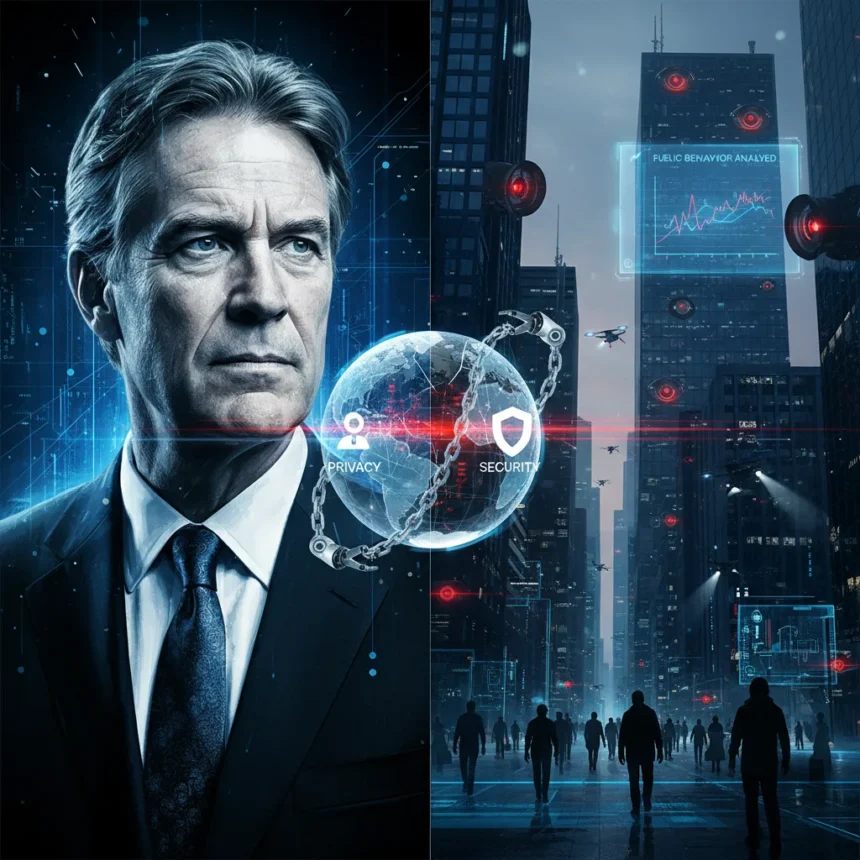
Larry Ellison, Oracle co-founder, has articulated a vision of an AI-powered surveillance state where continuous monitoring becomes the norm, not the exception. Speaking at Oracle’s financial analyst meeting, Ellison described a future in which security cameras, police body cams, and vehicle dashcams feed real-time footage into AI systems that analyze behavior and report problems to authorities. His comments crystallize a technological future many privacy advocates fear: a world where constant observation shapes how citizens behave.
Key Takeaways
- Ellison envisions AI-powered surveillance state using cameras across public-safety infrastructure to monitor police and citizens continuously
- He claims continuous surveillance will make citizens “on their best behavior” and reduce crime
- Historical police data bias could create racially skewed feedback loops when fed into AI systems
- A 2019 LAPD audit found its crime prediction program increased surveillance of Black and Latino communities
- The system would use AI to automatically flag problems and report them to appropriate authorities
Ellison’s Vision of Total Supervision
Ellison’s version of an AI-powered surveillance state rests on a simple premise: constant observation prevents wrongdoing. “We’re going to have supervision,” he stated, describing a world where “every police officer is going to be supervised at all times, and if there’s a problem, AI will report that problem and report it to the appropriate person”. The infrastructure is already partially in place—security cameras blanket most urban areas, law enforcement agencies deploy body cameras, and vehicles record dashcam footage. Ellison’s proposal simply connects these data streams into a unified AI system that watches the watchers and the watched alike.
The appeal is obvious: oversight of police conduct, faster crime prevention, and behavioral compliance without explicit coercion. But Ellison’s framing glosses over a critical flaw. He claims continuous surveillance will make “citizens will be on their best behavior because we are constantly recording and reporting everything that’s going on”. This assumes surveillance operates neutrally. It does not. Historical evidence suggests the opposite.
The Bias Problem Ellison Ignores
U.S. police data has never been neutral. A 2019 audit of the Los Angeles Police Department’s crime prediction program revealed that the AI system led to increased surveillance of Black and Latino neighborhoods, despite no corresponding increase in actual crime rates. When biased historical data feeds into AI systems, the algorithm amplifies those biases, creating what researchers call feedback loops—more surveillance of certain communities generates more arrests, which then trains the next iteration of the AI to focus even harder on those same areas. Ellison’s AI-powered surveillance state would turbochargethis dynamic.



The difference between Ellison’s vision and traditional surveillance is scale and speed. A human analyst reviewing footage can make judgment calls. An AI system running 24/7 across millions of camera feeds makes decisions at machine pace, with no pause for reflection or correction. Once a feedback loop begins, it accelerates automatically. The system does not care that it is targeting the wrong communities—it only knows what the historical data taught it.
Why This Matters Right Now
Ellison’s comments arrive at a moment when AI capabilities have outpaced legal and ethical frameworks. Facial recognition, behavioral analysis, and predictive policing are no longer theoretical—they are operational in cities worldwide. What Ellison is describing is not science fiction. It is an extrapolation of systems already deployed, simply made more comprehensive and automated. His willingness to articulate this vision publicly signals how normalized the idea of total surveillance has become in Silicon Valley.



The real danger is not Ellison’s honesty but the absence of serious pushback from policymakers. If an AI-powered surveillance state requires only existing hardware, AI software, and political will, then the question is not whether it can be built—it is whether democracies will choose to build it. Ellison’s comments should be read as a warning wrapped in enthusiasm, a tech leader describing a future his company is positioned to profit from, while leaving the hardest questions—about consent, power, and freedom—entirely unexamined.
Will AI surveillance actually reduce crime?
Ellison claims continuous surveillance prevents wrongdoing, but the evidence is mixed. While increased monitoring may deter some crimes, it also creates surveillance feedback loops that target marginalized communities disproportionately. A system is only as fair as the data it learns from, and U.S. policing data is historically biased.
How does an AI-powered surveillance state affect privacy rights?
Constant monitoring fundamentally erodes privacy by design. Citizens cannot consent to or opt out of surveillance integrated into public infrastructure. An AI-powered surveillance state normalizes the idea that all behavior is subject to recording and analysis, shifting the burden of privacy from institutions to individuals.
Could AI-powered surveillance systems be deployed without bias?
Not with current technology and historical police data. Biased training data produces biased AI systems. Unless policing data is first cleaned of systemic bias—a task that has not been accomplished anywhere—feeding it into AI will amplify existing inequities rather than eliminate them.


Ellison’s vision of an AI-powered surveillance state exposes a hard truth: technology companies and law enforcement agencies have the tools to build it, and the incentives to try. The question facing democracies is not whether the technology works—it does—but whether societies should accept the trade-offs. Privacy, autonomy, and freedom from constant observation are not luxuries. They are foundational to human dignity. A future where every citizen is always recorded and analyzed is not safer; it is simply controlled.
Edited by the All Things Geek team.
Source: TechRadar