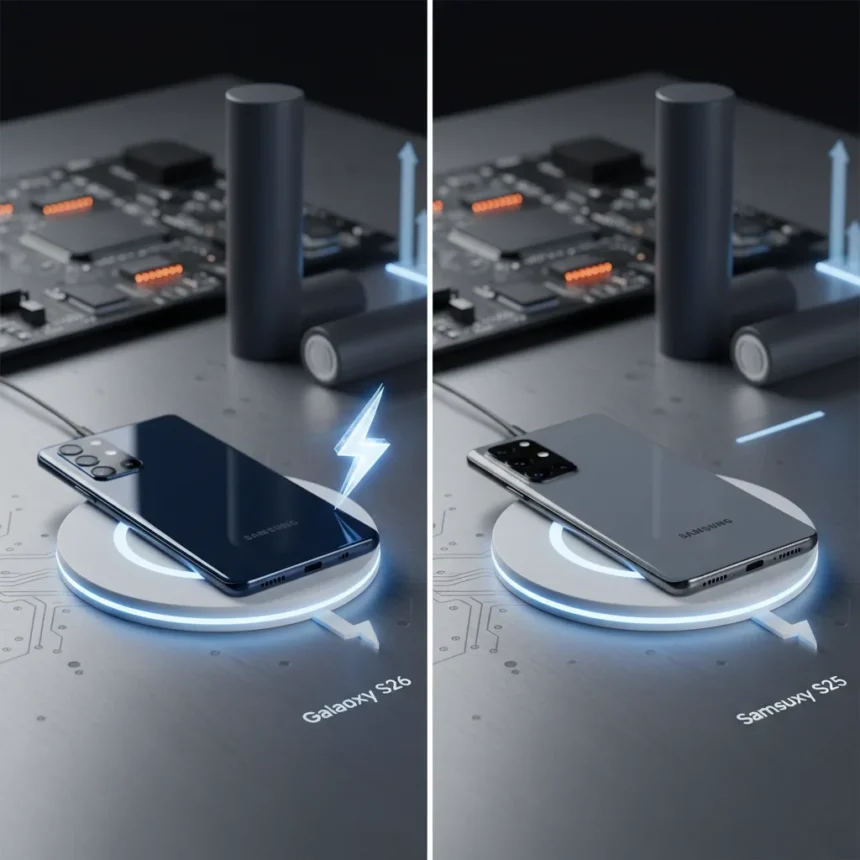
The Samsung Galaxy S26 vs S25 debate boils down to this: Samsung released a new flagship just one year after the S25 launched in February 2025, and the improvements are so thin that skipping this generation makes financial sense for most owners.
Key Takeaways
- Galaxy S26 launches March 2026 with 7% larger 4300mAh battery versus S25’s 4000mAh
- Screen gains 0.1 inches and 400 nits brightness but loses 7 PPI pixel density
- S26 gets Snapdragon 8 Elite Gen 5 (US) or Exynos 2600 (global); S25 uses Snapdragon 8 Elite
- S26 adds Qi2 15W wireless charging; base model skips wired speed upgrades given to Pro/Ultra
- One reviewer stated: “I personally wouldn’t upgrade from the S25 model”
The Battery Bump Is Real But Modest
The Samsung Galaxy S26 vs S25 comparison starts with the most tangible difference: battery capacity. The S26 packs a 4300mAh cell versus the S25’s 4000mAh—a 7% increase. For daily users, this translates to roughly an extra 30 minutes of endurance in mixed use, though the S25 already achieved 10 hours 6 minutes of gaming endurance. Neither phone will survive two full days of heavy use without charging.
The larger battery matters if you travel frequently or refuse to carry a charger, but it is not a reason to trade in a working S25. Battery degradation happens at the same rate on both devices, so within two years the practical difference shrinks further.
Display Gains Brightness But Loses Sharpness
Samsung’s screen upgrades favor brightness over pixel density. The Galaxy S26 vs S25 screen comparison reveals a 6.3-inch Dynamic LTPO AMOLED 2X panel on the S26 against the S25’s 6.2-inch Dynamic AMOLED. Peak brightness climbs from 2600 nits to 3000 nits, a meaningful jump for outdoor visibility. However, the pixel density drops from 416 PPI to 409 PPI—a subtle softening that most users won’t notice at arm’s length, but a retreat nonetheless.


Both screens support 120Hz refresh, HDR content, and identical screen-to-body ratios (91.02% vs 91.24%), so scrolling feels identical. The brightness upgrade helps in sunlight; the density loss is a wash in everyday use.
Processor Swap Brings Uneven Global Performance
The Samsung Galaxy S26 vs S25 processor story is fragmented by region. In the US and Canada, the S26 uses Snapdragon 8 Elite Gen 5, a generation newer than the S25’s Snapdragon 8 Elite. Global markets outside those regions receive the Exynos 2600 instead. This geographic split means US buyers get a modest CPU/GPU boost, while international customers receive a different chip that may perform similarly or worse depending on the workload.



Neither phone struggles with apps or gaming today. The S25 handles everything current Android throws at it. The Gen 5 upgrade offers future-proofing, but if you own an S25, you are not hitting performance walls right now.
Wireless Charging: The Confusing Upgrade
Here is where Samsung fumbled the Galaxy S26 vs S25 comparison. The base S26 adds Qi2 15W wireless charging support, which the S25 lacks. That sounds good until you realize the S26 base model does not ship with a faster wired charger—both phones still cap at 25W. The S26 Pro and Ultra models got the charging speed boosts (60W wired, 25W wireless on Ultra); the base S26 got the wireless standard without the power to match.
If you already own a Qi2-compatible charger, the S26 gains convenience. If you do not, you are buying into a wireless standard that few accessories support yet. Wired charging speed remains identical.
Software: One UI 8.5 vs One UI 7/8
The S25 ships with One UI 7 and upgrades to One UI 8; the S26 launches with One UI 8.5 based on Android 16 QPR2. This is a software generation ahead, but software updates flow to both phones over time. The S25 will receive One UI 8.5 eventually. This is not a reason to upgrade now.



The Ultra Models Tell a Different Story
The Samsung Galaxy S26 vs S25 comparison looks different at the Ultra tier. The S26 Ultra gains Snapdragon 8 Elite Gen 5 globally, faster 60W wired charging, 25W wireless, and improved camera sensors. The catch: the S26 Ultra still starts at $1299, the same price as the S25 Ultra. For S25 Ultra owners, trade-in deals can reduce the S26 Ultra to around $370 in the US, making the upgrade more attractive. The base S26 at $999.99 does not enjoy the same value proposition.
Should You Upgrade From the S25?
Unless you need Qi2 wireless charging or can exploit a trade-in deal, the Samsung Galaxy S26 vs S25 decision favors waiting. The battery gain is incremental. The screen is marginally brighter but less sharp. The processor upgrade is regional and not necessary for current apps. One year is too short a cycle for a flagship phone that still performs flawlessly. If you own an S25, keep it for two years minimum. If you own an S24 or older, the S26 is a reasonable upgrade, but the S25 remains a better value used.
Does the S26 have a faster processor than the S25?
The US and Canadian S26 models use Snapdragon 8 Elite Gen 5, one generation newer than the S25’s Snapdragon 8 Elite. Global models receive the Exynos 2600 instead. Performance gains are modest for everyday use; the S25 is not slow.
Is the Galaxy S26 worth buying over the S25?
Not if you own an S25. The improvements—7% more battery, 400 nits brighter screen, newer chip—do not justify the full retail price one year later. If you own an older phone or need Qi2 wireless support, the S26 is a solid choice at $999.99.
How much longer does the Galaxy S26 battery last compared to the S25?
The S26’s 4300mAh battery versus the S25’s 4000mAh yields roughly 30 additional minutes of mixed-use endurance, though real-world gains depend on usage patterns and screen brightness.
The Samsung Galaxy S26 vs S25 is a case study in why annual flagship cycles frustrate consumers. Samsung packed enough new features to justify a product launch, but not enough to justify trading in a phone that works perfectly. Wait for the S27, or pick up a discounted S25 if you need an upgrade now.
Edited by the All Things Geek team.
Source: Tom's Guide