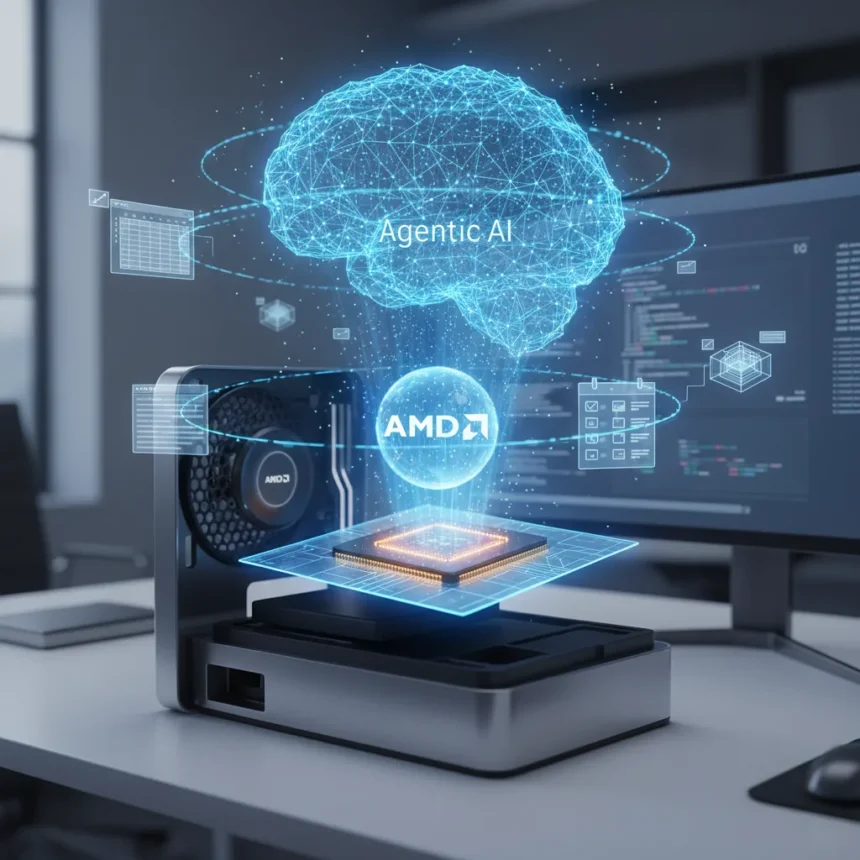
Agentic AI refers to autonomous AI systems that execute complex, multi-step tasks independently — without waiting for a human to issue every command. AMD believes this shift represents the most significant opportunity the PC industry has seen in decades, and on March 16, 2026, the company formally introduced a new device category called “Agent Computers” to capture it. The pitch is direct: the traditional PC is the machine you use; the Agent Computer is the machine that works for you.
Key Takeaways
- AMD launched the Agent Computer category on March 16, 2026, targeting always-on autonomous AI workflows.
- The Ryzen AI Max+ 395 supports up to 200B parameter models locally with 128GB unified memory and 256GB/s bandwidth.
- Gartner projects agentic AI will appear in 33% of enterprise software by 2028, up from under 1% in 2024.
- AMD CEO Lisa Su warned of tightening CPU supply due to unexpected agentic AI demand as of March 4, 2026.
- AMD’s performance claims against Nvidia rely on AMD-published figures, with no independent third-party benchmarks available in current sources.
What is agentic AI and why does it matter now?
Agentic AI describes systems that are always active, continuously accessing data, applications, and services to make decisions and complete complex tasks — a definition AMD CEO Dr. Lisa Su offered at the company’s Advancing AI event in June 2025. Unlike a chatbot that answers a question and stops, an agentic system handles parallel workflows end-to-end: drafting documents, querying databases, triggering app actions, and reporting results, all without step-by-step user oversight.
The timing matters. Gartner projects agentic AI will be present in 33% of enterprise software by 2028, compared to less than 1% in 2024. That is a trajectory fast enough to catch most IT departments flat-footed. AMD’s argument is that businesses which build agentic infrastructure now — on local hardware, not cloud subscriptions — will have a structural cost and privacy advantage when adoption accelerates. It’s a compelling argument, even if AMD is also the company selling the hardware to make it happen.
What makes an Agent Computer different from a standard AI PC?
An Agent Computer, as AMD defines it, is built for continuous, autonomous operation — running AI agents that communicate across apps via messaging platforms like WhatsApp and Slack, executing tasks in parallel without waiting for human input between steps. That is a meaningfully different workload profile from a standard AI PC, which typically runs inference on demand and then idles.


The hardware anchor for this category is the AMD Ryzen AI Max+ 395: 16 Zen 5 cores, 128GB of unified memory capable of running models up to 200 billion parameters locally, 256GB/s memory bandwidth, and a dedicated NPU delivering over 50 TOPS for AI inference. The unified memory architecture is the critical differentiator here. Running a 200B parameter model locally — privately, without cloud latency or per-token fees — requires the kind of memory bandwidth that discrete GPU setups with separate VRAM pools simply cannot match at this price tier.
AMD has also identified the Ryzen AI Halo and the Framework Desktop as strong Agent Computer candidates, citing category-leading cost-per-action for agentic workloads. The Framework Desktop mention is notable: it signals that Agent Computers are not necessarily premium-only territory, and that the open, upgradeable hardware philosophy aligns well with the iterative nature of agentic AI development.



How agentic AI software actually runs on AMD hardware
The Generate Agentic AI Suite from Iterate.ai offers a concrete example of what local agentic workflows look like in practice. The suite runs entirely offline on AMD PCs, using what it calls Agentic AI cards for private retrieval-augmented generation (RAG) workflows, document analysis, and automation tasks. No data leaves the device. For enterprises handling sensitive documents — legal, financial, medical — that privacy guarantee is worth more than any benchmark score.
The technical stack works in layers. The Ryzen AI processor handles local inference and parallel processing across multiple Agentic AI cards. AMD Radeon Graphics accelerates AI visualization and data processing via GPU. AMD’s Lemonade Server manages model selection and fast inference flexibility. On-device optimization across all three components minimizes latency and sustains performance without compromising thermal or battery stability. It’s a tightly integrated stack — and that integration is precisely where AMD’s architecture has an edge over solutions that bolt discrete components together.
How does AMD’s agentic AI hardware compare to Nvidia?
AMD’s server-side numbers are striking on paper. The 5th Gen AMD EPYC processor delivers 2.1x higher performance per core versus the Nvidia Grace Superchip, and a 2.26x uplift on SPECpower — a measure of operations per watt. AMD is also developing next-gen EPYC “Venice” processors for its “Helios” rack-scale AI architecture, targeting the infrastructure layer where agentic workloads at enterprise scale will ultimately run.
The honest caveat: these figures come from AMD’s own published estimates, not independent third-party testing. That doesn’t make them wrong, but it does mean they deserve scrutiny before they drive procurement decisions. On the client side, AMD positions the Ryzen AI Max+ as superior for local and multi-agent workloads compared to traditional PCs, with an integrated CPU, GPU, and ROCm software stack rather than isolated components. Whether that integration advantage holds up under sustained agentic load is something the market will determine over the next 12 to 18 months.



Is the Agent Computer hype justified?
AMD’s supply warning is the most credible signal that agentic AI demand is real. Lisa Su flagged unexpected CPU demand and tightening supply as of March 4, 2026 — a supply constraint driven by agentic AI workloads, not just the usual AI server boom. When a chip company warns its own customers about supply limits, it’s not doing so for marketing effect.
The Ryzen AI 400 series targeting mainstream notebooks, desktops, and mini-PCs suggests AMD is not limiting this vision to enterprise workstations. If agentic AI becomes a mainstream workflow tool — and Gartner’s 33% enterprise projection suggests it will — the addressable market extends well beyond the developers and early adopters currently building on Ryzen AI Max+ systems.
What is an Agent Computer and how is it different from a regular PC?
An Agent Computer is a device category introduced by AMD on March 16, 2026, designed for always-on autonomous AI operation. Unlike a standard PC that waits for user commands, an Agent Computer runs AI agents continuously across apps and services, handling parallel tasks end-to-end with minimal human oversight.
Can agentic AI really run locally without cloud access?
Yes, on capable hardware. The AMD Ryzen AI Max+ 395 supports up to 200B parameter models locally using 128GB of unified memory, enabling private, offline AI inference with no data sent to external servers. The Generate Agentic AI Suite from Iterate.ai already demonstrates this in practice, running RAG workflows and document analysis entirely on-device.
How fast is agentic AI adoption growing in enterprise?
Gartner projects agentic AI will be embedded in 33% of enterprise software by 2028, up from less than 1% in 2024. AMD CEO Lisa Su’s March 2026 supply warning suggests the ramp is already happening faster than the chip industry anticipated.
AMD’s Agent Computer vision is the most coherent hardware response to agentic AI that any chip maker has articulated so far. The Ryzen AI Max+ 395 specs are genuinely impressive for local model execution, the software ecosystem is taking shape, and the market trajectory is real. What’s missing is independent validation — third-party benchmarks that confirm AMD’s performance claims under sustained agentic load. Until those exist, treat the Agent Computer category as a compelling early bet, not a proven standard. The companies that build agentic infrastructure now may well have a durable advantage. Just make sure the hardware you’re buying can actually deliver before the market catches up.
Edited by the All Things Geek team.
Source: TechRadar