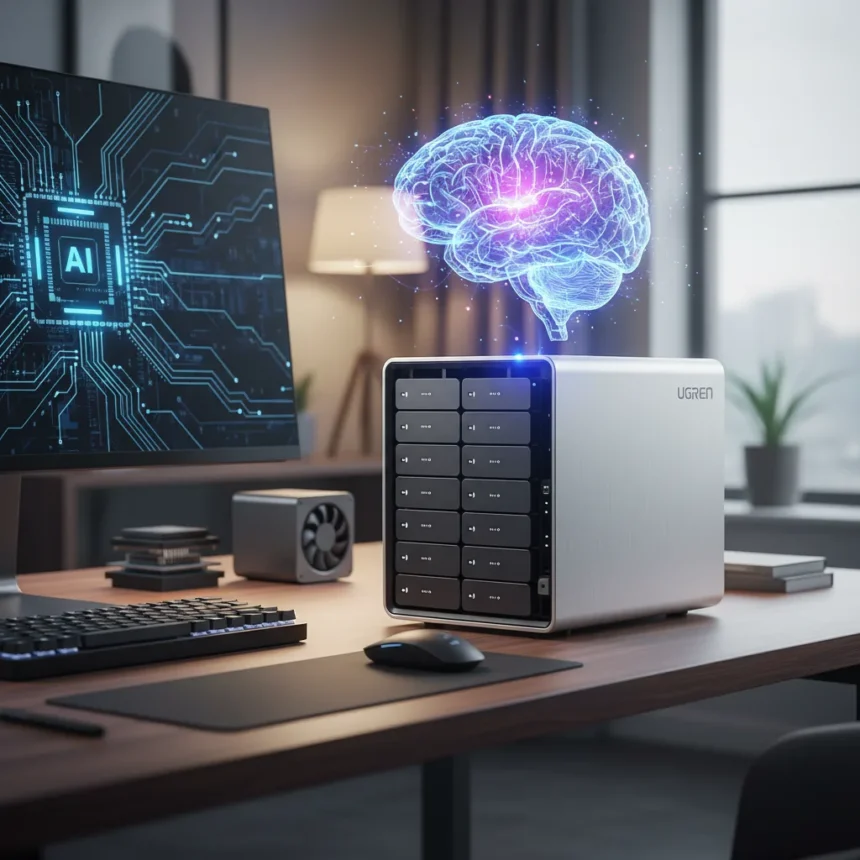
The UGreen NASync iDX6011 Pro NAS is a network attached storage device that merges workstation-class hardware with local artificial intelligence capabilities, launching at a price point that positions it squarely in the premium segment of the NAS market. This is not your typical consumer storage box—it is a machine designed for users who need both serious computational power and the ability to run AI workloads without sending data to the cloud.
Key Takeaways
- Combines desktop-grade processors with local AI inference capabilities for privacy-focused workflows.
- Premium pricing reflects high-end hardware specifications and workstation-class performance.
- Local AI features eliminate cloud dependency for sensitive data processing tasks.
- Targets professionals and power users, not casual home storage seekers.
- Bridges the gap between traditional NAS and AI-capable computing devices.
UGreen NASync iDX6011 Pro NAS: What Sets It Apart
The UGreen NASync iDX6011 Pro NAS stands apart because it refuses to be just a storage appliance. Instead of relegating AI processing to cloud services, this device handles inference locally, meaning your data never leaves your network. That architectural choice matters enormously for anyone processing sensitive documents, medical records, or proprietary business information. The hardware underneath justifies the premium—this is not a typical NAS processor squeezed into a box.
What makes the UGreen NASync iDX6011 Pro NAS genuinely different is the integration of workstation-class components. Unlike conventional NAS devices that prioritize power efficiency and quiet operation, this machine embraces the performance-first philosophy of desktop systems. That design choice creates friction with traditional NAS expectations, but it solves a real problem: users who need both storage and computation no longer have to buy two separate devices.
Hardware and Performance: Desktop Power in Storage Form
The UGreen NASync iDX6011 Pro NAS delivers computational capability that rivals entry-level workstations. This is where the device justifies its premium positioning—the internals are genuinely impressive and not the typical NAS fare. The machine is built for sustained multi-threaded workloads, not just sequential file serving, which changes how you can use it in practice.


Running AI models locally on the UGreen NASync iDX6011 Pro NAS means you avoid the latency and privacy concerns of cloud-based inference. Processing happens on-device, which matters when you are working with video analysis, document classification, or image recognition tasks. The hardware can handle these workflows without requiring a separate GPU workstation. For professionals managing large datasets, this eliminates the need to architect complex cloud pipelines or worry about data residency regulations.
Compared to traditional NAS devices from competitors like Synology or QNAP, the UGreen NASync iDX6011 Pro NAS takes a fundamentally different approach. Those systems excel at reliability and efficiency for pure storage duties. The iDX6011 Pro sacrifices some of that focused optimization to become a hybrid device—part storage, part compute platform. That trade-off works brilliantly if you need both functions, but it makes the device overkill if you only want network storage.



Local AI Capabilities: Privacy Without Compromise
The AI features on the UGreen NASync iDX6011 Pro NAS are not marketing fluff bolted onto a storage device. They represent a genuine architectural commitment to processing-on-device rather than streaming data to cloud APIs. Running inference locally protects your data from exposure to third-party services and eliminates recurring cloud compute costs. For enterprises handling confidential information, this capability transforms the device from a storage appliance into a compliance asset.
The local AI processing on the UGreen NASync iDX6011 Pro NAS works because the hardware can actually handle it. You are not waiting for results or dealing with throttled performance. Tasks that would normally require expensive cloud compute can run continuously on your own hardware. That changes the economics of machine learning workflows for small teams and individual professionals.
Price and Positioning: Premium Hardware Demands Premium Cost
The UGreen NASync iDX6011 Pro NAS costs significantly more than conventional NAS devices, and that price reflects the hardware inside. You are paying for workstation-class components, not consumer-grade storage appliance parts. If you only need a backup device or network storage for media files, this machine is overkill. But if you need a device that genuinely handles both storage and local AI processing, the pricing becomes more defensible.
The real question is whether you actually need this combination of storage and compute in a single box. For many users, the answer is no—they can get away with cheaper NAS for storage plus a separate machine for AI work. But for professionals who need both functions without managing multiple devices, the UGreen NASync iDX6011 Pro NAS solves a genuine problem.



Design and Usability: Form Follows Function
The UGreen NASync iDX6011 Pro NAS does not pretend to be a sleek consumer device. It looks like what it is—a workstation-class machine in a NAS form factor. The industrial design prioritizes function over aesthetics, which is appropriate for a device intended for professional environments or serious home labs. Noise and heat output reflect the performance orientation; this is not a whisper-quiet device designed for living room placement.
Setup and management follow familiar NAS conventions, which helps offset the learning curve of working with a more powerful machine. The software interface should feel comfortable to anyone who has used Synology or QNAP systems, though the underlying hardware capabilities are substantially different.
Is the UGreen NASync iDX6011 Pro NAS Worth Buying?
The UGreen NASync iDX6011 Pro NAS makes sense if you genuinely need local AI processing plus network storage in a single device. If you are a data analyst, small business owner, or creative professional working with sensitive information, the privacy benefits of local inference justify the premium. But if you need a straightforward backup solution or media server, cheaper alternatives will serve you better.
What makes the UGreen NASync iDX6011 Pro NAS different from regular NAS devices?
The UGreen NASync iDX6011 Pro NAS combines workstation-class hardware with local AI inference capabilities. Traditional NAS devices prioritize storage reliability and efficiency; this machine adds serious computational power and the ability to run AI models without sending data to the cloud.
Can the UGreen NASync iDX6011 Pro NAS replace a separate AI workstation?
For many workflows, yes. The UGreen NASync iDX6011 Pro NAS can handle local inference tasks that would normally require a dedicated GPU workstation. Whether it fully replaces a separate machine depends on your specific needs—if you only do occasional AI work, a separate device might still make sense.
Is local AI processing on the UGreen NASync iDX6011 Pro NAS faster than cloud APIs?
Local processing eliminates cloud latency and avoids the overhead of uploading and downloading data. For the UGreen NASync iDX6011 Pro NAS, this means faster inference for most tasks, plus the privacy benefit of keeping data on your own hardware.
The UGreen NASync iDX6011 Pro NAS succeeds because it refuses to compromise on either storage or compute. It is expensive, it is powerful, and it solves a specific problem for professionals who need both capabilities in a single device. If that describes your workflow, it is worth the premium. If you need just storage or just compute, you will find cheaper alternatives that fit better.
Edited by the All Things Geek team.
Source: TechRadar