



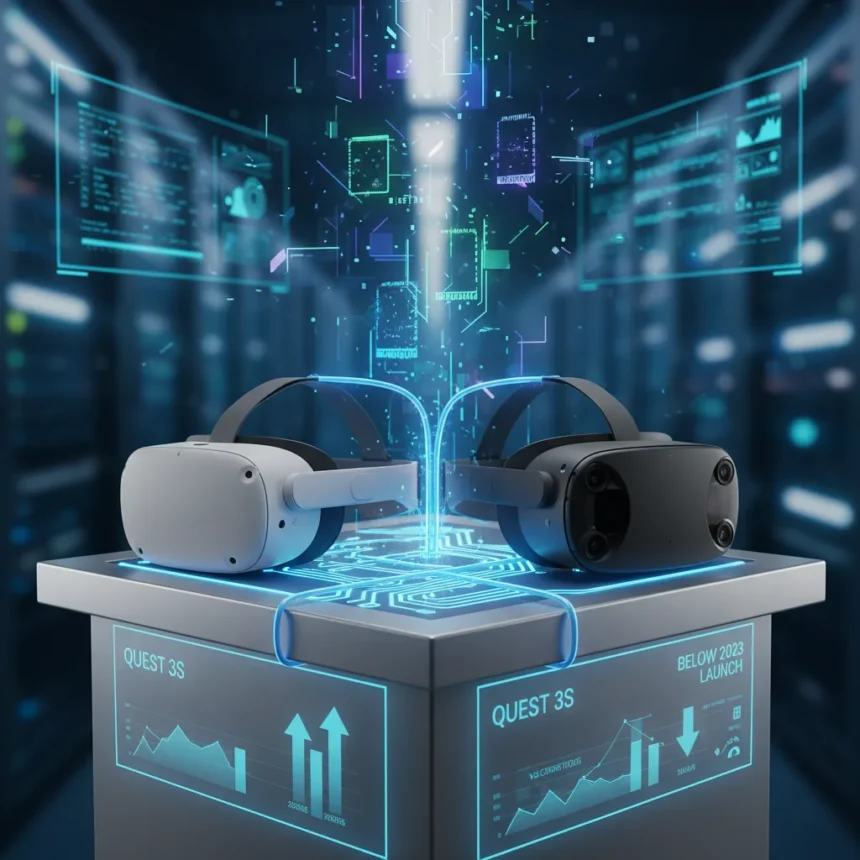
Meta Quest 3S and Quest 3 price hike announcements landed in April 2026 with the kind of inevitability that makes industry observers nod knowingly. Starting April 19, the Quest 3S 128GB model jumps from $300 to $350, the 256GB variant climbs from $400 to $450, and the Quest 3 512GB model leaps from $500 to $600. Meta’s explanation: memory chips have become scarce and expensive.
Key Takeaways
- Meta Quest 3S and Quest 3 price hike takes effect April 19, 2026, with increases ranging from $50 to $100 per model.
- Meta blames the increase on a global RAM and flash storage shortage driven by AI chip demand.
- Quest 3 at $600 still costs $50 less than its original $650 launch price in 2023.
- Competitors including Samsung, Microsoft, and Sony also raised hardware prices due to the memory crisis.
- Fans view the new prices as acceptable given the value proposition and component cost pressures.
The blame lands squarely on the global memory chip shortage. “We’re making this change because the cost of building high-performance VR hardware has risen significantly,” Meta said in its announcement. “The global surge in the price of critical components — specifically memory chips — is impacting almost every category of consumer electronics, including VR”. The AI boom has turbocharged demand for advanced semiconductors, and VR headsets depend on both LPDDR5 memory and flash storage. While LPDDR5 has faced less pressure than DDR5, flash storage prices have roughly doubled since 2025.
Why the Meta Quest 3S and Quest 3 price hike happened now
The timing is not random. AI infrastructure buildouts have created a bottleneck in memory chip production that ripples across consumer electronics. Meta’s statement acknowledges this directly: the cost of maintaining the “quality of hardware, software, and support” on the Quest platform demands higher prices. It is a familiar argument in tech — pass component costs to consumers or absorb them and shrink margins. Meta chose the former.
This is not Meta’s first rodeo with VR price adjustments. In 2022, the company raised Quest 2 prices by $100, a move it later reversed. That history adds context to the current hike. Fans appear more forgiving this time, possibly because the Quest 3 at its new $600 price still undercuts its original $650 launch price from 2023. The Quest 3S, meanwhile, remains an affordable entry point into standalone VR at $350 for the base model.


Meta Quest 3S and Quest 3 price hike in context of competitors
Meta is not alone. Samsung, Microsoft, and Sony have all raised hardware prices in response to the memory crisis. Valve announced delays and pricing revisions for its Steam Frame and Steam Machine devices, citing the same memory shortage and targeting a release in the first half of 2026. The broader industry is recalibrating around higher component costs, making Meta’s move feel less like price gouging and more like synchronization with market realities.
What distinguishes Meta’s position is that the Quest platform remains competitively priced. The Quest 3S at $350 for 128GB positions it as the most accessible standalone VR headset. The Quest 3, despite the hike, still offers more power and features than competitors at comparable price points. Refurbished units also receive the price adjustment, signaling that Meta is applying the increase uniformly across its inventory.

Is the Meta Quest 3S and Quest 3 price hike justified?
Analysis suggests Meta’s increases may exceed the pure component cost burden. RAM prices have surged up to 400 percent in some categories, but the Quest 3S and Quest 3 use LPDDR5, which has faced less dramatic pressure. Flash storage has doubled from 2025 levels, a significant jump but one that does not fully account for the $50 to $100 price jumps across the lineup. This hints that Meta is spreading the memory crisis cost strategically across models rather than absorbing it entirely or passing it through in lockstep with component inflation.
Yet fans and analysts are not outraged. The consensus seems to be that VR hardware is genuinely expensive to build, and memory chips represent a real cost driver. At $350, the Quest 3S remains an attractive entry point. At $600, the Quest 3 is still cheaper than its 2023 debut, a fact that softens the sting of the increase. This is not a market correction that feels exploitative — it feels like a company adjusting to real constraints.
What happens to accessories and refurbished units?
Meta’s price adjustments apply to the headsets themselves and refurbished inventory, but accessories remain unchanged. This means buyers can still expand their VR setup with controllers, straps, and other add-ons at existing prices. The decision to hold accessories steady while raising core hardware prices is a small gesture of restraint.
Does the Meta Quest 3S and Quest 3 price hike signal a trend?
Yes. The memory crisis is not a temporary blip — it reflects structural demand from AI infrastructure buildouts that will persist through 2026 and likely beyond. Expect similar price adjustments across consumer electronics. The fact that multiple manufacturers are raising prices simultaneously suggests this is a sector-wide recalibration, not individual company greed. For VR specifically, the Quest platform’s price increases come at a moment when the installed base is growing and software support is maturing, factors that may offset some buyer resistance to higher prices.


Should I buy a Meta Quest 3S or Quest 3 before the price hike?
If you have not purchased yet, the April 19 deadline is real. The Quest 3S at $350 is still the most accessible standalone VR entry point, and the Quest 3 at $600 remains competitive with its original launch price. After April 19, both models cost more, and there is no indication Meta will reverse the increase as it did in 2022. Buy now if you were already considering a purchase.
Are the Meta Quest 3S and Quest 3 still good deals after the price increase?
The Quest 3S at $350 remains the best value in standalone VR for casual users and newcomers. The Quest 3 at $600 is pricier but still undercuts its 2023 launch price and offers significantly more performance. Whether they are a “good deal” depends on your use case — if you value standalone VR without external PC or console requirements, yes. If you are comparing strictly on price, the increases narrow the margin, but the Quest platform’s software ecosystem and ease of use still justify the cost.
Meta’s Meta Quest 3S and Quest 3 price hike is a reality check for the VR industry. Memory chips are expensive, AI demand is real, and consumers are absorbing the cost. The company could have absorbed the increases or delayed new hardware, but instead it chose transparency and a price adjustment that still keeps its flagship products competitive. For buyers, the lesson is simple: if you were thinking about jumping into VR, April 19 is the cutoff date before prices rise. After that, the math shifts.
Where to Buy
This article was written with AI assistance and editorially reviewed.
Source: TechRadar


