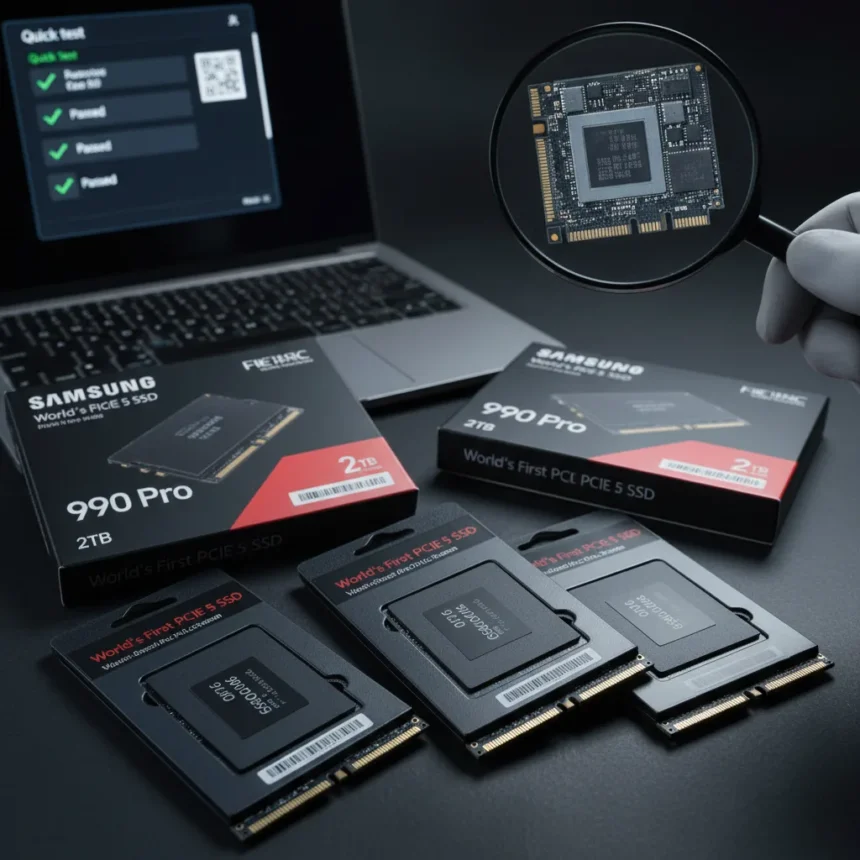
Fake Samsung 990 Pro SSDs are now circulating across Europe with a level of sophistication that makes them nearly indistinguishable from genuine drives in casual inspection. In early April, two counterfeit 1TB models were purchased from an Austrian online store and reported by German tech outlet ComputerBase, revealing a counterfeiting operation that has already hit Japan and is now targeting European buyers.
Key Takeaways
- Fake Samsung 990 Pro SSDs use inferior Maxio MAP1602 controllers and likely QLC NAND instead of genuine TLC V-NAND
- Counterfeit drives pass quick benchmarks like CrystalDiskMark but fail under sustained workloads
- Samsung Magician app identifies fakes as “non-Samsung” and blocks diagnostic features
- Austrian retailer is investigating how counterfeits entered its supply chain
- Genuine Samsung 990 Pro 1TB models cost around $319 on Amazon
How Sophisticated Fake Samsung 990 Pro SSDs Deceive Buyers
The counterfeit drives are engineered to fool both visual inspection and initial performance testing. According to Akiba PC Hotline, the fakes that flooded Japanese markets “report correct capacity, pass quick benchmarks like CrystalDiskMark, but use Maxio MAP1602 controller (DRAM-less, smaller design), likely QLC NAND instead of genuine Samsung 176-Layer V-NAND TLC and Pascal controller with LPDDR4 DRAM”. The rear of the fake PCB openly states the Maxio model number, a detail genuine drives would never expose.
The Austrian counterfeits show different red flags in physical packaging. ComputerBase found that the fake Samsung 990 Pro drives featured poorer print quality on the box, misplaced CE markings, and a blue PCB instead of the genuine black PCB. These visual cues are easier to spot than the Japanese variants, but many buyers purchase online without inspecting packaging in detail.
Tom’s Hardware noted that the fake SSD “features a frighteningly sophisticated level of counterfeiting,” highlighting how the operation has evolved beyond crude knock-offs. The counterfeits are now “harder to distinguish from genuine ones, are now flooding the market,” according to reporting from Japanese sources.


Why Standard Tests Miss Fake Samsung 990 Pro SSDs
This is where the counterfeiting becomes dangerous. A buyer running CrystalDiskMark or checking Windows storage properties will see the correct capacity and near-identical speed numbers compared to a genuine drive. The fake drives perform adequately under short benchmark runs because the Maxio controller handles sequential reads and writes reasonably well in brief stress tests.
The problems emerge during sustained workloads. QLC NAND, used in the counterfeits, has lower endurance and slower write speeds when the drive’s cache fills up—something that happens quickly under real-world usage like large file transfers or video editing. A user might not notice degradation for weeks, by which time the return window has closed.



CrystalDiskInfo will flag the mismatched memory and firmware ID if you know what to look for, but the tool requires technical knowledge to interpret. This is why Samsung Magician is the most reliable detection method.
The Definitive Way to Identify Fake Samsung 990 Pro SSDs
Samsung Magician, the company’s free diagnostic app, is the gold standard for authentication. When you connect a fake Samsung 990 Pro drive to your PC via M.2 slot or external enclosure and launch Samsung Magician, the app identifies counterfeits as “non-Samsung” and blocks features like diagnostic scans and performance optimization. This is not a false positive—Samsung Magician’s firmware recognition is tied to the drive’s actual controller and NAND architecture, both of which differ fundamentally in counterfeits.
Beyond Samsung Magician, you can inspect the PCB color (genuine is black, Austrian fakes were blue), check the controller label (should be Pascal, not Maxio), and examine rear labeling for any third-party controller model numbers. If you buy from an unfamiliar online retailer, request high-resolution photos of the drive’s rear before purchase. Legitimate sellers will accommodate this request; scammers rarely will.
Where Fake Samsung 990 Pro SSDs Are Appearing
The Austrian online store that sold the counterfeits is investigating its wholesaler, but the source of the fake inventory remains unclear. The drives are confirmed in German and Austrian markets after being initially reported in Japan, suggesting a supply chain infiltration rather than isolated incidents. This pattern indicates the counterfeiting operation has access to legitimate distribution channels or is exploiting them through fraudulent wholesale accounts.



Buying from Amazon, Newegg, or other major retailers significantly reduces risk because these platforms verify seller credentials and offer buyer protection. Smaller online stores, especially those with limited feedback histories, are higher-risk sources. If a price seems unusually low for a genuine Samsung 990 Pro—significantly below $319—that is a warning sign.
What Makes Genuine Samsung 990 Pro Drives Different
The authentic Samsung 990 Pro uses a proprietary Pascal SSD controller paired with LPDDR4 DRAM and 176-Layer V-NAND TLC NAND. This combination delivers consistent performance across both quick bursts and sustained workloads. The drive’s DRAM buffer allows it to handle large file operations without performance cliffs, something the DRAM-less Maxio controller in counterfeits cannot match.
The genuine drive’s TLC NAND also outlasts QLC alternatives in endurance testing. TLC stores three bits per cell; QLC stores four. This means QLC cells wear faster and have lower write speeds when the cache fills. For professional workflows involving constant large file transfers, this difference compounds over months of use.
How to Protect Yourself From Fake Samsung 990 Pro SSDs
Start by buying from trusted retailers with verified seller ratings and return policies that cover defective products. Before installation, download Samsung Magician and run it on any new drive, even if it appears genuine. If the app flags it as “non-Samsung,” you have documentation for a return or chargeback.
If you have already purchased a drive from a questionable source, test it immediately rather than waiting weeks. Run CrystalDiskInfo to check for firmware mismatches, inspect the PCB if you can open the enclosure, and use Samsung Magician as your final verification step. The sooner you detect a counterfeit, the easier the return process.
Is Samsung Magician the only way to detect fake Samsung 990 Pro SSDs?
Samsung Magician is the most reliable method because it reads the drive’s firmware and controller directly. However, visual inspection of the PCB, controller label, and packaging can reveal Austrian-style counterfeits. CrystalDiskInfo will show mismatched specs in sophisticated fakes, but requires technical interpretation. Use multiple methods together rather than relying on any single test.
Can fake Samsung 990 Pro SSDs damage your PC?
Counterfeits are unlikely to physically damage your motherboard, but they can fail unexpectedly, causing data loss if you do not have backups. The real risk is performance degradation and sudden failure after the return window closes. This makes early detection critical.
Should I buy Samsung 990 Pro drives from smaller online retailers?
Smaller retailers carry legitimate inventory, but the counterfeiting operation has already infiltrated at least one Austrian store. If you buy from a smaller retailer, verify the seller’s feedback history, request photos of the product before purchase, and test immediately upon arrival using Samsung Magician. Major platforms like Amazon offer better buyer protection if something goes wrong.
The fake Samsung 990 Pro SSD crisis is a reminder that even premium storage components are targets for sophisticated counterfeiting. The good news is that detection is straightforward if you use the right tools. Download Samsung Magician, buy from trusted sources, and test immediately upon arrival. These three steps eliminate virtually all risk from counterfeit drives flooding European markets.
Edited by the All Things Geek team.
Source: TechRadar