





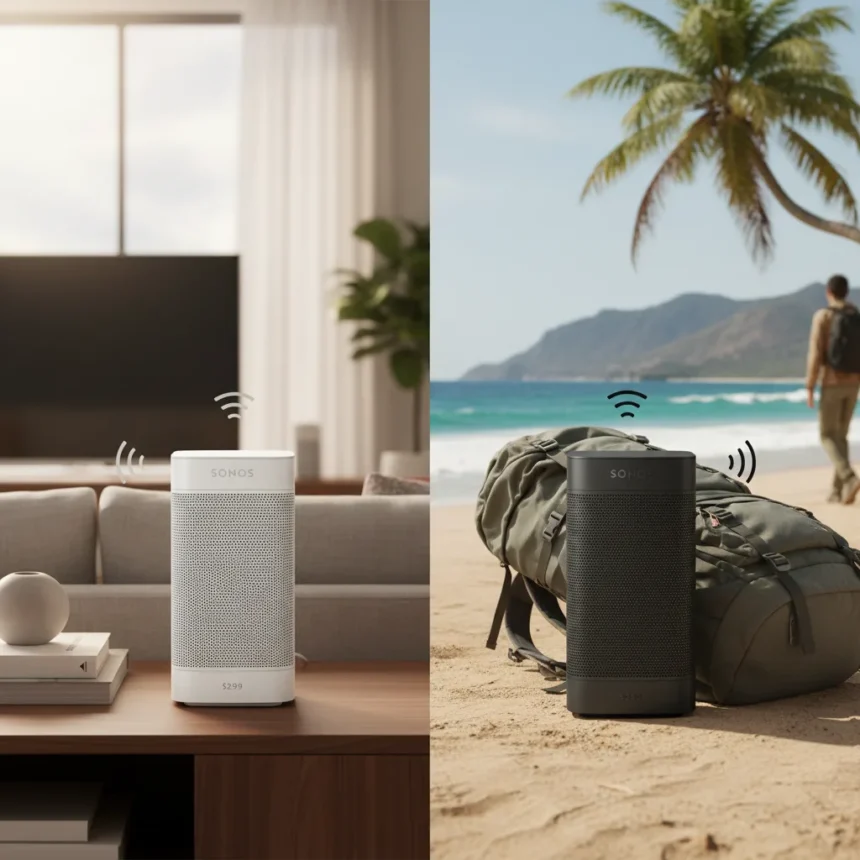
The Sonos Play speaker is a $299 portable device that does something most speakers refuse to do: it works equally well as a standalone Bluetooth device and as part of Sonos’s entire Wi-Fi multi-room ecosystem. That dual identity is the story here. Most portable speakers choose one lane and stay in it. The Sonos Play straddles both, offering 24-hour battery life, balanced sound, and a design that travels without losing access to your home audio network.
Key Takeaways
- Sonos Play combines Wi-Fi multi-room audio with Bluetooth connectivity in one $299 speaker.
- 24-hour battery life supports full-day portable use without recharging.
- Balanced sound signature works across music genres without excessive bass boost.
- Portable design integrates with Sonos ecosystem for multi-room expansion at home.
- Bridges gap between dedicated portable Bluetooth speakers and stationary Wi-Fi audio.
Sonos Play Speaker: Dual-Mode Audio That Actually Works
The Sonos Play speaker delivers balanced sound from a compact, portable form factor. Unlike Sonos’s stationary speakers, which anchor themselves to your home network, the Play is built to move. Plug it in at home and it joins your Sonos ecosystem instantly, letting you group it with other speakers or control it from the app. Take it to a friend’s apartment, a patio, or a beach and it becomes a standalone Bluetooth speaker. The battery lasts 24 hours, which means you are not hunting for outlets constantly.
This hybrid approach matters because the portable speaker market has fractured. You either buy a Bluetooth-only device like the Marshall Kilburn III, which sounds great but cannot talk to your home speakers, or you commit to a Wi-Fi ecosystem and sacrifice portability. The Sonos Play refuses that binary choice. It is not the loudest speaker in its price range, and it is not the most feature-rich. But it is the only one that genuinely works in both contexts without compromise.
Sound Quality and Balanced Audio Profile
The Sonos Play delivers balanced sound, which means it does not color the music with artificial bass boost or treble spike. That approach appeals to people who listen across genres—pop, jazz, podcasts, classical—without wanting the speaker to impose its personality on the mix. The speaker uses multiple driver configurations to separate frequency ranges, a design philosophy Sonos has refined across its product line.


Compared to the Marshall Kilburn III, which displaced the Sonos Move 2 as Tom’s Guide’s top Bluetooth speaker pick, the Play takes a different tonal path. The Marshall leans into color and character; the Sonos Play aims for transparency. Neither is objectively better—it depends on whether you want the speaker to disappear into the mix or to add its own flavor. For critical listening at home, balanced sound wins. For outdoor parties, you might prefer the Marshall’s more assertive presence.
Multi-Room Potential and Home Integration
At home, the Sonos Play becomes part of something larger. Add it to a room in the Sonos app and it can play in sync with other Sonos speakers, or independently. You can group the Play with a Sonos Arc soundbar in your living room, or with a Sonos One in your kitchen. That expandability is where the Sonos ecosystem proves its value. A standalone Bluetooth speaker cannot do this.



The Sonos app handles all the heavy lifting—room assignment, grouping, zone control, and audio optimization through Trueplay tuning, which uses your phone’s microphone to calibrate sound for your specific space. This integration is seamless if you already own Sonos speakers; it is a nice bonus if the Play is your first device. Either way, the Wi-Fi connectivity means you are not limited to Bluetooth range or paired-device restrictions.
Battery Life and Portability in Practice
Twenty-four hours of battery life is the headline, and it is genuinely useful. A full charge gets you through a day of moderate use—music during breakfast, a few hours at the office, evening listening without plugging in. That is more than most Bluetooth speakers offer in this price range. The portable design means the speaker fits in a backpack or bag without dominating the space.
The trade-off is that you cannot squeeze a 24-hour battery into a speaker that also delivers concert-hall volume. The Sonos Play is not the loudest option at $299, but it is loud enough for a room, a patio, or a small gathering. If you need to fill a stadium, buy a different speaker. If you need reliability, battery life, and balanced sound in a package that also works at home, this is the target.
Where the Sonos Play Fits in Your Setup
The Sonos Play is not a replacement for a dedicated Bluetooth speaker if pure portability is your only goal. The Audio Pro Addon C3 and similar alternatives exist in the same space, each with different strengths. But the Sonos Play is the only one that also functions as a serious home audio component. That duality is its defining feature and its justification for the $299 price.


If you already own Sonos speakers, the Play becomes a logical addition—an extra zone for the bedroom, a portable option for travel, a speaker that bridges your home and your life outside it. If you are building your first Sonos system, the Play is an unconventional starting point, but it works. You get home audio capability plus portability in one device, which is rare.
Is the Sonos Play worth $299?
The Sonos Play justifies its price if you value both home integration and portability equally. If portability is your only concern, cheaper Bluetooth speakers exist. If home audio is your only concern, the Sonos One or Play:1 offer better value as stationary speakers. The Play is for people who refuse to choose between the two.
How does the Sonos Play battery compare to other portable speakers?
The 24-hour battery life is competitive for a speaker in this price range. Most portable Bluetooth speakers in the $200-$400 bracket deliver 12-20 hours. The Sonos Play’s advantage is that the battery supports both Wi-Fi and Bluetooth modes without requiring a separate charge cycle, meaning you can switch between home and travel use without draining faster.
Can the Sonos Play work without Wi-Fi?
Yes. The Sonos Play functions as a standard Bluetooth speaker when Wi-Fi is unavailable. Switch to Bluetooth mode and it behaves like any other portable speaker—pair it once and it reconnects automatically. You lose the multi-room features and Sonos app control, but the speaker still plays music and the battery still lasts 24 hours.
The Sonos Play is a bridge device in a market that usually demands you pick a side. It is not the best Bluetooth speaker, and it is not the most feature-rich home audio solution. But it is the only one that genuinely excels at both. For $299, that versatility is worth the premium over single-purpose alternatives.
Where to Buy
Edited by the All Things Geek team.
Source: Tom's Guide




