






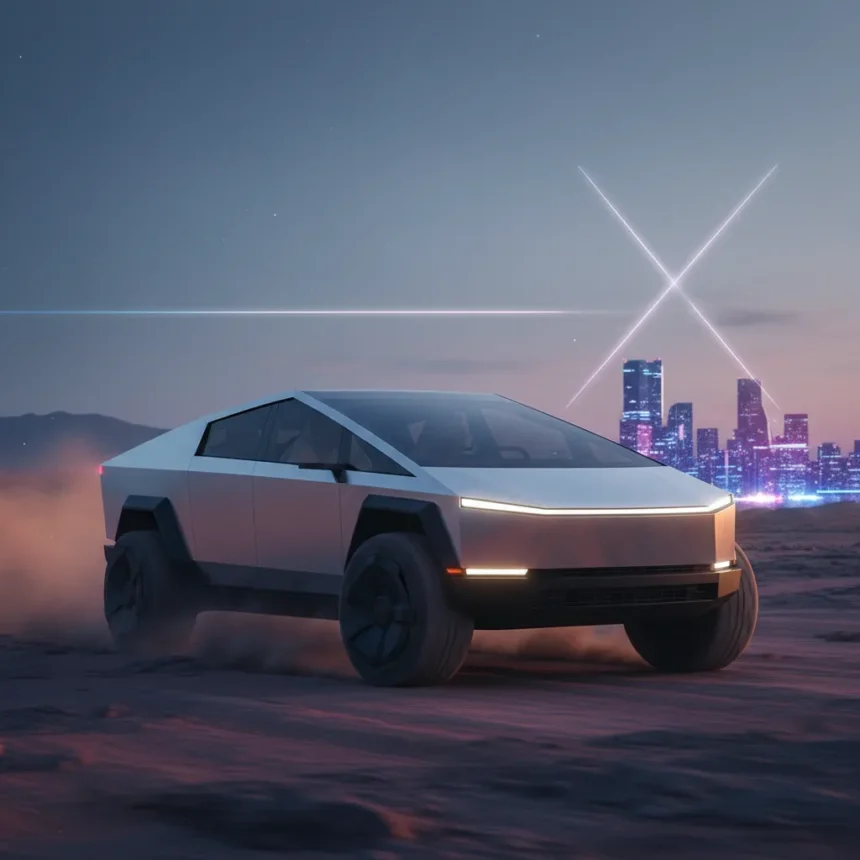
Tesla’s CyberSUV is coming, and it will be far more practical than a minivan. On March 25, 2026, Elon Musk posted on X that “something way cooler than a minivan is coming” in response to a user who suggested Tesla build a minivan after noticing the Cybertruck’s rear seats could fit three child seats abreast. That cryptic message now looks like a direct confirmation of what Tesla fans have been speculating about for months: a full-size, three-row family SUV based on the Cybertruck platform.
Key Takeaways
- Elon Musk confirmed a CyberSUV is in development on March 25, 2026, calling it “way cooler than a minivan.”
- Clay models of a larger Cybertruck-inspired SUV appeared in Tesla’s “Sustainable Abundance” teaser video in September 2025.
- Tesla is discontinuing the Model S and Model X by end of Q2 2026, creating a gap in large family vehicles.
- The CyberSUV would feature Cybertruck’s 48-volt architecture, steer-by-wire system, and stainless steel design.
- Direct competitors include the Cadillac Escalade IQ and Rivian R1S, both premium three-row electric SUVs.
Why Tesla CyberSUV Matters Right Now
The timing of Musk’s hint is no accident. Tesla announced it would discontinue the Model S and Model X, with production winding down by the end of Q2 2026. That leaves a gaping hole in Tesla’s lineup for families needing a spacious, premium electric vehicle. The Model X, despite its falcon-wing doors, has always suffered from cramped interior packaging and poor practicality compared to traditional three-row SUVs. A Cybertruck-based alternative would solve that problem while doubling down on the angular, stainless steel aesthetic that made the Cybertruck such a polarizing hit.
The Tesla CyberSUV would directly compete with the Cadillac Escalade IQ and Rivian R1S, both of which dominate the premium three-row EV segment. Those vehicles are expensive, heavy, and designed for luxury buyers willing to pay six figures. A Tesla CyberSUV could undercut them on price while offering more distinctive design and Supercharger network access—a competitive advantage neither Cadillac nor Rivian can match.
Tesla CyberSUV Design and Architecture
The Tesla CyberSUV is not entirely speculation. Clay models of a larger, Cybertruck-inspired SUV appeared in the background of Tesla’s official “Sustainable Abundance” teaser video in September 2025. When fans questioned Tesla’s chief designer Franz von Holzhausen about the prototypes spotted in videos, he offered only a cryptic “wait and see” response. That restraint suggests the project is real and far enough along that Tesla does not want to spoil the reveal.

Based on what leaked, the Tesla CyberSUV would inherit the Cybertruck’s 48-volt electrical architecture, steer-by-wire system, stainless steel exoskeleton, and full-width LED light bar. The Cybertruck’s chassis is 18.6 feet (5,683 mm) long, giving Tesla a massive footprint to work with for a three-row, seven-seat flagship. That scale would position the CyberSUV as a direct, more rugged alternative to the Cadillac Escalade IQ and Rivian R1S. Unlike those vehicles, which emphasize luxury and refinement, the CyberSUV would lean into Tesla’s uncompromising design philosophy: bold, angular, and unmistakably futuristic.
What About the Model Y L?
Tesla already offers a stretched six-seat Model Y L in China, with expansion planned for Australia, New Zealand, and Thailand. Drone footage from around February 2026 showed a blue plastic-wrapped Model Y L prototype at Giga Texas. However, Musk has previously stated the Model Y L would not reach the US before the end of 2026, if at all. That makes the CyberSUV—a purpose-built, full-size three-row vehicle—the real answer to Tesla’s family vehicle gap in North America and Europe.



When Will the Tesla CyberSUV Launch?
No launch date has been confirmed. Musk’s March 2026 teaser provides no timeline, and Tesla has a long history of overpromising and underdelivering on vehicle announcements. The clay models shown in September 2025 suggest the design is advanced, but advanced design work does not guarantee imminent production. Given that Model S and X production winds down by June 2026, Tesla may want the CyberSUV to arrive before or shortly after that cutoff to avoid losing sales to competitors. Realistically, expect a reveal in late 2026 or early 2027, with production beginning sometime in 2027 or 2028.
Does Tesla Need a CyberSUV?
Yes. The discontinuation of the Model S and Model X leaves Tesla without a premium family vehicle, and the Model Y L is not coming to most markets soon enough. The Cadillac Escalade IQ and Rivian R1S are stealing market share from buyers who want three rows, luxury features, and electric power. A CyberSUV would give Tesla a chance to reclaim that segment with a vehicle that is unmistakably Tesla: bold, technically advanced, and architecturally different from anything else on the road. Whether that design language appeals to families shopping for a practical SUV is another question entirely.
Could the CyberSUV replace the next-gen Roadster as Tesla’s halo car?
No. Tesla’s next-generation Roadster is expected to replace the Model S as the brand’s halo performance car, according to the company’s product roadmap. The CyberSUV would serve a different purpose: a three-row family flagship that competes on space and practicality, not speed or exclusivity.
Why did Musk dismiss the minivan idea so strongly?
Musk’s “way cooler than a minivan” response reflects Tesla’s brand positioning. Minivans are practical but uncool—they lack the design boldness and technological distinctiveness that define Tesla’s vehicles. A CyberSUV, by contrast, would be immediately recognizable as a Tesla, with the same stainless steel and angular design language as the Cybertruck. It is the same reason Tesla has never made a sedan that looks like a Honda Accord—the company competes on differentiation, not convention.



The Tesla CyberSUV is still months or years away from production, but Musk’s March 2026 teaser confirms what Tesla fans have suspected since the Cybertruck’s 2019 debut: a full-size, three-row family vehicle is coming. Whether it will actually be “cooler” than a minivan depends on whether you value angular stainless steel and steer-by-wire over sliding doors and practical storage. For Tesla’s target audience, the answer is probably yes.
This article was written with AI assistance and editorially reviewed.
Source: TechRadar