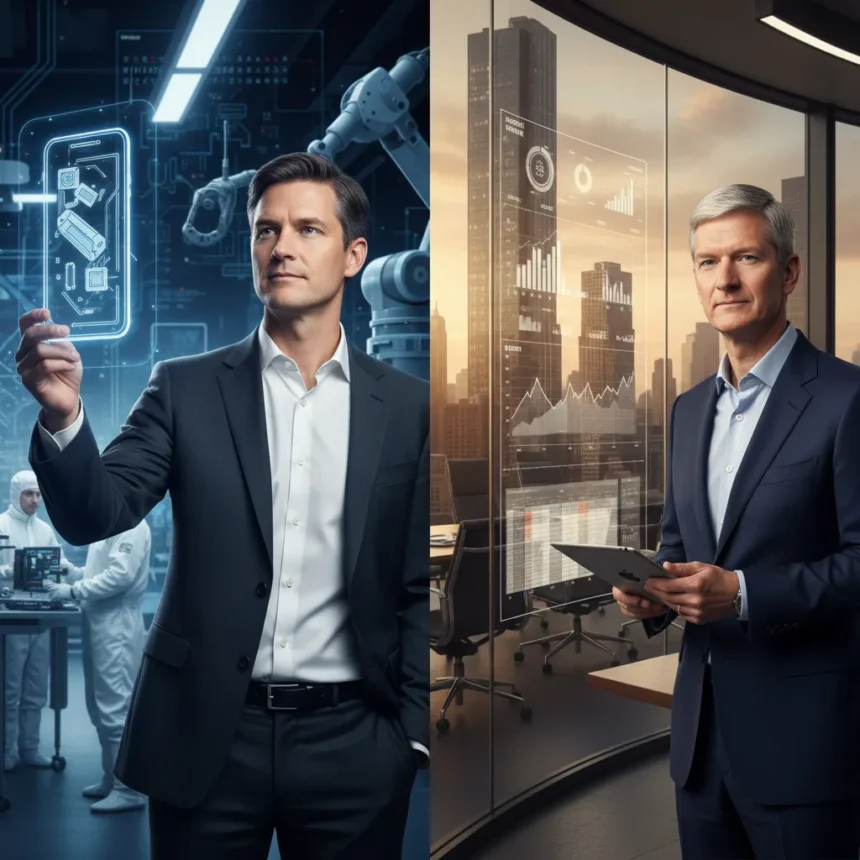
John Ternus is Apple’s Senior Vice President of Hardware Engineering and is now positioned to become the company’s next CEO as Tim Cook transitions to Apple Executive Chairman. This leadership shift marks a significant departure from the Cook era, and Ternus brings a distinctly different background and approach to the role. Unlike Cook, who built his reputation in operations and supply chain mastery, Ternus is fundamentally a hardware engineer—a distinction that will reshape how Apple thinks about product development and innovation.
Key Takeaways
- John Ternus becomes Apple CEO as Tim Cook moves to Executive Chairman role
- Ternus is an engineer, not an operations executive like Cook
- The leadership transition includes Johny Srouji as new chief hardware officer
- Ternus is nicknamed “Johnny Appleseed” to contrast with Cook’s “Tim Apple” persona
- This marks Apple’s most significant leadership change since Cook took over from Steve Jobs
Why John Ternus represents a hardware-first Apple
Ternus’s career trajectory places him squarely in the engineering camp rather than the business operations side where Cook thrived. As Senior Vice President of Hardware Engineering, he has spent years leading the teams responsible for designing and building Apple’s physical products—iPhones, Macs, and wearables. This background suggests his leadership will prioritize deep technical innovation over the supply-chain optimization that defined Cook’s tenure. Cook transformed Apple into a logistics powerhouse; Ternus is likely to push the company toward more ambitious hardware breakthroughs.
The nickname “Johnny Appleseed” underscores this distinction. While Cook earned the moniker “Tim Apple” for his reputation as the company’s operational steward, Ternus’s nickname evokes the romantic image of planting seeds—creating new possibilities, spreading innovation, thinking long-term about what Apple could build. It’s a telling contrast that hints at a leadership philosophy rooted in creation rather than efficiency.
The organizational restructuring signals Ternus’s vision
Apple’s simultaneous appointment of Johny Srouji as chief hardware officer is not coincidental. This move suggests Ternus will step away from day-to-day hardware engineering decisions to focus on broader strategic leadership. Srouji’s elevation frees Ternus to think about Apple’s product roadmap, market positioning, and long-term bets on emerging technologies without being bogged down in the engineering details that consumed his previous role. The restructuring reveals a company preparing for a CEO who thinks like an engineer but needs to act like a visionary.

This organizational clarity matters because it prevents a knowledge vacuum. Ternus doesn’t have to choose between being a CEO and staying connected to hardware development—the new structure lets him do both, with Srouji handling the technical execution. It’s a setup that amplifies Ternus’s strengths while mitigating the risk of losing engineering expertise at the top.
How Ternus differs from Tim Cook’s operational legacy
Cook’s genius lay in making Apple’s supply chain invisible. He negotiated with component suppliers, optimized manufacturing, and ensured that products launched on schedule and at scale. His approach was about reliability, predictability, and maximizing margins through operational excellence. Ternus, by contrast, comes from a world where the constraint is not logistics but imagination. Hardware engineers ask: What can we build? Cook’s operations teams asked: How do we build it cheaply and on time?



This philosophical difference will likely manifest in product strategy. Cook’s Apple became incrementally better at existing products—thinner iPhones, faster processors, longer battery life. Ternus may be more willing to take bigger risks on novel form factors, experimental materials, or entirely new product categories. An engineer leading Apple signals that the company is ready to prioritize breakthrough innovation over predictable iteration, even if it means higher costs or supply-chain complexity in the short term.
What this means for Apple’s future under Ternus
The leadership transition from Cook to Ternus represents a philosophical shift, not a crisis. Cook leaves Apple in phenomenal financial health and with a proven management structure. Ternus inherits a machine that works—his job is to point it in new directions. Given his engineering background, expect increased investment in hardware R&D, more ambitious moonshot projects, and a willingness to challenge industry conventions on product design and manufacturing.
Ternus is not Tim Cook 2.0 because he doesn’t need to be. Cook solved the problems of his era—scaling manufacturing, managing global supply chains, defending margins during market disruption. Ternus faces different challenges: reigniting hardware innovation, competing against AI-native competitors, and keeping Apple relevant in an era where software and services increasingly drive value. His engineering mindset equips him to tackle those problems in ways a pure operations executive could not.
Will Ternus’s hardware focus slow Apple’s services growth?
Unlikely. Services have become so integral to Apple’s ecosystem that no CEO can ignore them. Ternus’s hardware-first approach doesn’t mean abandoning services—it means using hardware as the platform to drive services adoption. An engineer CEO may actually strengthen the connection between device and software, ensuring that new hardware capabilities unlock new service possibilities rather than treating them as separate business lines.



How does Ternus’s appointment change Apple’s product timeline?
The transition itself should not disrupt existing product roadmaps. Apple’s product development cycles are set years in advance, and Cook’s departure is planned, not sudden. Ternus likely inherits a clear pipeline of products already in development. His influence will shape Apple’s product strategy starting with decisions made in 2025 and beyond, not with immediate changes to current-generation devices.
Is Ternus the right choice to lead Apple?
The market will ultimately judge. What’s clear is that Ternus brings a fundamentally different skill set than Cook. If Apple needs to accelerate hardware innovation and take bigger risks on new product categories, his engineering background is a significant asset. If the company needed another decade of operational optimization, Cook’s heir apparent would look different. Ternus’s appointment signals that Apple’s board believes the company’s next chapter is about invention, not just execution—and that requires a leader who thinks like an engineer.
Edited by the All Things Geek team.
Source: TechRadar