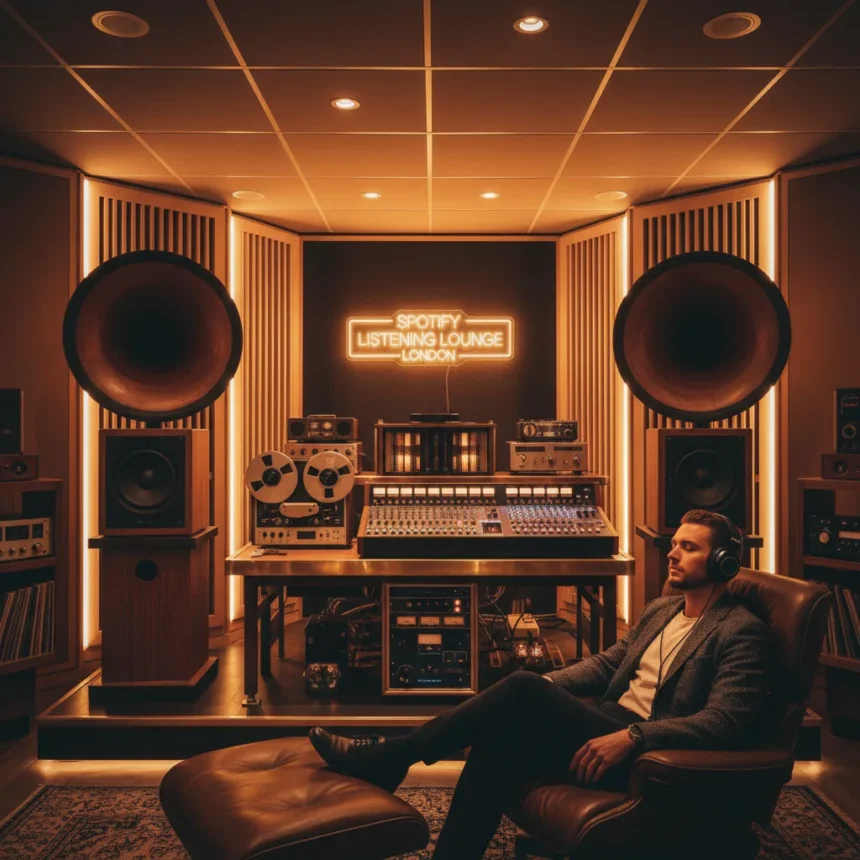
Spotify’s Listening Lounge stereo system opened this week in London, and it is a pointed reminder that the music industry’s obsession with convenience and compression has left something essential behind. The space, located at Spotify’s London headquarters, is a purpose-built acoustic environment designed to showcase lossless audio through a bespoke sound system engineered by Friendly Pressure, a London-based loudspeaker design studio founded by Shivas Howard-Brown. The setup is not a gimmick. It is a deliberate statement about how music should sound when listeners actually pay attention.
Key Takeaways
- Spotify’s Listening Lounge features a custom stereo system built by Friendly Pressure with ALNICO magnet drivers, the same components used in Abbey Road mastering systems.
- The acoustic environment was designed in collaboration with Cake Architecture and calibrated by New York-based acoustician Ethan Bordeau.
- Access is limited to Spotify Premium subscribers and artists’ top fans, with year-round programming hosted by featured artists.
- The loudspeakers weigh approximately half a tonne and are crafted from aluminum with resin horns, topped on a console by Eddie Olin.
- Spotify updated its “Songs to Test Speakers With” playlist cover to feature the Friendly Pressure system.
Why Spotify Listening Lounge stereo matters now
The timing of this space is telling. Streaming has democratized music access but normalized mediocre audio quality. Most listeners hear compressed files through earbuds or phone speakers. Spotify’s Listening Lounge stereo system directly challenges that race to the bottom by creating a space where sound quality becomes the main event. The loudspeakers feature ALNICO magnet drivers, components historically used in respected studio mastering systems at Abbey Road during the 1960s, ’70s, and ’80s. This is not retro aesthetics masquerading as substance. It is engineering archaeology.
Billie Baier, Co-Head of Marketing at Spotify U.K. & Ireland, framed the initiative as a convergence of priorities: “The Listening Lounge is where technology, craftsmanship, and culture align. By bringing lossless audio into this environment, we’re demonstrating the full potential of streaming and fostering a deeper connection between fans and the music they love”. The statement avoids corporate platitude by grounding itself in a specific architectural commitment. Lossless audio through a custom stereo system is not an abstract promise. It is a room you can walk into.
The acoustic design behind Spotify Listening Lounge stereo
The physical space itself is engineered as rigorously as the speakers. Cake Architecture collaborated on the surrounding environment, treating the room as an instrument. The walls are acoustically tuned using Kvadrat’s acoustic systems, with calibrated surface patterns developed in consultation with acoustician Ethan Bordeau. Hugh Scott Moncrieff from Cake explained the philosophy: “Collaborating with Spotify and Friendly Pressure allowed us to treat the room itself as an instrument. Every surface pattern and material choice was a functional decision to eliminate interference, ensuring that the craftsmanship of the speakers is matched by the precision of the architecture surrounding them”.



This level of detail separates a listening room from a listening lounge. A generic hi-fi setup can be dropped into any space and produce decent sound. A purpose-built environment requires acoustic modeling, material selection, and precise tuning. The Friendly Pressure speakers themselves are substantial objects, weighing about half a tonne, crafted from aluminum with resin horns and topped on a console by Eddie Olin. These are not consumer products. They are installations.
Who can actually access Spotify Listening Lounge stereo?
Here is where the experience becomes exclusive. Access is limited to Spotify Premium subscribers and artists’ top fans. The space hosts year-round programming centered on intimate artist events, with a focus on presence, community, and sound. The inaugural event featured U.K. artists Joy Crookes, Nao, and Yazmin Lacey, who shared inspiring tracks listened to in full. This is not a public museum exhibit or a retail showroom. It is a curated experience reserved for a subset of listeners.



That exclusivity is both the strength and the limitation of the Lounge. Strength: it ensures the space remains intentional and undiluted by casual foot traffic. Limitation: most music fans will never experience it. Spotify has updated its “Songs to Test Speakers With” playlist to feature the Friendly Pressure system, a small gesture toward democratizing the sonic reference point. But a playlist is not the same as sitting in a room engineered for stereo listening.
What does Spotify Listening Lounge stereo reveal about the future of audio?
The space is a counterargument to the streaming-era assumption that audio quality does not matter. Spotify is betting that a subset of listeners—the Premium subscribers, the superfans, the artists themselves—will pay attention if given the opportunity. By reintroducing this level of craftsmanship, Spotify is allowing listeners to experience music precisely as it was originally heard in the studio. That is not nostalgia. That is quality control.
The Listening Lounge also suggests that stereo, far from being obsolete, remains the gold standard for intentional listening. Spatial audio and immersive formats have their place, but the stereo pair—left speaker, right speaker, the listener between them—remains the most direct path from artist to ear. Friendly Pressure’s design honors that geometry.
Is Spotify Listening Lounge stereo open to the public?
No. Access is restricted to Spotify Premium subscribers and artists’ top fans. The space hosts curated events throughout the year, but you cannot simply walk in. Spotify has not announced plans to open additional Listening Lounges in other cities, though the success of the London location could prompt expansion.



Can I listen to lossless audio on Spotify at home?
Spotify offers lossless audio through the Listening Lounge, though the experience is tied to the specific acoustic environment. The research brief does not detail whether lossless streaming is available for home listeners through Spotify’s standard app, so that detail cannot be confirmed here. The Listening Lounge experience is distinctly tied to the physical space and its engineered acoustics.
What makes the Friendly Pressure speakers different from standard hi-fi systems?
The speakers use ALNICO magnet drivers, the same components found in Abbey Road mastering systems from the 1960s–1980s. They weigh approximately half a tonne and are constructed from aluminum with resin horns. The entire system is bespoke, not a consumer product, and is calibrated specifically to the Listening Lounge’s acoustically tuned environment.
Spotify’s Listening Lounge is a rare corporate investment in audio quality at a time when most streaming platforms treat sound as an afterthought. The space proves that stereo, craftsmanship, and intentional listening still have cultural value. For the Premium subscribers and superfans lucky enough to experience it, that is not a reminder—it is a revelation.
Edited by the All Things Geek team.
Source: TechRadar