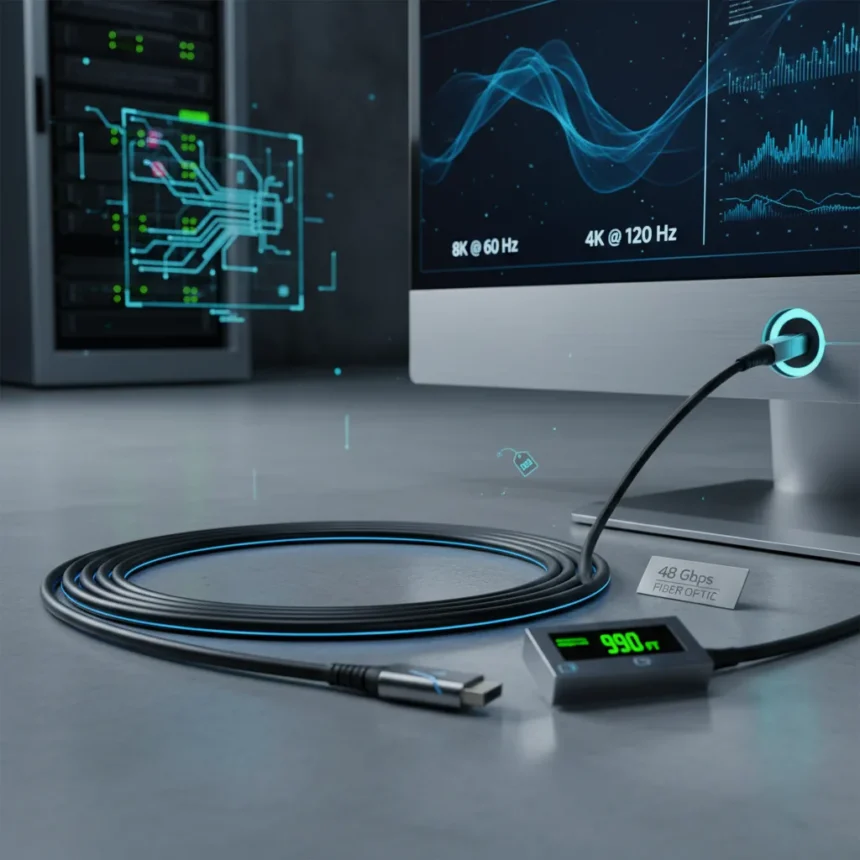
A fiber optic HDMI cable tested at 990 feet proves that distance no longer limits ultra-high-speed video transmission. The $500 cable delivers a full 48 Gbps bandwidth over approximately 300 meters, supporting flawless 8K at 60 Hz and 4K at 120 Hz with uncompressed HDR, a demonstration that upends conventional wisdom about HDMI’s reach.
Key Takeaways
- Fiber optic HDMI cable delivers 48 Gbps bandwidth across 990 feet using laser transmission and pure fiber construction.
- Supports 8K@60Hz with full 4:4:4 chroma and 4K@120Hz/144Hz/240Hz over extended distances where copper fails.
- Ultra High Speed HDMI 2.1 certified, compliant with FRL (Fixed Rate Link) standard introduced in 2020.
- Price point of $500 reflects premium positioning for large installations, conferencing, and commercial applications.
- Fiber optic architecture eliminates electromagnetic interference and maintains full bandwidth beyond 300 meters.
Why Fiber Optic HDMI Cable Changes the Game for Long Distances
Standard copper HDMI cables degrade signal quality dramatically beyond 30 to 50 feet. A fiber optic HDMI cable solves this by replacing conductive metal with pure fiber strands and laser transmission, eliminating electromagnetic interference entirely. The 990-foot cable tested achieves this through low-EMI shielding and noise-free transmission architecture, delivering every bit of the 48 Gbps Ultra High Speed HDMI 2.1 standard without compromise.
This matters for anyone running video over long distances: large conference rooms, medical facilities, security installations, and home theater setups spanning multiple rooms or entire buildings. Where a standard cable would require expensive signal boosters or repeaters, a fiber optic HDMI cable simply works, delivering 10-bit and 12-bit color depth, Dolby Vision, VRR, eARC, and HDCP 2.3 protection across the full 990-foot run.
How Fiber Optic HDMI Cable Stacks Against Copper Alternatives
Competitors in the fiber optic HDMI space offer far shorter reach. The TECHLY 100-meter pure fiber cable delivers 48 Gbps with 8K@60Hz and 4K@120Hz support, but maxes out around 328 feet. Wireworld’s Stellar 48 extends only to 98 feet with VIVIDTECH noise reduction and II-VI lasers, making it suitable for shorter runs. A Newegg Ultra High Speed Fiber Optic option reaches just 50 feet. Standard copper Ultra High Speed HDMI cables face hard physical limits—attempting 48 Gbps transmission beyond 30 feet typically results in signal loss and dropout.


The $500 cable’s 990-foot capability represents roughly a 10-fold distance advantage over mid-range competitors and a 20-fold leap over typical copper limits. For installations where cable runs exceed 100 feet, copper becomes economically irrational; you either accept signal degradation or invest in active boosters. Fiber optic architecture eliminates that trade-off.
Specs That Matter: 48 Gbps, 8K@60Hz, Full Color Depth
The fiber optic HDMI cable tested meets Ultra High Speed HDMI certification, the mandatory compliance program for 48 Gbps devices. It supports the FRL (Fixed Rate Link) standard, which enables variable refresh rates, low-latency gaming, and uncompressed video transport. At 990 feet, the cable maintains full bandwidth for 8K resolution at 60 Hz with 4:4:4 chroma subsampling—meaning no color compression, no quality loss, just pure signal integrity.



For 4K displays, the cable pushes even harder: 120 Hz, 144 Hz, and 240 Hz refresh rates are all viable, opening possibilities for competitive gaming and high-refresh displays positioned far from source equipment. HDR metadata, CEC (Consumer Electronics Control), Ethernet over HDMI, and bidirectional EDID support round out the feature set, making this cable compatible with nearly every HDMI 2.1 device on the market.
Who Actually Needs a 990-Foot Fiber Optic HDMI Cable?
The $500 price tag is steep for a casual home theater upgrade, but consider the alternative costs. A commercial conference room with a projector mounted 200 feet away from the source equipment faces a choice: run multiple copper cables with repeaters (expensive, unreliable), use a professional video distribution system (thousands of dollars), or deploy a single fiber optic HDMI cable (one-time $500 investment, zero maintenance). Medical imaging facilities, security operations centers, and large-scale AV installations face similar equations.
Residential applications exist too. A home theater spanning a basement media room, upper-floor bedrooms, and an outdoor patio could justify a single fiber optic HDMI cable run through walls, eliminating the need for multiple shorter cables or wireless streaming solutions that introduce latency and compression.
Is a Fiber Optic HDMI Cable Worth $500?
The answer depends on distance. For runs under 50 feet, standard Ultra High Speed HDMI cables cost $20 to $100 and work fine. Beyond 100 feet, fiber optic becomes the only reliable option. At 990 feet, this cable is arguably the cheapest solution available—signal boosters, professional distribution systems, and wireless alternatives would cost multiples more and introduce their own reliability concerns.



Can you use a fiber optic HDMI cable with older HDMI devices?
Yes. The fiber optic HDMI cable maintains backward compatibility with HDMI 2.0, HDMI 1.4, and earlier standards. Your older 4K TV or 1080p display will work fine, though you will not access the 48 Gbps bandwidth or 8K capabilities—the cable simply operates at the device’s native speed.
What makes fiber optic HDMI cable immune to electromagnetic interference?
Fiber optic transmission uses laser light instead of electrical signals, so it is inherently immune to EMI and RFI (radio frequency interference). Standard copper cables can pick up noise from power lines, wireless routers, and electrical equipment; fiber cannot. This is why fiber excels in noisy industrial and medical environments.
Is the 990-foot distance the maximum for fiber optic HDMI cable?
The tested cable reaches 990 feet, but some fiber optic HDMI designs claim up to 1000 feet or 303 meters as their specification. Beyond these distances, signal degradation becomes possible depending on fiber quality and laser power. For most installations, 300 meters is the practical maximum.
The fiber optic HDMI cable tested at 990 feet represents a genuine shift in what is possible for long-distance video. Where copper hits a wall at 50 feet, fiber opens doors to installations that were previously impractical or prohibitively expensive. At $500, it is a premium product for a specific need—but for that need, it is the only rational choice.
Where to Buy
Edited by the All Things Geek team.
Source: Tom's Hardware