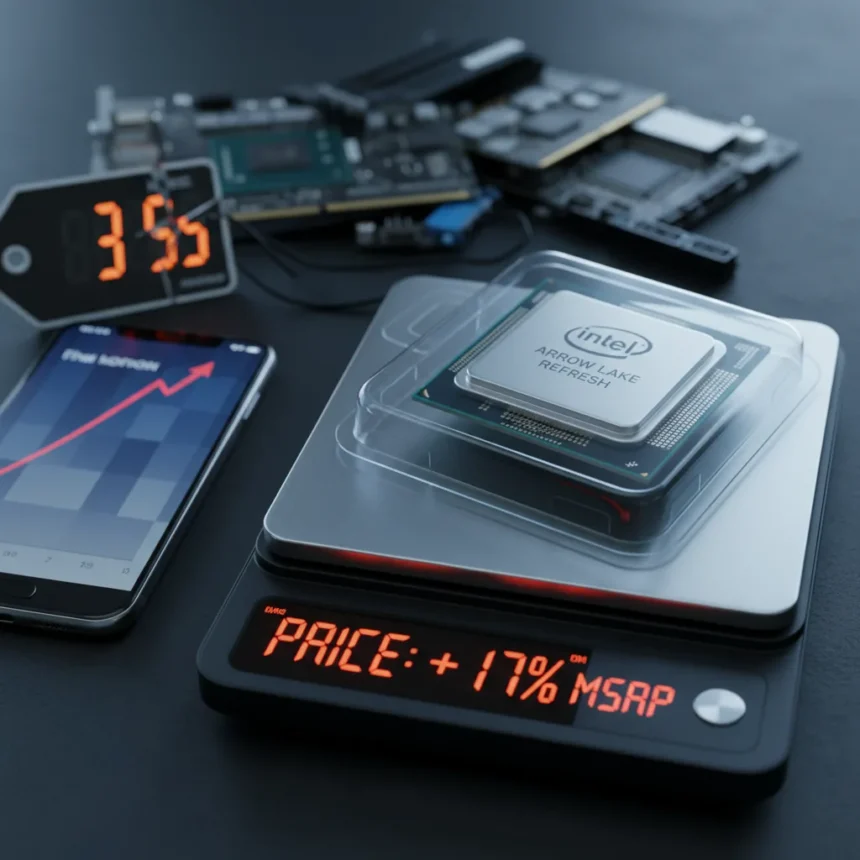
Arrow Lake Refresh CPU prices were supposed to be Intel’s strongest argument in years — and for about 48 hours, they were. The Core Ultra 200S Plus series launched with MSRPs of $199 for the Core Ultra 5 250K Plus and $299 for the Core Ultra 7 270K Plus, representing genuine cuts compared to the original Arrow Lake lineup. Then retail dynamic pricing took over, and those numbers climbed up to 17% above MSRP before most buyers had even finished reading the reviews.
Key Takeaways
- The Core Ultra 5 250K Plus and Core Ultra 7 270K Plus launched at $199 and $299 MSRP respectively, with meaningful cuts versus original Arrow Lake.
- Retail prices jumped up to 17% above MSRP within 48 hours of launch due to dynamic pricing algorithms.
- Intel claims a 15% gaming performance uplift over original Arrow Lake, driven by more E-cores, faster die-to-die frequencies, and an improved memory controller.
- Intel is reportedly planning a 10% price increase across consumer CPUs in 2026, tied to AI data center demand and TSMC costs.
- The Core Ultra 7 270K Plus directly competes with AMD’s Ryzen 7 9700X — at MSRP, it’s a compelling matchup; at inflated retail, less so.
What are Arrow Lake Refresh CPU prices doing at retail?
Within 48 hours of launch, Arrow Lake Refresh CPU prices at major retailers had already exceeded Intel’s recommended prices by as much as 17%. Dynamic pricing — the algorithmic practice of adjusting prices in real time based on demand signals — overrode the MSRPs Intel had set to make this generation competitive. For buyers who moved fast, the value proposition held. For everyone else, the window closed almost immediately.
This isn’t a new phenomenon in PC hardware, but it stings more here because Intel clearly designed the Core Ultra 200S Plus pricing to be a statement. The original Arrow Lake launched at over $300 for the Core Ultra 5 245K and $400 for the Core Ultra 7 265K. The refresh brought those entry points down sharply, with street prices on older stock settling around $200 and $280-$310 respectively. Watching retailers claw that discount back within two days is frustrating, and it’s a pattern Intel has limited power to prevent once product leaves its hands.
What actually improved in the Core Ultra 200S Plus?
The Core Ultra 200S Plus series addresses the most criticised weaknesses of original Arrow Lake: memory latency, core configuration, and die-to-die communication speed. Both the 250K Plus and 270K Plus add four extra E-cores compared to their predecessors, the die-to-die frequency receives up to a 900MHz boost, and the memory controller runs faster — also up to 900MHz. Intel claims these changes deliver 15% higher gaming performance and a multi-threaded boost, with lower system latency as a key target.


Those performance claims come directly from Intel, and independent verification matters before treating them as settled fact. That said, the architectural changes are real and address documented complaints about the original Arrow Lake’s memory subsystem. The K (unlocked) and KF (unlocked, no integrated graphics) variants are both available for the 250K Plus tier, giving builders flexibility depending on whether they need an iGPU.
How do Arrow Lake Refresh CPU prices compare to AMD alternatives?
At MSRP, the Core Ultra 5 250K Plus at $199 and Core Ultra 7 270K Plus at $299 sit in direct competition with AMD’s Ryzen 5 9600X and Ryzen 7 9700X respectively. That’s a fight Intel can credibly enter at those price points. At 17% above MSRP, the calculus shifts — suddenly AMD’s offerings look steadier, because their street prices don’t tend to spike on launch day the same way.



At the top of the stack, there’s an odd situation developing. The Core Ultra 9 285K is currently available around $557 USD, which puts it uncomfortably close to the Core Ultra 7 270K Plus’s inflated retail price. That proximity makes the 285K a harder sell rather than an obvious step up. Meanwhile, AMD’s Ryzen 7 9850X3D leads in gaming performance outright, though it carries a higher price tag than either of these Intel options. The refresh doesn’t dethrone AMD’s gaming champion, but at MSRP it offers a genuinely competitive alternative for buyers who don’t need to chase the absolute gaming peak.
Should you buy an Arrow Lake Refresh CPU right now?
The honest answer depends entirely on what price you can actually find. At MSRP, the Core Ultra 7 270K Plus at $299 is the most interesting Intel consumer CPU in some time — it fixes real problems, competes with AMD on price, and arrives with a meaningful performance uplift over the chip it replaces. At 17% above MSRP, that story gets murkier. You’re paying a premium driven by an algorithm, not by genuine scarcity or a market that’s decided this chip is worth more than Intel priced it.
There’s also a longer-term consideration. Intel is reportedly planning a 10% price increase across its consumer CPU lineup in 2026, attributed to rising semiconductor demand from AI data centers and increased TSMC production costs. If that hike materialises, buying now — even slightly above MSRP — may look reasonable in hindsight. But that’s a speculative reason to overpay today, not a solid one. Watch prices, set alerts, and don’t reward the spike by paying it.
Is the 17% price spike above MSRP permanent?
Probably not. Launch-day and launch-week dynamic pricing spikes typically stabilise as initial demand cools and retailer stock normalises. The more relevant question is whether prices will ever settle back at MSRP, or whether they’ll land somewhere in between. Given Intel’s reported 2026 price increase plans, the window for buying at or near the original MSRP may be shorter than usual for this generation.



How does the Core Ultra 7 270K Plus compare to the Ryzen 7 9700X?
At their respective MSRPs, the Core Ultra 7 270K Plus at $299 and AMD’s Ryzen 7 9700X are direct competitors. The Intel chip brings more E-cores and a faster memory controller to the fight, while AMD’s platform has a reputation for pricing stability at retail. Neither is a clear knockout at launch — the choice comes down to platform ecosystem, motherboard costs, and which retailer you can find closer to MSRP on a given day.
Arrow Lake Refresh CPU prices were Intel’s best pitch to budget-conscious builders in years. The hardware improvements are real, the MSRPs were aggressive, and the competitive positioning against AMD was credible. Retail dynamic pricing undermined all of that within 48 hours — and with a 10% industry-wide hike looming in 2026, the pressure to buy smart and buy soon has rarely been higher. Wait for prices to stabilise, then move. Don’t let an algorithm make the decision for you.
Edited by the All Things Geek team.
Source: Tom's Hardware