





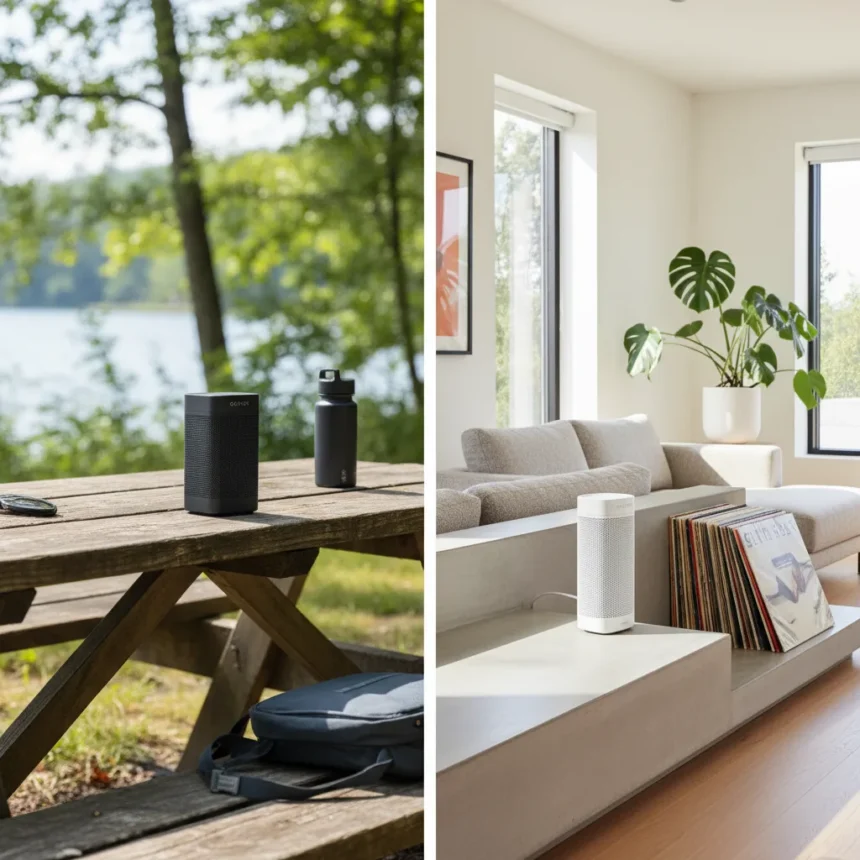
Sonos Play vs Era 100 puts two fundamentally different speakers head-to-head: one built for movement, the other for staying put. The Play sits between the Roam 2 and Move 2 in Sonos’s portable lineup, while the Era 100 is a stationary home speaker designed to replace the aging Play:1. Choosing between them depends entirely on whether you need portability or performance in a fixed room.
Key Takeaways
- Sonos Play is portable with Wi-Fi 6 and Bluetooth 5.3, positioned between Roam 2 and Move 2 for balanced versatility
- Era 100 delivers superior soundstage, bass, and immersive Dolby Atmos through upward-firing mid-woofer and larger drivers
- Era 100 SL costs less than standard Era 100 but removes microphones, cutting voice control and Quickplay tuning
- Play uses Class H amplifiers with heavier bass; Era 100 offers more robust, gripping sound at all volumes
- Play starts at £299, Era 100 at £199, Era 100 SL at £169; shipping begins March 31st
Sonos Play vs Era 100: Core Design Philosophy
The Sonos Play vs Era 100 comparison reveals two opposite design priorities. Play sacrifices some sound refinement to gain portability—it weighs less, runs on battery, and connects via Bluetooth after Wi-Fi setup. You can group up to four Play units over Bluetooth, making it ideal for moving between rooms or taking outdoors. Era 100, by contrast, anchors itself to a wall or shelf, prioritizing acoustic performance through a larger enclosure, extra tweeter, bigger woofer, and an upward-firing mid-woofer that bounces sound off your ceiling for immersive Dolby Atmos playback.
Both speakers were tuned by Sonos Soundboard, leaders in music and film production, ensuring sound stays true to the artist’s intent. But the tuning philosophies diverge. Play’s Class H amplifiers produce powerful bass—sometimes too heavy-handed—with well-rounded mids and treble that shine best above 40% volume. Era 100’s architecture delivers more robust, gripping dynamics across the frequency range, with superior stereo separation and a wider soundstage that fills medium rooms convincingly.
Sound Quality: Where Era 100 Dominates
Era 100 outperforms Play in almost every acoustic metric. The extra tweeter handles high frequencies with more precision, the bigger woofer digs deeper into bass without muddiness, and the upward-firing mid-woofer creates a three-dimensional soundscape that Play cannot match. When paired as a stereo set, two Era 100 speakers deliver far superior separation and imaging compared to older Play:1 or Play:3 units. This matters if you stream music frequently—Era 100 reveals detail in complex mixes that Play’s portability-focused drivers gloss over.



Play’s sound remains respectable for a portable speaker. TechRadar notes the bass is powerful but heavy-handed, with well-rounded mids and treble that handle intricate arrangements reasonably well. The compromise is acceptable if you prioritize flexibility over acoustic refinement. But if your speaker stays in one room, Era 100’s larger drivers and room-tuning features (Trueplay automatic calibration) make it the obvious choice.
Features: Bluetooth, Line-In, and Voice Control
Era 100 includes connectivity options Play cannot offer. Both speakers support Bluetooth, but Era 100 adds a USB-C line-in port for wired audio input, plus Trueplay room tuning that adapts the speaker’s response to your space. Standard Era 100 includes built-in microphones for voice control via Sonos Voice Control or Alexa integration, plus Quickplay tuning for Android devices. Era 100 SL strips out the microphones, losing voice control and Quickplay, but costs less and delivers identical sound.



Play prioritizes wireless convenience. Wi-Fi 6 ensures fast streaming, and Bluetooth 5.3 lets you connect without network setup. The ability to group multiple Play units over Bluetooth after initial Wi-Fi configuration is unique—you can have synchronized audio in different rooms without a full mesh network. For renters or those who move frequently, this flexibility outweighs Era 100’s fixed-room advantages.
Price and Value Proposition
Pricing strongly favors budget-conscious buyers. Era 100 SL starts at £169, standard Era 100 at £199, while Sonos Play costs £299. In US pricing, Era 100 SL runs $189, Era 100 $199, and Play $299; Australian pricing sits at AU$289 (SL), AU$319 (Era 100), and AU$499 (Play). Pre-orders opened with shipping starting March 31st.
For home audio only, Era 100 SL offers remarkable value—you get the superior soundstage and bass of the full Era 100 without microphones at a significant discount. If voice control matters, standard Era 100 remains cheaper than Play while delivering better sound. Play justifies its premium only if portability is non-negotiable.
Which Speaker Should You Buy?
Choose Sonos Play if you need a portable speaker that moves between rooms, goes outdoors, or travels with you. Its battery life, Bluetooth connectivity, and compact form factor make it the only option for non-stationary use. Choose Era 100 if your speaker has a permanent home and music quality matters. The larger drivers, Dolby Atmos support, and room-tuning features justify the investment. For budget-focused buyers, Era 100 SL splits the difference—identical sound to Era 100 without the microphone premium.



The Sonos Community consensus holds: test both speakers in your actual use case. Sound varies by room, content, and listening habits. A speaker that excels in a studio apartment might disappoint in a large living room, and vice versa.
Should I buy Sonos Play if I already own a Roam 2?
Play sits between Roam 2 and Move 2, offering more power than Roam 2 but less bulk than Move 2. If Roam 2 meets your portability needs, Play is an unnecessary upgrade. If you want louder outdoor performance or plan to group multiple speakers, Play’s extra power and Bluetooth grouping capability justify the switch.
Can Era 100 work as a surround speaker in a home theater setup?
Era 100 works as surrounds but may not shine in that role compared to using it as a standalone speaker. The upward-firing mid-woofer and large soundstage are wasted if the speaker sits to the side of your TV, handling only ambient sound effects. Test both Era 100 and Play:1 as surrounds in your specific room before deciding.
Is Era 100 SL worth buying over standard Era 100?
Era 100 SL delivers identical sound at a lower price, making it the smarter choice if you don’t use voice control or Quickplay tuning for Android. If Alexa integration or hands-free control matters to your daily routine, standard Era 100’s microphones justify the extra cost.
Sonos Play vs Era 100 ultimately comes down to lifestyle. Play wins for those who move their speaker frequently and value wireless flexibility. Era 100 wins for everyone else—better sound, more features, lower cost, and the acoustic refinement that justifies a stationary speaker. If budget is tight, Era 100 SL offers the best value without compromise on audio quality.
Where to Buy
£299 at Amazon | £199 at Amazon
Edited by the All Things Geek team.
Source: T3




